Property Mutation (Intiqal) in Pakistan 2026
Property mutation, commonly called Intiqal, is the process of updating the government land or property record after ownership rights are acquired through a sale, inheritance, gift, court order, exchange, or another legally recognized transaction.

A common mistake in Pakistan is to assume that signing a Sale Deed (Registry) automatically completes every land-record requirement. Registration and mutation are related but different steps. Mutation records the acquired right in the relevant revenue or land record, while registration records the registrable instrument according to the applicable registration law.
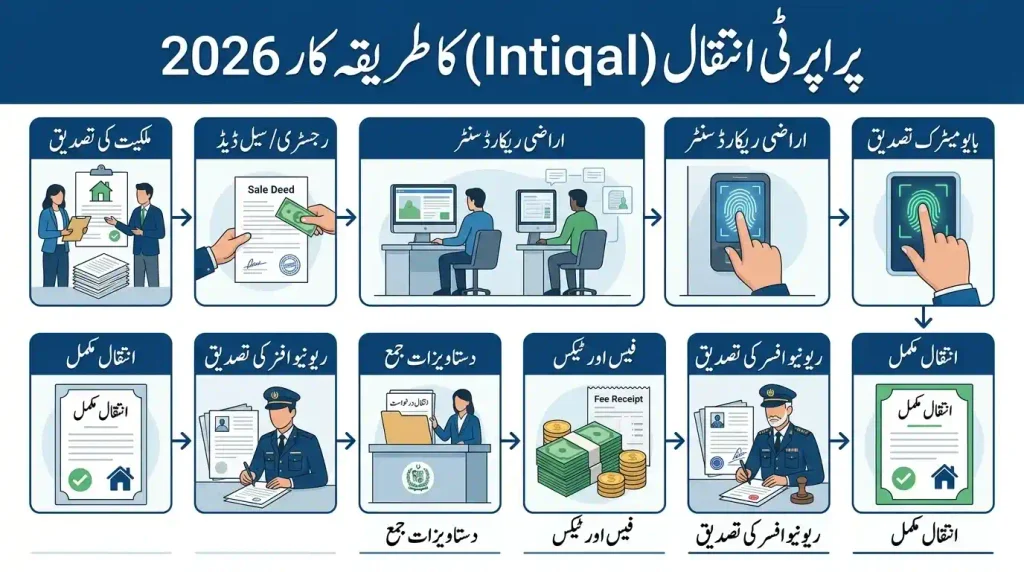
In Punjab, the Punjab Land Records Authority (PLRA) has digitized important parts of the mutation process through Arazi Record Centres (ARCs), including token issuance, CNIC-based biometric verification, document submission, fee payment and verification by the Assistant Director Land Records (ADLR).
This guide explains Property Mutation (Intiqal) in Pakistan 2026, including the difference between registry and mutation, required documents, the Punjab procedure, inheritance mutation, gift mutation, mutation after a court order, provincial differences, taxes and fees, common mistakes, and what to do after Intiqal is completed.
Important: Property-transfer requirements, government fees, taxes, valuation rates and procedures can change. Always confirm the applicable charges and requirements with the relevant land/revenue authority, development authority and FBR before completing a transaction.
What Is Property Mutation (Intiqal) in Pakistan?
Property Mutation (Intiqal) is an entry made in the relevant land or revenue record to reflect the acquisition or transfer of rights in property.
In simple terms:
Registry / Sale Deed = registration of the transaction or instrument
Mutation / Intiqal = recording the acquired right in the land or revenue record
The exact legal effect of mutation depends on the applicable law and the nature of the property. Mutation should therefore not be treated as a substitute for a registered deed where registration is legally required.
The Punjab Land Records Authority describes mutation as the process through which ownership rights in land are transferred or recorded in the official land record after transactions such as sale, inheritance or a court order.
Is Intiqal the Same as Fard Badar?
No.
This is an important correction to a common misconception.
Intiqal (Mutation) records a change or acquisition of rights in the land record.
Fard Badar generally relates to the correction of an error or discrepancy in the revenue record. It should not be used as a synonym for ordinary property mutation.
For example, after purchasing property, the relevant transaction may result in a mutation entry. If an existing land-record entry contains a clerical or record-related error, a correction mechanism such as Fard Badar may be relevant depending on the circumstances and applicable rules.
When Is Property Mutation Required?
Mutation may be required when a person acquires or transfers rights in property through a legally recognized transaction or event.
Common examples include:
- Sale or purchase of property
- Inheritance after the death of an owner
- Gift or Hiba
- Court decree or judgment
- Partition of jointly owned property
- Exchange of property
- Certain transfers between family members
- Other transactions or events that require an alteration of the land record
The exact procedure depends on how the property was acquired, where it is located, and which authority maintains its record.
Types of Property Mutation
The terminology can vary by province and revenue system, but common categories include:
Mutation After Sale
This is commonly known as Intiqal Ba’i or mutation following a sale transaction. The registered transaction and supporting property record are used to update the relevant land record.
Inheritance Mutation — Intiqal Wirasat
When a property owner dies, the rights of legal heirs may need to be recorded through an inheritance mutation.
The authority may require documents establishing the death and legal heirship, and the process can become more complicated where heirs dispute their shares or the deceased left competing claims.
Gift Mutation — Intiqal Hiba
A gift of property may require appropriate documentation and recording in the relevant land record. The precise requirements depend on the applicable law and the nature of the gift.
Mutation Through Court Order
Where ownership or property rights are affected by a court decree or order, the relevant authority may record the change on the basis of the legally enforceable order and supporting documents.
Mutation After Partition
When jointly owned property is partitioned, the resulting rights and shares may need to be reflected in the land record.
Mutation After Exchange
Where property is legally exchanged between parties, the resulting changes in ownership rights may require corresponding mutation entries.
Why Is Property Mutation Important?
Completing the mutation process helps keep the government land record consistent with the transaction or acquisition of rights.
An updated record can be important when:
- Selling the property in the future
- Applying for another transfer
- Establishing the recorded ownership position
- Handling inheritance
- Obtaining certified land-record documents
- Dealing with revenue authorities
- Resolving discrepancies in land records
- Completing certain development-authority or municipal processes
- Demonstrating the recorded ownership position to a bank or other institution
However, mutation should not be described as the document that independently creates ownership in every situation. The underlying sale deed, gift deed, inheritance rights, court decree, allotment document or other title documents remain important.
Documents Required for Property Mutation in Pakistan
The exact document list varies according to the province, type of property and nature of transfer.
For a normal sale-related mutation, commonly requested documents may include:
- Original CNIC of the buyer/transferee
- CNIC of the seller/transferor
- Registered Sale Deed / Registry
- Relevant Fard or ownership record
- Mutation-related application or prescribed form, where applicable
- Property details such as Khewat, Khatooni, Khasra or survey information where applicable
- Applicable tax and fee payment evidence
- Property tax or dues clearance where required
- Photographs or biometric verification where required
- CNICs and presence of witnesses where required
- NOC from the relevant development authority or housing society, where applicable
Additional Documents for Inheritance Mutation
Inheritance cases can require additional documentation, such as:
- Death certificate
- CNIC or identity documents of legal heirs
- Proof of legal heirship
- Succession-related documents where applicable
- Family tree / Shajra Nasab where required
- Relevant Fard or ownership record
- Court order where the matter has been decided by a court
- Other documents required by the concerned revenue authority
Documents for Gift, Partition or Court-Based Mutation
Depending on the transaction, additional documents may include:
- Gift deed or relevant Hiba documentation
- Partition deed or partition order
- Court decree or judgment
- Settlement documents
- Exchange deed
- Authority NOC
- Tax or dues clearance
- Previous title documents
Always obtain the current checklist from the relevant authority before visiting, because document requirements can differ between jurisdictions and property types.
Property Mutation Procedure in Punjab 2026
Punjab has one of Pakistan’s more digitized land-record systems through the Punjab Land Records Authority (PLRA).
The current PLRA mutation guidance describes a process involving an Arazi Record Centre, CNIC registration, biometric verification, document submission, fee payment, verification and confirmation.
Step 1: Verify the Property Record
Before completing a transaction, verify the existing ownership record and property details.
Check:
- Current owner
- Property description
- Relevant land-record identifiers
- Existing mutations
- Possible encumbrances or restrictions
- Court-related issues where applicable
- Outstanding dues where relevant
Obtaining and checking the appropriate Fard / land-record extract before paying the full purchase price is an important due-diligence step.
Step 2: Complete the Sale or Other Transfer Instrument
For a sale, the parties normally complete the appropriate transaction documentation and, where required, register the Sale Deed through the relevant registration authority.
Do not assume that a private agreement or receipt is equivalent to a registered title document where the law requires registration.
Step 3: Visit the Relevant Arazi Record Centre
For Punjab’s computerized land-record system, the parties can approach the concerned Arazi Record Centre (ARC).
PLRA’s published process states that the applicant registers the CNIC and completes photograph and biometric verification to receive a token.
Step 4: Submit the Mutation Documents
When the token is called, submit the required property and transaction documents to the concerned Service Centre Official.
PLRA records the mutation information in its system after the required documents are presented.
Step 5: Pay Applicable Fees and Taxes
The applicable mutation charges, local-government charges and federal taxes depend on the transaction.
PLRA states that applicable mutation and local-government fees can be deposited through the designated payment mechanism, including Bank of Punjab counters at ARCs or PSID online payment where available. FBR taxes can be deposited using the relevant FBR challan/payment mechanism.
Step 6: Verification by the Revenue Officer
The mutation file is reviewed by the competent revenue official.
Under the current Punjab process, the Assistant Director Land Records (ADLR) reviews the mutation and completes the required confirmation process, including photographs and biometric verification of the parties and witnesses where applicable.
Step 7: Mutation Confirmation
Once the required verification and legal requirements have been completed, the mutation is confirmed and the relevant final record/document is prepared.
Step 8: Obtain the Updated Land Record
After mutation, obtain an updated Fard / certified land-record extract where appropriate and check that the property information and owner’s name have been correctly recorded.
Can Punjab Mutation Be Completed in One Visit?
PLRA’s current FAQ states that if the buyer and witnesses visit the Arazi Record Centre, a mutation can be completed in one visit in the applicable circumstances. It also explains that parties may record their statements before the Revenue Officer on the same day after required fees are deposited.
This should not be interpreted as a guarantee that every mutation case will finish on the same day.
Cases involving:
- disputed ownership
- inheritance
- missing documents
- court orders
- record discrepancies
- objections
- complex title history
- non-digitized records
may require additional verification or visits.
What Is Bai Zubani Mutation?
Bai Zubani refers to a mutation process based on oral statements of the relevant parties and witnesses before the Revenue Officer in accordance with the applicable Punjab procedure.
PLRA explains that the parties visit the concerned ARC, obtain a token after biometric verification, provide property details, deposit applicable fees and appear before the ADLR for statements and approval.
Because oral-transfer procedures can have significant legal consequences, anyone considering this route should confirm the current requirements with the concerned revenue authority before proceeding.
Property Mutation Fees in Pakistan 2026
There is no single nationwide mutation fee applicable to every property transaction in Pakistan.
Fees can vary according to:
- Province
- District
- Property type
- Nature of transfer
- Property value
- Applicable valuation table
- Revenue authority
- Development authority
- Housing society
- Whether the service is ordinary or expedited
Punjab’s land-revenue framework allows mutation fees to be prescribed by the competent authority, and PLRA can prescribe charges for computerized mutation and certified copies.
PLRA’s published service-charge schedule also shows that service charges can differ according to the method used for mutation, such as mutation through registry, banks or express service. Because the publicly available schedule is not necessarily the current 2026 schedule, users should verify the latest charges before payment.
Do Not Confuse Mutation Fees With Property Taxes
The following are separate categories that may apply to a transaction:
- Mutation fee
- Registration fee
- Stamp duty
- Capital Value Tax where applicable
- Local government charges
- Federal advance income tax
- Capital gains tax where applicable
- Development authority transfer charges
- Housing-society transfer charges
The exact combination depends on the transaction and jurisdiction.
Property Transfer Taxes in Pakistan 2026
The tax portion of your original article requires an important update.
The previous draft used older Section 236C and 236K rates. FBR now lists its current withholding-tax rate card for Tax Year 2027, updated through the Finance Act 2026.
For the current tax year beginning 1 July 2026, the commonly reported operative rates are:
| Transaction | Section | ATL / Active Taxpayer rate | Non-ATL rate |
| Sale / transfer of immovable property | 236C | 2.75% | 11.5% |
| Purchase of immovable property up to Rs. 50 million | 236K | 1.25% | 10.5% |
| Purchase above Rs. 50 million up to Rs. 100 million | 236K | 1.25% | 14.5% |
| Purchase above Rs. 100 million | 236K | 1.25% | 18.5% |
These are federal advance-tax/withholding provisions, not a complete calculation of every tax or transfer charge that may apply to a property transaction. FBR’s current rate-card page confirms that the Tax Year 2027 card is updated under Finance Act 2026.
The 2026 changes mean that the older 2025/Tax Year 2026 figures in your original draft should not be presented as current 2026-27 rates.
Because tax treatment can depend on the taxpayer, transaction, valuation and applicable exemptions, buyers and sellers should verify the exact amount through FBR or a qualified tax professional before completing the transfer.
Capital Gains Tax on Property
Capital Gains Tax (CGT) is different from the advance tax collected under Sections 236C and 236K.
Section 236C relates to tax collected from the seller/transferor at the time of the transaction, while CGT concerns the tax treatment of a capital gain under the applicable income-tax provisions.
Therefore, it is inaccurate to treat the 236C amount as automatically being the seller’s complete and final tax liability.
For a transaction involving substantial value, commercial property, investment property or unusual ownership circumstances, obtain a current tax calculation before signing the final transfer documents.
Property Mutation Process by Province
The procedure is not identical across Pakistan. The authority maintaining the land record can differ by province, district, development authority and property type.
Punjab Property Mutation
Punjab uses the Punjab Land Records Authority (PLRA) and Arazi Record Centres for computerized land-record services. PLRA’s current mutation process includes CNIC registration, biometric verification, document submission, fee payment and ADLR verification.
Sindh Property Mutation
The Board of Revenue Sindh operates the Sindh Zameen / LARMIS land-record platform.
Its official portal provides services including:
- Land-record search
- Registry search
- Property registers
- Ruled cards
- Deh maps
- Sale certificates
- Revenue-record services
- Complaints and verification-related facilities
The Sindh system includes Village Form 7-A, Village Form 7-B and other land records. The official portal also warns that online information is for public information and users should obtain certified records from the relevant service centre when an official document is required.
Khyber Pakhtunkhwa Property Mutation
The Revenue & Estate Department, Government of Khyber Pakhtunkhwa provides online services for Fard and Fard/Mutation appointments and has been expanding digitization of land records.
KP’s Service Delivery Centres use computerized land records and biometric verification for mutation-related services.
For FY 2025-26, the KP Revenue & Estate Department lists separate taxes/charges for registration and mutation, demonstrating why Punjab-style rates should not simply be copied to KP transactions.
Balochistan Property Mutation
Property-transfer and land-record procedures in Balochistan are administered under the province’s applicable revenue and land-record framework.
Because service availability, digitization and requirements can vary by district and property category, applicants should confirm the current procedure and fee schedule with the relevant Board of Revenue or district revenue office.
Islamabad Property Transfer and Mutation
Islamabad requires special attention because many properties fall under the Capital Development Authority (CDA) or other relevant land/property systems.
CDA maintains specific procedures for transfer of plots and houses, including documentation, identity verification, dues clearance and other requirements. For certain properties, Building Control Section requirements may also apply.
Therefore, an Islamabad property transaction should not automatically be treated exactly like an ordinary Punjab revenue-land mutation.
Property Mutation vs Registry — What Is the Difference?
This is one of the most important distinctions for property buyers.
| Feature | Registry / Sale Deed | Mutation / Intiqal |
| Main purpose | Records/registers the relevant deed or instrument | Updates the land/revenue record regarding acquired rights |
| Common authority | Sub-Registrar / registration authority | Revenue / land-record authority |
| Usually associated with | Sale deed, gift deed and other registrable instruments | Sale, inheritance, gift, court order and other changes |
| Document | Registered deed | Mutation/Intiqal entry or certificate/document |
| Replaces the other? | No | No |
| Importance | Establishes documentary evidence of the transaction where registration is required | Keeps the official land record updated |
A registered deed and mutation serve different functions. Completing one should not automatically be treated as completion of every legal or administrative requirement.
Does Mutation Alone Prove Ownership?
Mutation is important evidence in the land/revenue record, but it should not automatically be treated as conclusive proof of title in every legal dispute.
The underlying title documents and the legal basis for acquisition remain important.
For example, depending on the case, relevant documents may include:
- Registered Sale Deed
- Previous title documents
- Allotment or transfer letter
- Inheritance documents
- Gift deed
- Court decree
- Partition documents
- Relevant Fard and mutation entries
Where ownership is disputed, a property lawyer should review the complete title chain rather than relying on a single mutation entry.
How Long Does Property Mutation Take in Pakistan?
There is no reliable single nationwide timeline for property mutation.
Your original article stated fixed periods such as 7–10 days in Punjab and 15–45 days elsewhere. Those figures should not be presented as universal official timelines because processing depends on the type of mutation, record status, authority and whether objections or additional verification are required.
Punjab’s current PLRA guidance specifically states that, in applicable cases, mutation can be completed in one visit when the parties and witnesses appear at the ARC and the required steps are completed.
A straightforward computerized case can therefore be considerably faster than a disputed inheritance or record-correction case.
Factors That Can Delay Mutation
Mutation may take longer when:
- Documents are incomplete
- CNIC information does not match the record
- The seller’s ownership record contains discrepancies
- Property details are incorrect
- Previous mutations are missing
- There is an inheritance dispute
- A legal heir objects
- A court stay exists
- Taxes or dues remain unpaid
- A required NOC is missing
- The property is under a development authority
- The record has not yet been digitized
- Additional verification is required
What Happens After Mutation Is Completed?
After confirmation, carefully check the resulting land record.
The new owner should consider obtaining:
- Mutation/Intiqal copy or confirmation document
- Updated Fard or relevant certified land record
- Updated property-tax record where applicable
- Development-authority transfer confirmation where applicable
- Updated utility records where necessary
- Copies of all payment receipts and transaction documents
Do not simply collect the mutation paper and assume the entire ownership file is complete.
Common Mistakes to Avoid During Property Mutation
1. Buying Property Without Checking the Fard
Always verify the existing land record before making a major payment.
2. Assuming Registry Automatically Means Mutation Is Complete
Registration and mutation are separate processes and should be checked independently.
3. Treating Fard Badar as Mutation
Fard Badar concerns correction of record discrepancies and should not be used as a general synonym for Intiqal.
4. Using Old Tax Rates
Property-transfer taxes can change through annual Finance Acts. The 2025/2026 rates in older articles may no longer apply. FBR currently maintains a Tax Year 2027 rate card updated under Finance Act 2026.
5. Ignoring the Property’s Jurisdiction
A CDA property, housing-society property and ordinary revenue-land property may follow different transfer procedures.
6. Relying Completely on an Agent
Use official portals, Arazi Record Centres, service centres and relevant government offices wherever possible.
7. Not Checking for Court Cases or Restrictions
A title search should consider possible litigation, stays, encumbrances and competing claims.
8. Failing to Check the Final Record
After mutation, verify that:
- Owner’s name is correct
- CNIC information is correct
- Property area is correct
- Khasra/survey details are correct
- Shares are correctly recorded
- Transaction information is correct
9. Paying Money Without Documentation
Keep the Sale Deed, receipts, tax challans, mutation papers, Fard and other supporting documents safely.
10. Ignoring Legal Heirs in Inheritance Cases
An inheritance transfer should be based on the legally recognized heirs and their applicable shares. Disputes should be resolved through the appropriate legal/revenue process rather than informal arrangements.
How to Check Property Ownership Records Online
Digital land-record services are increasingly available, but the exact method depends on the province.
Punjab
PLRA provides digital land-record services and mutation-related facilities through its land-record system and Arazi Record Centres.
Sindh
The official Sindh Zameen platform allows searches by name or CNIC and provides access to various land-record services. However, the portal itself states that online information is for information purposes and that certified documents should be obtained from the relevant service centre when legally required.
Khyber Pakhtunkhwa
The KP Revenue & Estate Department provides online Fard and mutation-related services and has expanded computerized Service Delivery Centres.
Can Property Mutation Be Rejected?
Yes. A mutation application may face a problem or require further action if the legal or documentary requirements are not satisfied.
Possible reasons include:
- Invalid or incomplete documents
- Ownership dispute
- Incorrect property information
- Missing legal heirs
- Court stay
- Unpaid applicable dues
- Missing NOC
- Identity mismatch
- Previous record discrepancy
- Lack of required authority
- Invalid transfer document
If the application is rejected or held up, ask the relevant authority for the specific reason and determine whether the problem requires a corrected document, additional evidence, administrative correction or legal proceedings.
What If There Is an Error in the Mutation Record?
Do not ignore an incorrect mutation entry.
First obtain the relevant record and identify exactly what is wrong.
Depending on the nature of the error, the remedy may involve:
- Correction of a clerical mistake
- Revenue-record correction
- Fard Badar or another prescribed correction process
- Review or appeal before the competent revenue authority
- Court proceedings where the dispute involves substantive title rights
The appropriate remedy depends on the type of error and the applicable provincial law.
Property Mutation for Inherited Property
Inheritance mutation deserves special attention because it can involve several heirs.
Before transferring inherited property, establish:
- The deceased owner’s identity
- Death record
- Complete list of legal heirs
- Applicable shares
- Existing property record
- Any will or other legally relevant document
- Any pending litigation or dispute
If one heir disputes the proposed transfer, the matter may require legal or judicial resolution.
Do not rely solely on a private family agreement where the official land record and legal rights require formal documentation.
Property Mutation for Housing Society Property
Housing societies can maintain their own transfer systems in addition to government land records.
Depending on the society and property, the buyer may need:
- Society transfer application
- Original allotment/transfer documents
- Sale deed
- CNICs
- NOC
- Clearance certificate
- Transfer fee
- Tax payment evidence
- Biometric verification
- Society membership/transfer documentation
Federal advance tax provisions can also apply to certain property transfers even where a society is involved. FBR has explained that Sections 236C and 236K can apply to transfers or attestations of immovable property in societies in relevant circumstances.
Property Mutation in Islamabad — Important Note
Islamabad property transactions require particular care because CDA procedures can differ from ordinary provincial revenue-land procedures.
For example, CDA’s published transfer procedure for a plot/house can require original allotment or offer documents, attested identity documents, photographs, indemnity documentation, property-tax clearance and Building Control Section requirements where applicable.
CDA also provides procedures for family gifts and inheritance-related transfers.
Therefore, before purchasing an Islamabad property, confirm whether the property is under CDA, a private housing scheme, another authority or a different land-record regime.
Can You Sell Property Before Mutation?
This is a situation where professional legal advice is important.
If you have acquired property but the land record has not yet been updated, the ability to sell or transfer it can depend on:
- Your underlying title document
- Registration status
- Nature of the property
- Applicable land-record rules
- Development-authority requirements
- Whether the previous transfer has been recorded
- Whether the authority will recognize the proposed transaction
Do not assume that an uncompleted mutation has no consequences or that another buyer can simply be substituted in the transaction.
Is a Mutation Certificate the Same as a Sale Deed?
No.
A Sale Deed documents the sale transaction and, where registration is legally required, is registered through the appropriate registration authority.
A Mutation/Intiqal document reflects the corresponding change or acquisition of rights in the relevant land record.
You should preserve both where both apply.
How to Verify a Property Before Buying in Pakistan
Before paying a substantial amount for property, perform a complete due-diligence check.
Property Verification Checklist
- Verify seller’s CNIC
- Obtain current Fard / land record
- Check the seller’s recorded ownership
- Review previous title documents
- Verify property description and measurements
- Check existing mutations
- Check for mortgages or encumbrances
- Check for litigation or stay orders
- Verify property tax and other dues
- Check development-authority approval
- Obtain required NOC
- Confirm applicable valuation
- Calculate registration and transfer charges
- Calculate current FBR taxes
- Use a properly drafted legal agreement
- Register the appropriate deed where required
- Complete mutation
- Obtain updated land record after mutation
For expensive or complicated transactions, have the title reviewed by a qualified property lawyer before making the final payment.
Property Mutation 2026 — Quick Checklist
Before considering your property transfer complete, make sure you have:
- Current Fard / land record checked
- Seller’s identity verified
- Title documents reviewed
- Sale/Gift/other transfer deed prepared
- Required registration completed
- Applicable taxes calculated using current rates
- Mutation application submitted
- Required biometric verification completed
- Mutation fees paid
- Required NOCs obtained
- Mutation confirmed
- Updated Fard/certified land record obtained
- Property-tax record updated where applicable
- Development-authority record updated where applicable
- Utility records updated where necessary
- All original documents and receipts safely stored
Final Words
Property Mutation (Intiqal) in Pakistan 2026 is an important part of keeping land and property records consistent with a completed transaction or legally recognized change of rights.
The most important point is to understand that registry, mutation, Fard and Fard Badar are not the same thing. Each serves a different purpose, and the correct procedure depends on the type of property, transaction and jurisdiction.
Punjab has a computerized mutation workflow through PLRA and Arazi Record Centres, while Sindh, KP, Islamabad and other jurisdictions have their own systems and requirements.
Tax rates are also not static. For transactions falling in Tax Year 2027, which began on July 1, 2026, FBR’s current rate-card framework reflects the Finance Act 2026 changes to Sections 236C and 236K.
Before buying, selling, gifting or inheriting property, verify the title, land record, applicable taxes, government fees, NOCs and current procedural requirements with the relevant official authority. For disputed or high-value property, professional legal and tax advice can help identify issues before they become expensive disputes.