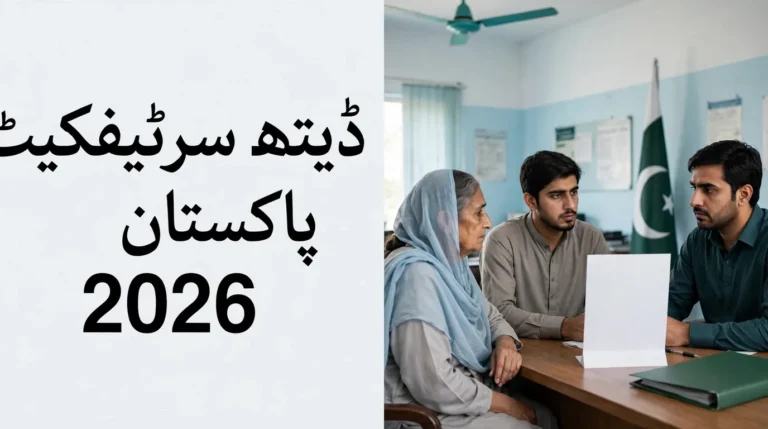
NADRA Succession Certificate Pakistan 2026
When a person dies in Pakistan, their legal heirs may need formal legal documentation before banks, financial institutions and other relevant authorities can release or transfer the deceased person’s assets. For movable assets, this document is generally known as a Succession Certificate, while a Letter of Administration is used for immovable property under the NADRA succession framework.
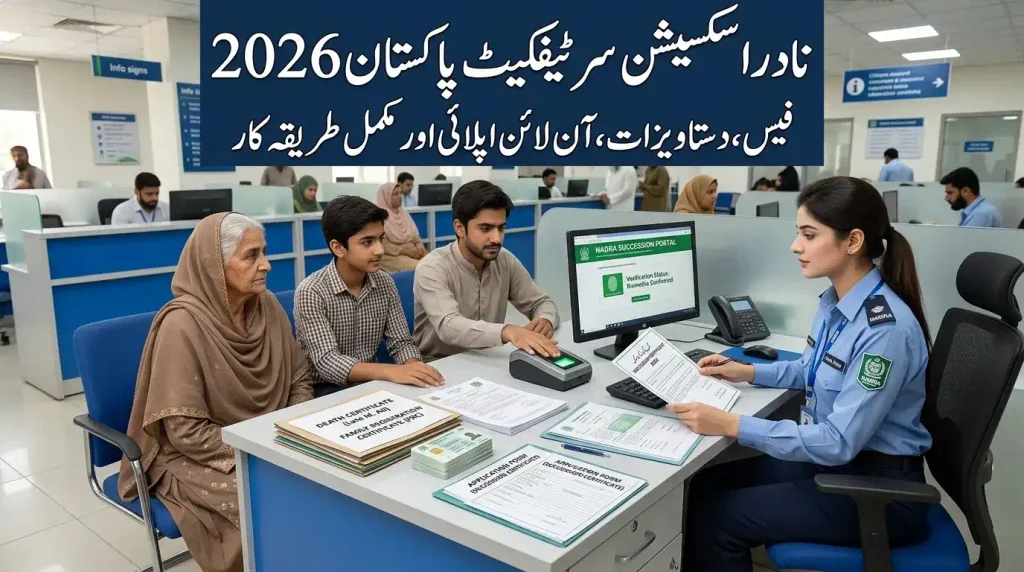
In 2026, NADRA continues to provide succession-related services through designated offices and Succession Facilitation arrangements. The current NADRA process uses identity and family-record verification, including biometric verification, and requires applicants to disclose the deceased person’s assets and legal heirs accurately. NADRA states that federal and provincial governments have mandated it under the applicable succession laws to issue Succession Certificates for movable property and Letters of Administration for immovable property.
This updated guide explains the NADRA Succession Certificate process in Pakistan 2026, eligibility, required documents, fees, biometric verification, public notice and objection period, overseas Pakistani arrangements, provincial differences, and the latest legal developments.
What Is a Succession Certificate in Pakistan?
A Succession Certificate is a legal document used to establish the entitlement of the legal heirs of a deceased person in relation to the deceased’s movable assets.
Depending on the estate, these assets may include:
- Bank accounts and balances
- Shares and securities
- Certain financial investments
- Prize bonds and other financial instruments
- Insurance-related amounts where applicable
- Pension or other receivables where succession documentation is required
- Other movable assets covered by the applicable law
The purpose of the certificate is to provide formal succession proof to the relevant institution so that assets can be released, transferred or dealt with according to the lawful shares of the heirs.
NADRA’s current guidance specifically describes Succession Certificates as relating to movable properties, while Letters of Administration relate to immovable properties.
Succession Certificate vs Letter of Administration
The two documents are often confused because both deal with inheritance after someone’s death.
| Succession Certificate | Letter of Administration |
| Generally relates to movable property | Relates to immovable property |
| Used for applicable bank and financial assets | Used for property such as land and buildings |
| Establishes heirs’ shares in covered movable assets | Supports administration/transfer of immovable estate |
| Issued through the applicable succession authority or court route | Issued through the applicable succession authority or court route |
For example, if a deceased person leaves money in a bank account, a Succession Certificate may be required. If the estate includes a house or land, a Letter of Administration may be relevant.
Because succession law can vary by province and the circumstances of an estate, applicants dealing with mixed, disputed or complicated assets should verify the correct legal route before filing.
NADRA Succession Certificate 2026 – Latest Update
NADRA’s current official succession service confirms that legal heirs can obtain Succession Certificates and Letters of Administration through the applicable NADRA process without necessarily starting with ordinary court proceedings in eligible cases. The process involves identity and family verification, asset details and a public-notice mechanism.
A particularly important update is that provincial laws have also changed.
In Punjab, the Punjab Letters of Administration and Succession Certificates (Amendment) Act 2025 restored civil-court authority alongside the Authority for issuing these documents and removed the previous requirement under Section 10 that affected access to court proceedings.
Sindh also enacted the Sindh Letters of Administration and Succession Certificates (Amendment) Act 2025, which came into force on December 18, 2025.
In Khyber Pakhtunkhwa, the Peshawar High Court in May 2026 upheld the provincial law empowering NADRA to issue succession certificates and letters of administration and directed the provincial government to consider changes similar to Punjab’s amendment.
Therefore, it is not accurate to describe the 2025 developments as one single nationwide federal amendment giving exactly the same procedure everywhere. The applicable provincial law and the nature of the estate matter.
Who Can Apply for a NADRA Succession Certificate?
The application is intended for the legal heirs of a deceased Pakistani citizen.
NADRA’s current official requirements state that:
- The deceased and legal heirs must be Pakistani citizens.
- The relevant property/assets must be located within Pakistan.
- One of the legal heirs must visit the designated NADRA site in person after completing the required documentation.
- In Sindh and Balochistan, NADRA’s current page specifically notes the involvement of legal counsel for the applicable process.
The actual entitlement of each heir is determined under the applicable personal and inheritance law. NADRA verifies identity and family information but should not be treated as a substitute for legal determination of a genuinely disputed inheritance claim.
Can One Legal Heir Apply on Behalf of Other Heirs?
An authorization/affidavit may be required where one heir is handling the application on behalf of others.
NADRA’s current requirements include a Letter of Authorization/Affidavit attested by an Oath Commissioner.
The exact authorization requirements can depend on the circumstances, particularly where some heirs are abroad. Applicants should use the prescribed NADRA form or current official specimen rather than preparing an informal authority letter.
NADRA Succession Certificate Requirements 2026
Before visiting NADRA, prepare the required documents carefully.
Basic Documents
The current NADRA guidance lists the following core requirements:
- Death Certificate of the deceased
- CNIC Cancellation Certificate issued by NADRA
- Family Registration Certificate (FRC)
- List of legal heirs with copies of their CNICs
- Details of movable and immovable property/assets
- Letter of Authorization/Affidavit, attested by an Oath Commissioner where required
Additional documents may be required depending on the nature of the assets and the particular case.
Asset-Related Documents
Applicants should keep relevant evidence of the deceased person’s assets, such as:
- Bank account information
- Bank statements or correspondence
- Share or securities records
- Investment documents
- Pension or benefit records
- Property documents where a Letter of Administration is involved
- Institutional claim forms
- Other documents establishing ownership or entitlement
The exact supporting documents depend on what is being claimed.
Is FRC Required for a Succession Certificate?
Yes. NADRA’s current Succession Certificate requirements specifically include the Family Registration Certificate (FRC).
The FRC is important because NADRA uses its family records to help validate the legal-heir information provided in the application.
If the FRC does not accurately reflect the family relationship, resolve the relevant NADRA record issue before relying on it for a succession application.
Is CNIC Cancellation Certificate Required After Death?
Yes. NADRA’s current Succession Certificate page lists the CNIC Cancellation Certificate of the deceased among the required documents.
NADRA separately provides a cancellation service for identity documents following death. Applicants should therefore make sure the deceased person’s identity record has been properly updated before proceeding with the succession application.
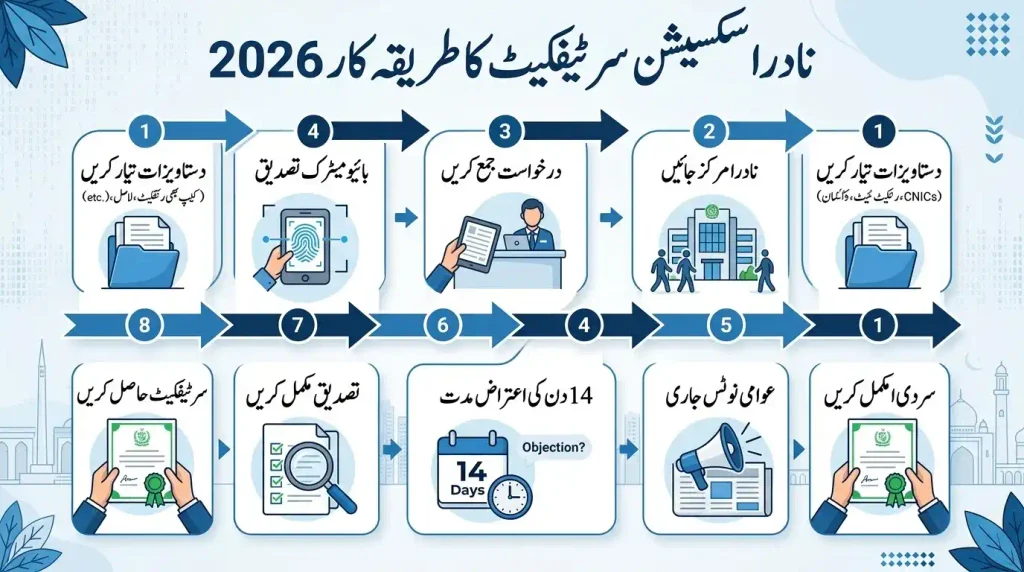
NADRA Succession Certificate Application Process 2026
The process can be summarized as follows.
Step 1: Collect the Required Documents
Prepare the death certificate, CNIC cancellation certificate, FRC, legal-heir information, CNIC copies and asset details.
Step 2: Visit a Designated NADRA Site
NADRA states that one legal heir must visit a designated site in Pakistan after completing the required documentation. The applicable process can vary by province.
Step 3: Submit the Application
The applicant provides information about:
- The deceased person
- Legal heirs
- Family relationship
- Movable assets
- Immovable assets where relevant
- Contact information
- Authorization documents where applicable
All information should be accurate and complete.
Step 4: Biometric Verification
NADRA uses biometric verification as an important identity-authentication step.
NADRA also lists biometric verification of a legal heir for a Succession Certificate as one of its biometric services.
The governing framework also provides for biometric verification of the applicant and legal heirs and allows verification at notified offices within Pakistan or abroad.
Step 5: Public Notice and Objection Period
After the application is accepted into the process, a public notice is published through the prescribed mechanism.
Under the statutory framework, the public notice is published on the Authority’s web portal and in a widely circulated newspaper in English and Urdu. A 14-day period is provided for objections or claims.
Step 6: Objection Review
If no valid objection is received and all other requirements are satisfied, the process can proceed toward issuance.
If an objection or factual controversy arises, the application may require additional review or the appropriate legal forum.
Step 7: Issuance of the Certificate
After the required formalities are completed, the Succession Certificate or Letter of Administration is issued in favour of the legal heirs with their respective shares according to the applicable law.
How Long Does a NADRA Succession Certificate Take in 2026?
NADRA’s current official page states:
Processing Time: 14 days after publication.
This should not be interpreted as a guarantee that every case will be completed in exactly 14 calendar days from the day the applicant first visits NADRA.
The overall time can be affected by:
- Missing documents
- Incorrect family information
- Biometric verification issues
- Asset-detail discrepancies
- Public objections
- Name or identity mismatches
- Authorization problems
- Provincial procedural requirements
- Legal disputes
The 14-day objection period after publication is the important statutory stage to understand.
NADRA Succession Certificate Fee 2026
The current official NADRA fee structure lists the following charges:
| Application | Assets Worth Rs. 100,000 or More | Assets Worth Less Than Rs. 100,000 |
| Fresh/New Application | Rs. 20,000 | Rs. 10,000 |
| Sindh Fresh Application | Rs. 22,000 | Rs. 10,000 |
| Duplicate Application | Rs. 5,000 | Rs. 5,000 |
| Amended Application | Rs. 5,000 | Rs. 5,000 |
| Decline on Processed Application | Rs. 15,000 | Rs. 15,000 |
| Office Mistake | Free | Free |
NADRA’s current fee structure also notes an additional Rs. 2,000 where applicable for assets worth Rs. 100,000 or more. Applicants should verify the amount displayed or communicated through the official NADRA process before payment.
Important Fee Correction
Some older online articles claim that the normal fresh Succession Certificate fee is Rs. 100,000 for higher-value assets. That is not the current fee shown on NADRA’s official fee structure.
The current official NADRA listing shows Rs. 20,000 for assets worth Rs. 100,000 or more, with Rs. 22,000 in Sindh, plus Rs. 10,000 for assets below Rs. 100,000.
Always check the current official fee before submitting payment because government fee schedules can change.
Where Is the NADRA Succession Certificate Service Available?
NADRA’s current website provides dedicated succession-service infrastructure for multiple regions.
Its official domain-authenticity page currently lists these succession subdomains:
- Islamabad: ictsuccession.nadra.gov.pk
- Punjab: punjabsuccession.nadra.gov.pk
- Sindh: sindhsuccession.nadra.gov.pk
- Khyber Pakhtunkhwa: kpsuccession.nadra.gov.pk
- Balochistan: balochistansuccession.nadra.gov.pk
NADRA specifically states that websites operating under nadra.gov.pk are its official authorized subdomains and advises users to verify the domain before entering personal information or making payments.
For this reason, avoid relying on unofficial websites claiming to provide NADRA succession services.
Can You Apply for a Succession Certificate Online?
The word online can be misleading.
NADRA has digital succession infrastructure and official regional portals, but its current central guidance states that one legal heir must visit the designated NADRA site in person after completing the required documentation.
Therefore, applicants should not assume that the entire succession process can be completed remotely from a mobile phone in the same way as an ordinary online application.
Online systems may support parts of the process, information access or regional workflows, but identity and biometric requirements still apply.
Succession Certificate for Overseas Pakistanis
Overseas Pakistani heirs can participate in the succession process through notified arrangements.
The underlying law provides that biometric verification can be conducted at notified offices within Pakistan or abroad.
NADRA’s arrangements for overseas applicants can involve:
- Pakistan Missions
- Overseas biometric verification
- PakID-related identity services
- Authorization documents
- Affidavits
- Power of Attorney where applicable
The exact procedure depends on the applicant’s country, province, asset location and the applicable legal framework.
Before travelling to a Pakistan Mission, overseas applicants should confirm the current biometric and succession service availability with the relevant official mission and NADRA channel.
Succession Certificate for Heirs Living Abroad
If one or more legal heirs live outside Pakistan, additional documentation may be required.
Potential requirements include:
- Valid CNIC or NICOP
- Passport
- Authority/authorization documents
- Affidavit
- Power of Attorney where applicable
- Overseas biometric verification
- Documents proving the relationship where necessary
Do not use a generic internet Power of Attorney template without checking the applicable NADRA or Pakistan Mission requirements.
What Happens If One Heir Objects?
The public-notice stage exists specifically to allow claims or objections to be raised.
An objection can affect the processing of the application and may require additional review.
Examples of situations that can create complications include:
- An omitted legal heir
- Disagreement about heirship
- Identity or family-record discrepancies
- Disputed ownership
- Questions about the deceased’s assets
- A disputed will
- Allegations of concealment or fraud
- Other factual controversies requiring evidence
NADRA’s statutory framework provides a mechanism for dealing with factual controversy rather than treating every disputed matter as a routine administrative application.
NADRA Succession Certificate vs Civil Court in 2026
The answer is not identical throughout Pakistan because provincial succession laws have developed differently.
In Punjab, the 2025 amendment restored civil-court authority alongside the Authority, allowing the applicable court route to operate under the Succession Act 1925.
In Sindh, a 2025 amendment also changed the provincial framework.
In Khyber Pakhtunkhwa, the Peshawar High Court in May 2026 upheld the provincial law authorizing NADRA to issue succession certificates and letters of administration. The court also directed the provincial government to consider an amendment similar to Punjab’s approach.
Therefore, the safest general rule is:
Use the NADRA route where the applicable law and NADRA service cover your case, but consider the relevant civil-court route where provincial law permits it or where the estate involves disputes and issues requiring judicial determination.
What Is the Difference Between an Uncontested and Contested Succession Case?
Uncontested Case
An uncontested case generally involves:
- Clearly identifiable legal heirs
- No disagreement about heirship
- Consistent identity records
- Proper documentation
- Clearly identified assets
- No objection during the public-notice period
These cases are more suitable for an administrative succession process where the applicable law permits it.
Contested Case
A case may become legally complicated where there is:
- A disputed heir
- A disputed will
- An allegation of concealed heirs
- Disagreement over ownership
- Conflicting family records
- Questions requiring evidence
- Other factual controversy
Such cases may require court proceedings or legal advice rather than treating the matter as a routine NADRA application.
What Happens If NADRA Rejects or Declines the Application?
If NADRA cannot proceed because of a legal or factual problem, the applicant should first identify the reason for the decision.
Common problems include:
- Missing documents
- Incorrect information
- Unverified legal heirs
- Identity mismatch
- Incomplete asset details
- Objection from another claimant
- Legal controversy
The appropriate next step depends on the reason and the province. Following the 2025 legal changes in Punjab, for example, civil-court access was restored without requiring the previous Section 10 route.
For disputed inheritance matters, consulting a qualified lawyer is advisable because the correct legal route depends on the facts of the estate.
Common Reasons for Succession Certificate Delays
A succession application can be delayed when the information submitted to NADRA does not match the underlying records.
Common causes include:
- Missing CNIC cancellation certificate
- Incorrect FRC
- Unlisted heirs
- Incorrect CNIC details
- Name spelling differences
- Missing asset information
- Incomplete authorization
- Biometric verification problems
- Public objection
- Disputed inheritance
- Incorrect fee payment
- Incomplete supporting documents
NADRA itself places responsibility on the applicant to provide correct information and warns that false information or forged documentation may lead to legal proceedings under the NADRA Ordinance 2000.
Important: Do Not Hide Legal Heirs or Assets
Applicants should provide complete and accurate information.
Do not deliberately:
- Omit a legal heir
- Hide a bank account
- Understate assets
- Submit a false affidavit
- Use forged documents
- Provide incorrect family information
NADRA explicitly states that providing fake information or forged documentation can result in legal proceedings.
A complete application is not only important for faster processing; it also protects the heirs from future legal disputes.
Can a Succession Certificate Cover Property?
A common misunderstanding is that a Succession Certificate is the universal document for every inherited asset.
Under NADRA’s current framework:
Succession Certificate → Movable property
Letter of Administration → Immovable property
Therefore, if an estate contains a house, land or another immovable asset, the relevant Letter of Administration process may be required instead.
If an estate contains both movable and immovable assets, applicants should identify the applicable documents and process for each category.
Succession Certificate for Bank Accounts
Banks commonly require legal succession documentation before releasing or transferring certain assets belonging to a deceased customer.
For a bank-related claim, applicants should keep:
- Deceased person’s death certificate
- CNIC cancellation certificate
- FRC
- CNICs of legal heirs
- Succession Certificate where applicable
- Bank account information
- Any bank-specific claim forms
The bank may have its own procedural requirements in addition to the succession document.
Succession Certificate for Shares and Securities
Where the deceased held shares, securities or similar financial assets, the relevant institution may require succession documentation before transferring the deceased person’s holdings to the lawful heirs.
Applicants should retain:
- Shareholding records
- Account statements
- Investor information
- Succession Certificate
- Identity documents
- Any institution-specific forms
The exact transfer process depends on the institution holding the asset.
How to Avoid Succession Certificate Delays
Before submitting the application, use this checklist:
- Confirm the deceased’s death record
- Obtain the CNIC Cancellation Certificate
- Obtain an updated FRC
- Identify every legal heir
- Check CNIC/NICOP details
- Prepare copies of identity documents
- List the assets accurately
- Collect bank/share/pension records
- Prepare the required authorization or affidavit
- Complete biometric requirements
- Verify the current NADRA fee
- Keep payment evidence
- Check the public notice
- Respond promptly if an objection or clarification is raised
NADRA Succession Certificate 2026 Quick Checklist
| Requirement | Status |
| Death Certificate | Required |
| CNIC Cancellation Certificate | Required |
| FRC | Required |
| Legal Heirs List | Required |
| CNIC Copies of Heirs | Required |
| Asset Details | Required |
| Authorization/Affidavit where applicable | Required |
| Biometric Verification | Required |
| Public Notice | Applicable |
| Objection Period | 14 days after publication |
| Current Fresh Fee | From Rs. 10,000 depending on asset value/province |
| Processing | 14 days after publication according to NADRA |
NADRA’s official page should be checked before filing because fees, designated offices and procedural requirements can change.
Final Words
The NADRA Succession Certificate process in Pakistan 2026 provides a formal route for legal heirs dealing with the movable assets of a deceased person, while a Letter of Administration is generally used for immovable property under the NADRA framework.
The most important steps are to prepare the death certificate, CNIC cancellation certificate, FRC, legal-heir information, asset details and authorization documents where applicable, complete biometric verification and understand the 14-day public-notice objection period.
The current NADRA fee structure should also be checked carefully because outdated websites may still display incorrect figures. NADRA currently lists fresh application fees based on the declared asset value, including Rs. 20,000 for assets worth Rs. 100,000 or more and Rs. 10,000 for assets below Rs. 100,000, with a separate Sindh rate shown by NADRA.
Because succession laws and procedures have continued to evolve at the provincial level, especially through the 2025 amendments, applicants should verify the latest applicable provincial procedure rather than relying on an old article or unofficial website.