
Death Certificate Pakistan: Union Council Registration Guide 2026
A death certificate is the official document that records the death of a person in Pakistan. It confirms the date of death, the place of death and, where recorded, the cause of death. Almost every legal and financial step after a death, from closing bank accounts to claiming a pension and dividing property, starts with this document.
One point needs to be clear before anything else. A death certificate in Pakistan is issued by the Union Council or the local government office of your area, not by NADRA. NADRA comes into the process after the certificate exists: it cancels the identity card of the deceased person and updates the national record. This guide explains the full sequence in the right order: registration, documents, fee and timing in 2026, late registration, and how the certificate connects to the NADRA CNIC cancellation certificate and the succession certificate your family may need next.
What Is a Death Certificate in Pakistan?
A death certificate is the government record of a death. When a death is registered, the local registration authority enters the details into the civil registration system and issues a computerized death certificate, carrying the name and identity number of the deceased, the date and place of death, and a registration reference other departments can verify.
This registration is part of the same civil registration system that records births and marriages. Just as a birth is first registered locally before NADRA issues a Child Registration Certificate, a death is first registered locally before NADRA changes anything in its database. Our birth certificate guide for Pakistan works on the same principle.
Who Issues a Death Certificate in Pakistan?
The death certificate is issued by the local registration authority of the area where the deceased person lived, or where the death took place. Depending on the area, that authority is the Union Council, a Municipal Committee or Town Committee, or a Cantonment Board in cantonment areas. NADRA does not issue this certificate, and a NADRA Registration Centre cannot register a death for you.
| Office | What It Does | When You Deal With It |
| Union Council / Municipal Committee | Registers the death and issues the computerized death certificate | First step, always |
| Cantonment Board | Same registration role for residents of cantonment areas | First step, if the deceased lived in a cantonment area |
| Hospital | Issues the medical death report when the death occurs in hospital | Before registration, for hospital deaths |
| NADRA | Cancels the CNIC of the deceased and issues a Cancellation Certificate, updates the family record | After you have the death certificate |
| NADRA Succession Facilitation Unit | Issues the succession certificate for the legal heirs | After cancellation, when assets must be transferred |
You will often see the phrase “NADRA death certificate” on other websites. That usually means the computerized certificate printed from the NADRA linked registration system at the council office. The issuing authority is still the council: NADRA’s own cancellation service asks you to bring a death certificate issued by the Union Council.
Death Certificate vs NADRA Cancellation Certificate
These two documents are confused with each other more than any other pair in this process, and they are not the same thing. The death certificate proves that a death happened and was registered. The Cancellation Certificate proves that NADRA has terminated the identity card of the deceased so that it cannot be misused.
The order cannot be reversed: NADRA will only cancel a CNIC when the family presents the council issued death certificate. Our guide on the NADRA cancellation certificate after death covers that second step in full. This article covers the first step only.
Why Is a Death Certificate Used?
A death certificate may be required for:
- Cancelling the CNIC of the deceased person at NADRA
- Applying for a succession certificate so legal heirs can receive money and property
- Settling bank accounts, closing loans and releasing deposits
- Claiming a government or employer pension for the surviving family
- Filing life insurance claims
- Transferring property, vehicles and other assets to the heirs
- Updating the family record on the Family Registration Certificate (FRC)
- Visa cancellation and the repatriation of remains when the deceased lived or worked abroad
Because so many departments ask for the same document, apply for it early and keep several copies.
Who Can Apply for a Death Certificate?
The death is normally reported by a close family member, such as a spouse, a son or daughter, a parent, or a brother or sister. That person, sometimes called the informant, carries their own CNIC, because the council records who reported the death.
A legal representative can also complete the registration when the close relatives live abroad. Expect the council to ask for proof of your relationship and your authority to act.
Documents Required for a Death Certificate
Prepare the following documents before you visit the council office. A council can ask for an additional document in a specific case, but this is the standard set:
- CNIC of the deceased person, original if available and a copy
- CNIC of the applicant or informant who is reporting the death
- Medical death report from the hospital, if the death occurred in a hospital. This is the hospital document that states the date, time and cause of death
- Burial or graveyard certificate, where one is issued
- Proof of relationship with the deceased, such as the family record, where the council asks for it
- The death registration form, provided by the council office
Check every detail against the CNIC before you go. The name spelling and the CNIC number on the medical report should match the identity card exactly. If they do not, get the hospital report corrected first, because a mismatch follows the family into the NADRA cancellation and the succession case.
How to Register a Death and Get a Death Certificate
Step 1: Get the Medical Death Report
If the death occurred in a hospital, the hospital issues a medical death report recording the cause, date and time of death. Collect it before you leave, and check the name and CNIC number on it. If the death occurred at home, tell the council office when you apply: councils handle home deaths through their own verification, and the exact requirement is set locally.
Step 2: Visit the Correct Union Council
Go to the Union Council of the area where the deceased person was resident, or where the death took place, because the registration is entered in that council’s record. Cantonment residents go to their Cantonment Board, and municipal area residents to their Municipal Committee or Town Committee.
Step 3: Fill the Death Registration Form
Ask the office for the death registration form and fill it in carefully, with the full name of the deceased, the CNIC number, the date and place of death, the cause of death where known, and the name and CNIC of the person reporting the death, exactly as they appear on the CNIC and the medical report.
Step 4: Submit the Documents
Hand over the form with the documents listed above. Keep your original CNIC with you and give copies where copies are asked for. If a document is missing, ask the staff to note exactly what is needed, because a second visit is common with an incomplete file.
Step 5: Verification by the Council
The council staff verify the information against your documents. They may cross check the medical report with the hospital, or confirm the family record. The council record is the record every other department, including NADRA, relies on.
Step 6: Collect the Computerized Death Certificate
Once verification is complete, the council enters the registration and issues the computerized death certificate, signed by the Union Council Secretary. Read it before you leave, and check the name, CNIC number, and date and place of death letter by letter. An error is far easier to correct at the same counter on the same day.
Death Registration Through the Pak ID App in Punjab
In Punjab, NADRA and the provincial Local Government Department have signed an agreement under which life events, including deaths, are registered at the Union Council and the related certificates can also be obtained through NADRA’s Pak ID mobile app. It covers Union Councils across Punjab.
This does not change who issues the certificate: the registration still belongs to the Union Council, and the app is an additional channel in Punjab. Elsewhere, the office process above is the route to follow.
Death Certificate Fee in Pakistan 2026
There is no single fee across the whole country, because death registration is a provincial and local subject, and two large provinces have now abolished the fee altogether. The verified position in 2026 is:
| Province / Case | Fee | Basis |
| Punjab, death within the last 7 years | No fee | Punjab Birth and Death Registration Rules 2025: registration and the computerized certificate are free at Union Councils and Municipal Committees |
| Punjab, death more than 7 years ago | A fee applies, and a court decree is required | Same 2025 rules; a newspaper advertisement is also required for very late cases |
| Sindh | No fee | Sindh cabinet decision, October 2025: fee abolished at municipal, union council and town committee level; the province bears NADRA’s service charges |
| Other provinces and areas | Confirm at your own council | No nationwide fixed fee is officially published; any charge is a local council fee |
| NADRA CNIC cancellation after the certificate | No fee | NADRA allows blood relatives to cancel the CNIC of a deceased person free of charge through the Pak ID app or a NADRA centre |
Be careful with websites that quote one fixed rupee figure for the whole of Pakistan; it is not an official national fee. Where a fee applies, pay it only at the office against a receipt, and never pay an agent for a document your council issues directly.
How Long Does a Death Certificate Take?
No single official processing time applies across Pakistan, because each council works to its own procedure and workload. In straightforward cases, where the documents are complete and match, councils commonly issue the computerized certificate within a few working days.
Cases take longer when a document is missing, when a name or date does not match the CNIC record, or when the death is being registered late. When you submit the form, ask when the certificate will be ready and keep any acknowledgment or reference safe until you collect it.
Late Registration of a Death
Many families register a death months or years later, usually when a bank, a pension office or a succession case asks for the certificate. Late registration is possible, but its rules are provincial, so the Punjab position below should not be assumed for other provinces.
Under the Punjab Birth and Death Registration Rules 2025, the window for regular registration was extended from 60 days to one year. Registration remains free for up to seven years after the death, and no court decree is required within that period. Approval levels rise with the delay: recent cases are handled at council level, older cases go to the Assistant Director of Local Government, and cases older than seven years need the Deputy Director’s approval. For a death more than seven years old, a court decree remains a legal requirement, along with a newspaper advertisement and a fee.
In other provinces, a late application can involve additional local requirements, and families are commonly asked for an affidavit explaining the delay. Take every record you have, including the medical report and burial record, and ask the council office to state its requirement for your case before you start.
How to Get a Duplicate Death Certificate
If the original certificate is lost, apply for a copy at the same Union Council office that registered the death. The record stays with that office, so no other council, and not NADRA, can reprint it. Carry your own CNIC and any copy of the lost certificate, because the registration date helps the staff find the record.
NADRA can reissue its own documents, such as an identity card or a Cancellation Certificate, but a Union Council death certificate is a council document. Going to a NADRA centre for a duplicate is one of the most common wasted trips in this process.
Correcting an Error in a Death Certificate
If a name, a CNIC number, a date or any other detail on the certificate is wrong, the correction is made by the same Union Council that issued it. Take the certificate, the CNIC of the deceased, and the document that proves the correct detail, and ask for the record to be corrected and reprinted.
Do this before you go to NADRA. NADRA itself directs families to get death registration errors corrected at the Union Council before applying for CNIC cancellation, because NADRA works from the council record. A wrong date can otherwise stop the cancellation, and later the succession case, at verification.
Death Certificate Attestation for Use Abroad
If the certificate will be used outside Pakistan, it normally needs attestation by the Ministry of Foreign Affairs (MOFA) after it is issued. MOFA’s attestation requirements state that a hospital issued certificate must be signed by the MS or DMS of a government hospital, and that the certificate must be countersigned by MOFA. A Union Council certificate is signed by the Secretary of the Union Council before it goes to MOFA.
Pakistan is a member of the Apostille Convention, in force for Pakistan since 9 March 2023, and MOFA runs an online apostille system. For countries that accept an apostille, it replaces the older chain of embassy attestation. Check what the receiving country asks for before you apply, on the Ministry of Foreign Affairs website.
After the Death Certificate: Cancel the CNIC With NADRA
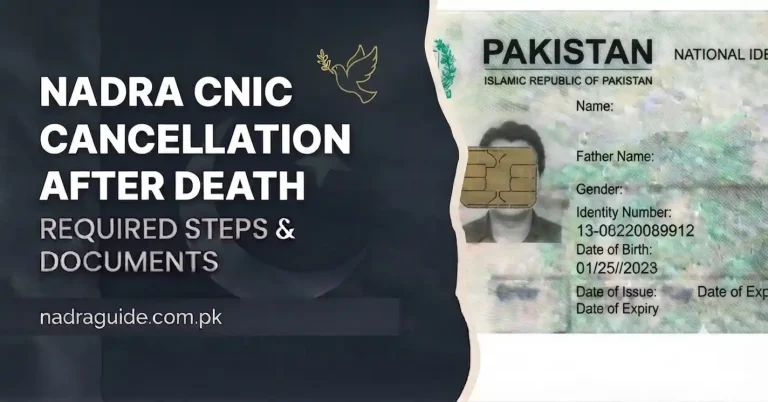
With the death certificate in hand, the next step is NADRA. A blood relative, such as a parent, spouse, sibling or child, applies for the Cancellation Certificate. NADRA’s requirement is the verified computerized death certificate from the Union Council, Municipal Committee or Cantonment Board, or a foreign death certificate where the death occurred abroad.
The application can be made at any NADRA Registration Centre, or through the Pak ID app, and the cancellation is free of charge. NADRA asks families to start it within 60 days of the death, because an active CNIC of a deceased person can be misused and can block identity applications of other family members. At a NADRA centre, the original identity cards of the deceased are taken and destroyed by the staff. Our complete walkthrough is the guide to the NADRA CNIC cancellation certificate after death.
Death Certificate and the Succession Certificate
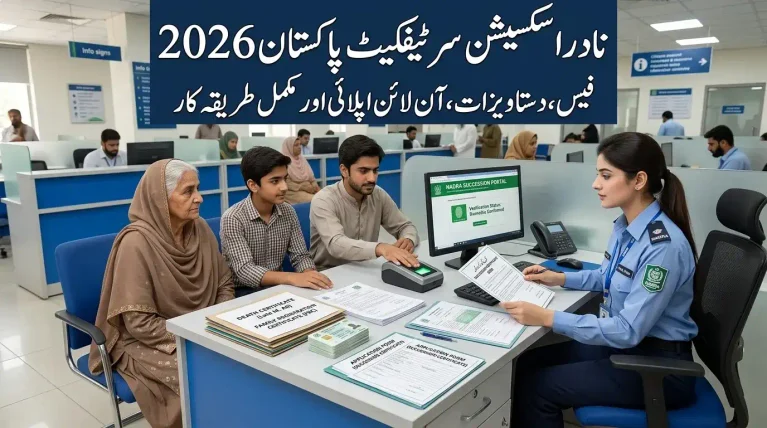
The death certificate is also the first document on NADRA’s list for a succession certificate, the document that lets legal heirs receive the money and property of the deceased. The application asks for the death certificate, the CNIC cancellation certificate, the Family Registration Certificate, a list of the legal heirs with copies of their CNICs, details of the movable and immovable property, and a letter of authorization or affidavit signed by the heirs.
This is why the order matters: death certificate first, CNIC cancellation second, succession third. Families who start with succession are sent back for the two earlier documents. Our guide to the NADRA succession certificate in Pakistan explains that stage in detail.
Common Problems and Solutions
| Problem | Solution |
| The family went to NADRA for the death certificate | NADRA does not issue it. Register the death at the Union Council, Municipal Committee or Cantonment Board first |
| The name on the medical report does not match the CNIC | Get the hospital report corrected before registration; both offices work from matching records |
| There is an error on the issued certificate | Return to the same Union Council for correction before applying for CNIC cancellation |
| The original certificate is lost | Apply for a copy at the same Union Council that registered the death; NADRA cannot reprint it |
| The death was never registered and it happened years ago | Use your province late registration route; in Punjab it is free up to seven years, then a court decree is needed |
| The death occurred abroad | Keep the foreign death certificate; NADRA accepts it for CNIC cancellation, and it may need attestation for use in Pakistan |
| An agent is demanding a large fee | Apply directly at the council office. In Punjab and Sindh the certificate is free; elsewhere pay any local fee only against a receipt |
Common Mistakes to Avoid
Mistake 1: Going to NADRA First
NADRA cannot register a death and cannot issue the certificate. The council office is the only starting point.
Mistake 2: Not Checking the Printed Certificate
Read the certificate at the counter. A single wrong digit in the CNIC number can stall the cancellation and the succession case months later.
Mistake 3: Leaving Registration for Years
Late registration adds approvals, and after seven years in Punjab it adds a court decree. Register within the first year, while the medical report is easy to produce.
Mistake 4: Paying an Agent for a Free Certificate
In Punjab and Sindh the certificate is officially free, and CNIC cancellation is free everywhere. Pay no agent for either document.
Mistake 5: Skipping the CNIC Cancellation
The death certificate alone does not close the identity record. Until the CNIC is cancelled, the deceased person remains active in the national database, which can block the family’s own identity applications and expose the card to misuse.
Death Certificate Checklist Before You Apply
- Medical death report collected, with name and CNIC number checked
- CNICs of the deceased and the applicant, originals and copies
- Burial or graveyard certificate collected, where issued
- The correct council office identified for your area
- Fee position for your province checked
- After collection: certificate read carefully, copies made and stored safely
- Next steps noted: NADRA CNIC cancellation, then succession if there are assets
Final Words
The death certificate is a local government document, and that single fact makes the whole process easier once you know it. Register the death at the Union Council or local office of your area, take the medical report and both CNICs with you, and read the printed computerized death certificate carefully before you leave.
Everything else follows in a fixed order: NADRA cancels the CNIC and issues the Cancellation Certificate, the family record is updated, and the legal heirs can move to the succession certificate for bank accounts, pension and property. Do the steps in that order and keep the original certificate safe.
For fees and local requirements, rely on the current position of your own province and council, and confirm it at your office on the day you apply.
Official Sources
- NADRA: official website, identity documents and Cancellation Certificate service
- Pak ID: official NADRA application portal
- Ministry of Foreign Affairs Pakistan, attestation and apostille requirements
- Government of Punjab, Local Government Department: Birth and Death Registration Rules 2025 (fee waiver and late registration)
- Government of Sindh: cabinet decision of October 2025 abolishing the death certificate fee

One Comment