Family Registration Certificate (FRC) — NADRA Online 2026
A Family Registration Certificate (FRC) is an official document issued by the National Database and Registration Authority (NADRA) that shows the family-composition information recorded in NADRA’s identity database.
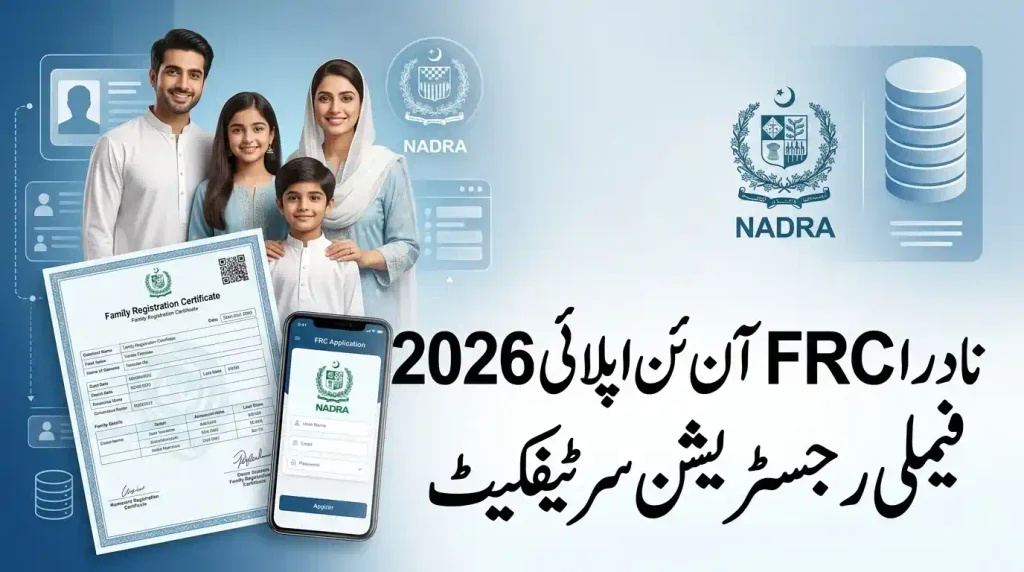
In Pakistan, an NADRA FRC is commonly used for visa applications, immigration, family sponsorship, dependent documentation, residency applications and other official purposes. The certificate reflects information already available in NADRA’s records; it does not itself create or change a family relationship.
This updated NADRA FRC guide 2026 explains what FRC is, its types, eligibility, required information, online application through PakID, NADRA Registration Centre procedure, current FRC fee, processing time, PDF access, CNIC-based checking, missing family members, corrections, overseas use and MOFA attestation or apostille.
What Is FRC in Pakistan?
FRC stands for Family Registration Certificate. It is a certificate issued by NADRA that provides a record of the family relationships and family-composition information available in the applicant’s NADRA record.
NADRA’s FRC service is intended to provide documentary evidence of registered family information. The certificate is generated from the information already stored in NADRA’s database.
The FRC may contain information relating to:
- Parents
- Brothers and sisters
- Spouse
- Children
- Adoptive or guardian relationships, where applicable
- Other family relationships covered by the selected FRC category
The information displayed depends on the applicant’s registered family record and the FRC category selected.
Why Is FRC Used?
An FRC may be requested for:
- Visa applications
- Immigration applications
- Family sponsorship
- Dependent documentation
- Family reunion applications
- Residency applications
- Embassy or consular documentation
- Other official or administrative requirements
The receiving authority may have additional document requirements, so an FRC should not be assumed to be sufficient by itself.
What Information Does NADRA FRC Show?
The information shown on an FRC depends on the category selected and the family relationships recorded in NADRA’s database.
For example, an FRC may show:
- Applicant’s name and identification information
- Parents
- Siblings
- Spouse
- Children
- Adopted children or guardian relationships where applicable
If a spouse, child, parent or sibling is missing, the issue may relate to the underlying NADRA family record rather than the certificate itself.
An FRC should therefore be viewed as a snapshot of the registered family information available when the certificate is generated.
NADRA FRC Types in Pakistan 2026
NADRA’s FRC service provides the following main categories:
- FRC By Birth
- FRC By Marriage
- FRC By Adoption
- FRC By All
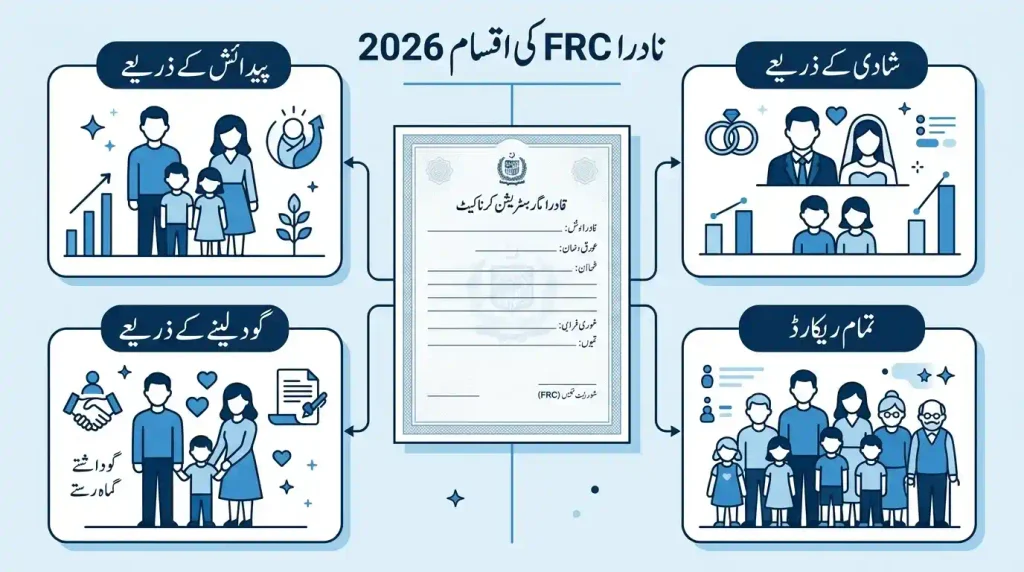
The appropriate category depends on the type of family relationship you need to document.
FRC By Birth
FRC By Birth is associated with the applicant’s parental family information.
It can include:
- Father
- Mother
- Brothers
- Sisters
The exact information depends on the family relationships recorded in NADRA’s database.
This category may be useful when documentary evidence of parental or sibling relationships is required.
FRC By Marriage
FRC By Marriage focuses on family relationships connected with marriage.
It can include:
- Husband or wife
- Children
It may be relevant for:
- Spouse visa applications
- Family immigration
- Dependent visas
- Family sponsorship
- Residency applications
- Overseas documentation
If a spouse or child does not appear, the relevant marital or family linkage may need to be checked and updated before obtaining a new FRC.
FRC By Adoption
FRC By Adoption is used for adoption-related family information recorded in NADRA’s system.
Depending on the registered information, the certificate may reflect relevant:
- Guardian relationships
- Adoptive family relationships
- Adopted children
The availability of information depends on the underlying NADRA record.
FRC By All
FRC By All provides broader family information across the applicable relationship categories recorded in NADRA’s system.
This can be useful when an organization or foreign authority requires a wider view of the applicant’s registered family composition.
Who Can Apply for an FRC?
A person applying for an FRC must have an identity record recognized by NADRA.
NADRA’s requirements include a valid 13-digit identification number. Depending on the applicant and circumstances, this can relate to:
- CNIC
- NICOP
- POC
- CRC
- Juvenile Card
The family members appearing on the FRC must also have the relevant information recorded in NADRA’s database.
An FRC is generated from existing identity and family records. Therefore, simply applying for an FRC does not automatically create a missing parent, spouse, child or sibling relationship.
Documents Required for NADRA FRC
For a straightforward FRC application, the applicant’s NADRA identification information is the primary requirement.
The relevant identification document may include:
- CNIC
- NICOP
- POC
- CRC
- Juvenile Card
Additional documents or verification may be required when there is an issue with the underlying family or identity record.
For example, additional action may be needed if:
- A spouse is missing
- A child is missing
- A parent or sibling is not correctly linked
- The name is incorrect
- CNIC details do not match
- A marriage record has not been updated
- Divorce information has not been reflected
- A family member’s registration requires correction
The exact documents depend on the specific problem and the NADRA procedure applicable to that record.
How to Apply for FRC Online Through PakID
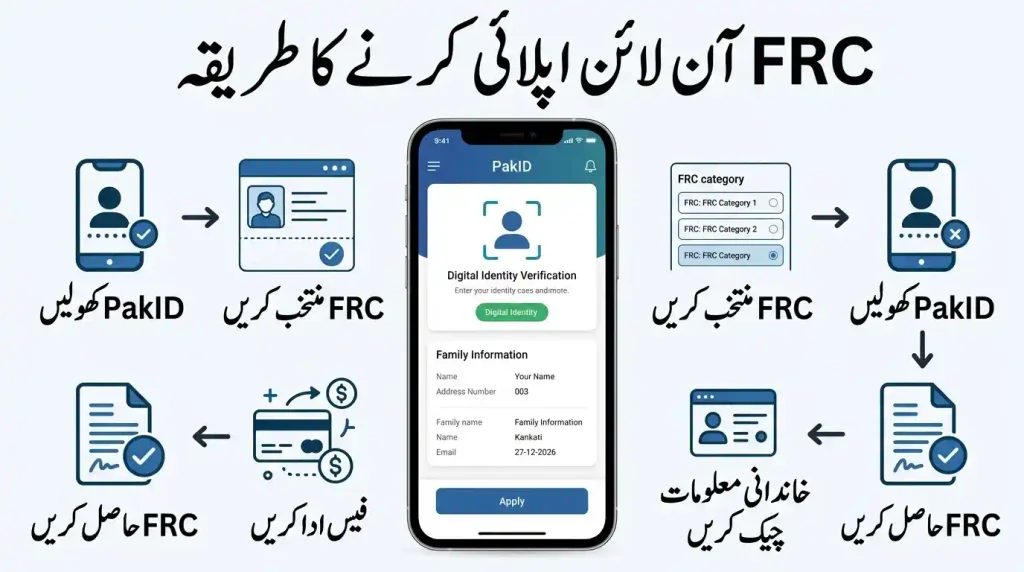
NADRA provides FRC services through its official PakID digital platform.
The general online process is:
Step 1: Open the Official PakID Service
Use NADRA’s official PakID platform or application.
Avoid websites, APK files, social-media pages or third-party services claiming that they can provide another person’s NADRA family record.
Step 2: Log In to Your PakID Account
Sign in to your PakID account and complete any identity verification required by the system.
Step 3: Select Family Registration Certificate
From the available services, select Family Registration Certificate (FRC).
The FRC service is available under the relevant family/document service section of PakID.
Step 4: Select the FRC Category
Choose the category required for your purpose:
- By Birth
- By Marriage
- By Adoption
- By All
Select the category according to the family information required by the organization, embassy or authority requesting the certificate.
Step 5: Review Family Details
Review the family members and relationships displayed by the system.
Pay particular attention to:
- Names
- CNIC/identification numbers
- Parents
- Spouse
- Children
- Family relationships
Step 6: Resolve Any Family-Record Problem
If an important family member is missing or the information is incorrect, do not assume that submitting another FRC application will fix the issue.
The underlying NADRA identity or family record may need to be corrected first.
Step 7: Pay the Applicable Fee
Pay the fee shown by the official NADRA/PakID system.
Available payment methods can depend on the service and current NADRA payment arrangements.
Step 8: Submit the Application
After completing the required information, verification and payment, submit the FRC application.
Step 9: Access the Issued FRC
Once processing is completed, follow the current PakID instructions to access the issued digital FRC.
The exact appearance and navigation of PakID can change as NADRA updates its digital services, so the instructions displayed inside the official platform should be followed.
How to Get FRC From a NADRA Registration Centre
Applicants who prefer or need physical assistance can visit a NADRA Registration Centre (NRC).
The general procedure is:
- Visit the relevant NADRA Registration Centre.
- Obtain the required token.
- Provide your identification information.
- Complete the required verification.
- Select the required FRC category.
- Review the family information.
- Pay the applicable fee.
- Complete the application process according to the centre’s instructions.
- Receive or access the certificate according to the applicable service procedure.
The exact process can vary depending on the applicant’s circumstances and NADRA’s current centre procedures.
NADRA FRC Fee 2026
NADRA’s current fee structure should be checked before payment because government fees and service classifications can change.
The current NADRA fee information lists:
| FRC Service | Listed Fee | Listed Priority |
| FRC Alpha / Beta / Gama family | PKR 1,000 | Executive |
| FRC Both | PKR 2,000 | Executive |
The current fee structure also lists a 1-day priority timeline for the FRC services shown on that page.
NADRA’s fee terminology can differ from the terminology used on its FRC information pages. The FRC information page commonly describes categories as By Birth, By Marriage, By Adoption and By All, while the fee structure uses terms such as Alpha, Beta, Gama and Both.
Therefore, always confirm the exact amount displayed in the official NADRA/PakID system before making payment.
FRC Processing Time 2026
NADRA’s current fee structure lists a 1-day priority timeline for the listed FRC services.
However, this should not be confused with the time required to resolve a family-record problem.
There is an important difference between:
- Generating an FRC from a correct record
- Processing an application
- Correcting an identity record
- Updating a marriage or family linkage
- Resolving missing family information
- Completing additional verification
A straightforward FRC may be processed according to the listed service timeline, while a record requiring correction may take longer.
How to Download FRC Online in PDF
After the FRC application has been processed, the issued digital certificate can be accessed through the official digital service according to the current NADRA procedure.
Before using the PDF, carefully check:
- Applicant’s name
- CNIC/NICOP/POC details
- Parents
- Siblings where applicable
- Spouse
- Children
- Other relevant family relationships
If an important relationship is missing or incorrect, resolve the underlying NADRA record issue rather than manually changing the PDF.
Can You Check FRC Online by CNIC?
Searches such as “FRC check by CNIC”, “NADRA FRC check online by CNIC” and “family tree check by CNIC” are common.
However, this does not mean that NADRA provides a public database where anyone can enter a CNIC number and download another person’s FRC.
An FRC is an authorized document generated through NADRA’s official services.
There should not be an expectation that entering another person’s CNIC into an unofficial website will legitimately reveal their complete family information.
Avoid Fake FRC Checking Websites
Do not provide your personal information to an unknown website or application claiming to offer:
- FRC check by CNIC
- NADRA family tree search
- Complete family details by CNIC
- Anyone’s FRC download
- NADRA family record search
Be especially careful with websites or APK files requesting:
- CNIC number
- CNIC photographs
- Family details
- PakID credentials
- OTP codes
- Biometric information
- Passport information
Use official NADRA channels for identity-related services.
Why Is My Spouse Missing From FRC?
If your spouse does not appear on an FRC By Marriage, the problem may be related to the underlying marital or family linkage.
Possible reasons include:
- Marriage information has not been updated
- CNIC information does not match
- Spouse details contain an error
- Family linkage is incomplete
- The relevant record requires correction
NADRA’s FRC guidance recognizes the issue of a spouse not appearing on the certificate.
The appropriate solution is to review and, where necessary, update the underlying NADRA record before generating another FRC.
Can a Foreign Spouse Appear on FRC?
A foreign spouse’s information can involve additional registration and documentation considerations.
If a foreign spouse is not appearing as expected, the issue may depend on how the spouse’s identity and family relationship are recorded in NADRA’s system.
Applicants should follow NADRA’s applicable procedure for the relevant foreign-spouse or family-record situation rather than relying on a third-party website.
For visa or immigration purposes, also check whether the receiving country’s authority requires additional proof of marriage or identity.
Can a Child Born Abroad Appear on FRC?
Children born abroad may require appropriate registration and identity documentation before their family relationship can be reflected correctly in NADRA records.
If the child does not appear on the FRC, check the child’s registration status and the linkage between the child’s record and the parents’ NADRA records.
The exact documentation depends on the child’s nationality, place of birth, existing NADRA registration and identity-document status.
Can Deceased Family Members Appear on FRC?
A deceased family member should not automatically be assumed to be excluded from every FRC situation.
NADRA’s current FRC guidance recognizes circumstances in which deceased or otherwise unregistered family members may be included based on the applicable record and information.
If a deceased person’s information appears incorrectly or causes a family-record problem, the underlying NADRA record should be reviewed.
Can an Ex-Spouse Appear on FRC After Divorce?
Yes, an ex-spouse may continue to appear if the relevant marital or family record has not been updated.
A divorce does not necessarily mean that an already-issued FRC will automatically change.
If the divorce has been legally registered but the NADRA family record still reflects the previous relationship, follow the applicable NADRA procedure to update the record and then obtain a new FRC.
FRC After Multiple Marriages
Family information involving more than one marriage can depend on the marital records registered in NADRA’s database.
If previous or current spouse information is not appearing as expected, the relevant marital and identity records may need to be reviewed.
Do not manually alter an FRC to remove or add relationship information. Any correction should be made through the appropriate official record-update process.
What If There Is an Error in FRC?
An FRC is generated from NADRA’s database, so manually editing the certificate does not correct the official record.
Errors may involve:
- Name
- Father’s name
- Mother’s name
- CNIC number
- Spouse
- Children
- Parents
- Family relationships
- Family linkage
If an error is found, the underlying NADRA identity or family record should be corrected through the appropriate procedure.
A new FRC can then be generated from the updated information.
Can FRC Data Be Modified Directly?
No. An FRC should not be treated as an editable document.
For example, if a downloaded FRC incorrectly shows a person’s name, relationship or CNIC number, changing the PDF manually does not change NADRA’s database.
The correct process is:
Identify the error → Correct the underlying NADRA record → Wait for the record update → Generate a new FRC
FRC for Overseas Pakistanis
An FRC can be particularly useful for overseas Pakistanis dealing with:
- Family visas
- Dependent visas
- Immigration
- Residency applications
- Family sponsorship
- Embassy documentation
- Foreign government requirements
The receiving authority may require a recently issued FRC, an attested document, an apostille or an official translation.
Therefore, overseas applicants should check the requirements of the specific embassy, immigration authority or organization before submitting the certificate.
FRC for Visa and Immigration Applications
FRC may be requested as supporting evidence of family composition in:
- Spouse visa applications
- Child or dependent visas
- Family reunion applications
- Immigration applications
- Family sponsorship
- Residency applications
However, an FRC does not guarantee approval of a visa or immigration application.
The relevant foreign government, embassy or immigration authority decides which documents it accepts and whether additional evidence is required.
MOFA Attestation and Apostille of FRC
An FRC may need authentication when it is intended for use outside Pakistan.
Pakistan’s Ministry of Foreign Affairs (MOFA) includes the Family Registration Certificate among personal documents covered by its document attestation/apostille services.
The required legalization process depends on the destination country and receiving organization.
Depending on the case, the receiving authority may require:
- MOFA attestation
- Apostille
- Embassy or consular legalization
- Certified translation
- Additional supporting documents
Applicants should check the current MOFA requirements and the requirements of the destination country’s authority before submitting the document.
Important MOFA Update for 2026
MOFA’s current information states that online registration is required for apostille applications from 27 July 2026.
Because document legalization procedures can change, applicants should verify the latest requirements before visiting a MOFA office or submitting an online application.
What Should You Check Before MOFA Attestation?
Before submitting an FRC for international use, compare the information on the certificate with your other identity documents.
Check:
- Full name
- Father’s name
- Mother’s name
- Spouse name
- Children’s names
- CNIC/NICOP information
- Passport information
- Family relationships
If there is an inconsistency, it is better to resolve the NADRA record before beginning the foreign-document legalization process.
MOFA attestation or apostille confirms the applicable document/legalization process; it does not automatically guarantee that every foreign authority will accept the document for every purpose.
Is FRC Proof of Pakistani Nationality?
No.
An FRC primarily provides information about family composition recorded by NADRA.
It should not automatically be treated as a replacement for:
- CNIC
- NICOP
- Pakistani passport
- Citizenship documentation
If an authority asks for proof of Pakistani nationality or citizenship, provide the specific document required by that authority.
Does FRC Have an Expiry Date?
An FRC reflects family information recorded when the certificate is generated.
Even if an organization does not technically describe an FRC as “expired,” an older certificate may no longer reflect current family circumstances.
For example, the family record may change after:
- Marriage
- Divorce
- Birth of a child
- Death registration
- Family-linkage correction
- Identity-record modification
For visa, immigration or embassy purposes, always check how recently the receiving authority requires the FRC to have been issued.
Can You Get More Than One FRC?
Yes. Different FRC categories can be relevant to different purposes.
For example:
- FRC By Birth — parental and sibling family information
- FRC By Marriage — spouse and children
- FRC By Adoption — applicable adoption/guardian relationships
- FRC By All — broader applicable family information
The appropriate certificate depends on the purpose for which it is required.
FRC vs Family Tree
An FRC should not be confused with an unrestricted public family tree.
An FRC is an official document generated from registered NADRA information for an authorized applicant.
There is no legitimate reason to expect an unrelated person to enter your CNIC on a random website and obtain your complete NADRA family record.
Websites claiming to provide unrestricted family information by CNIC should be treated with caution.
Common FRC Problems and Solutions
| Problem | Possible Reason | What to Do |
| Spouse missing | Marriage/family linkage issue | Check and update the relevant NADRA record |
| Child missing | Registration or linkage issue | Verify the child’s registration and family linkage |
| Parent missing | Family record issue | Request review through the appropriate NADRA procedure |
| Sibling missing | Family linkage/record issue | Check the relevant family information |
| Ex-spouse appears | Previous marital record remains reflected | Follow the applicable NADRA update procedure |
| Wrong name | Identity-record mismatch | Correct the underlying record |
| Wrong CNIC | Incorrect database information | Request record correction |
| FRC application not completing | Verification or data issue | Review the application and use official NADRA support |
| Old information appears | Certificate reflects existing database data | Update the record and generate a new FRC |
| Unknown website offers FRC lookup | Privacy/scam risk | Use official NADRA channels |
Common Mistakes to Avoid When Applying for FRC
Avoid these common mistakes:
- Using an unofficial FRC website.
- Trying to obtain another person’s family information by CNIC.
- Assuming an FRC can correct the NADRA database.
- Applying without checking the displayed family information.
- Ignoring a missing spouse or child.
- Using an old FRC for an immigration application without checking its acceptance requirements.
- Assuming every embassy accepts the same FRC format.
- Submitting an FRC containing name or identification discrepancies.
- Editing the FRC PDF manually.
- Relying on outdated FRC fee information.
- Uploading CNIC or family documents to an unknown APK or website.
- Sharing PakID login information or OTP codes.
- Assuming MOFA attestation automatically guarantees acceptance by a foreign authority.
FRC Checklist Before You Apply
Before submitting an FRC application, check the following:
- Valid CNIC/NICOP/POC/CRC/Juvenile Card details
- Correct applicant name
- Correct 13-digit identification number
- Parents’ information
- Sibling information where applicable
- Spouse information
- Children’s information
- Adoption/guardian information where applicable
- Correct FRC category
- Current NADRA fee
- Required processing timeline
- Destination-country requirements
- Embassy requirements
- MOFA attestation/apostille requirements where applicable
FRC Online Apply — Quick Process
For a straightforward online application, the basic sequence is:
Open Official PakID → Log In → Select FRC → Choose Category → Review Family Details → Pay Applicable Fee → Submit Application → Wait for Processing → Access Issued FRC
Always follow the latest instructions displayed by the official NADRA/PakID service because the digital interface and procedures may be updated.
Final Words
The NADRA Family Registration Certificate (FRC) 2026 is an important official document showing family-composition information recorded in Pakistan’s national identity database. It is commonly used for immigration, visa applications, family sponsorship, dependent documentation and other administrative purposes.
The key point is that an FRC reflects information already recorded by NADRA. It does not independently create, modify or legally establish a family relationship.
Before applying, select the appropriate category — By Birth, By Marriage, By Adoption or By All — and carefully review the family information shown in your NADRA record.
If a spouse, child, parent, sibling or other relevant family member is missing, the underlying NADRA record may need to be updated before a new FRC is generated.
For FRC fees, processing times and online application procedures, rely on the latest information displayed through official NADRA and PakID channels because government services and fees can change.
For international use, check the current requirements of MOFA Pakistan and the receiving embassy, immigration authority or organization, particularly when attestation, apostille, legalization or translation is required.
Official Sources
- NADRA — Family Registration Certificate
- NADRA — Fee Structure
- NADRA — PakID FAQs
- NADRA — FRC User Guide
- NADRA — Payment Guidelines
- Ministry of Foreign Affairs Pakistan — Personal Document Attestation/Apostille