NADRA New B-Form System Pakistan
The NADRA B-Form, officially known as the Child Registration Certificate (CRC), has undergone important changes in Pakistan. Instead of treating the child’s registration document as a single certificate that remains unchanged throughout childhood, NADRA’s current system uses age-based CRC stages with progressively stronger identity verification.

Under the current NADRA framework, CRC validity changes when a child reaches 3 years, 10 years and 18 years. The biometric requirements also increase with age. Children up to 3 years generally do not require biometrics, children aged 3 to 10 require a photograph and iris, while children aged 10 to 18 require a photograph, fingerprints and iris.
This guide explains the new NADRA B-Form system 2026, the three CRC stages, photographs and biometric requirements, validity periods, required documents, fees, PakID online application, NADRA Registration Centre requirements, passport-related rules, old B-Form issues and the most important questions parents need to know.
What Is the NADRA B-Form / Child Registration Certificate?
The B-Form is commonly used to refer to NADRA’s Child Registration Certificate (CRC).
NADRA states that the CRC is an identity document issued to children under 18 and serves as the initial registration of a child in the NADRA database. It also provides proof of the child’s identity and relationship with the parents or legal guardian.
The CRC is important for many child-related identity processes, including documentation and passport-related procedures.
Under the current system, the CRC is not simply a one-time document. Its validity ends at specific age milestones, after which the applicable age-stage CRC must be obtained.
What Changed in the New NADRA B-Form System 2026?
The major change is the introduction of an age-based CRC structure.
The current NADRA information identifies these age brackets:
| Child’s Age | Photograph | Fingerprints | Iris | CRC Validity |
| Up to 3 years | Generally not required* | Not required | Not required | Until age 3 |
| 3 to 10 years | Required | Not required | Required | Until age 10 |
| 10 to 18 years | Required | Required | Required | Until age 18 |
*NADRA specifically notes that a photograph is required for children up to 3 years when the CRC is being processed for passport purposes.
This means parents should pay attention to the child’s age when applying for or renewing a CRC.
NADRA B-Form 3 Stages Explained
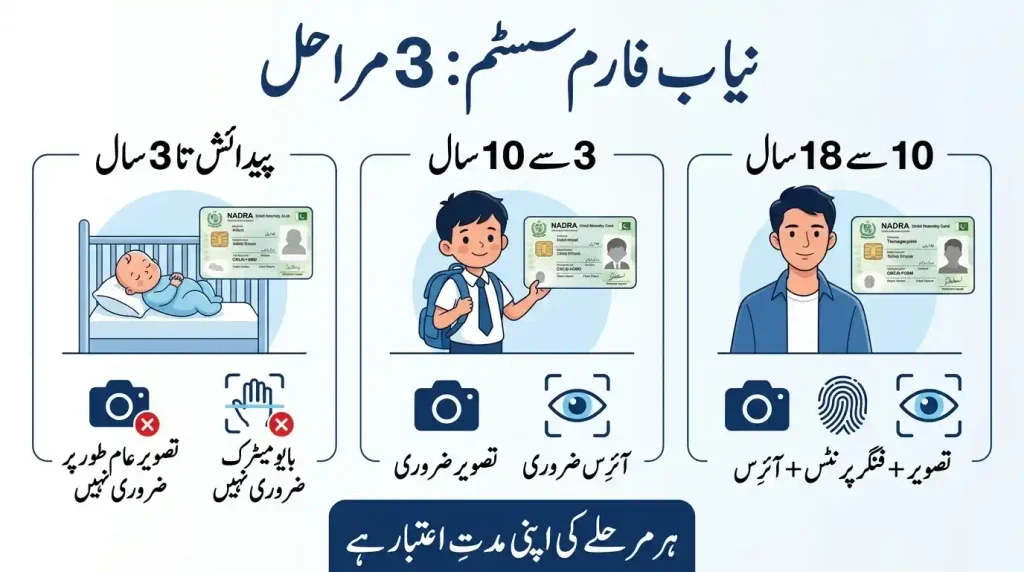
Stage 1: Birth to 3 Years
The first CRC stage covers children up to the age of 3.
At this stage:
- Biometrics are not required.
- The CRC normally does not require a photograph.
- A photograph is required when the CRC is being processed for passport purposes.
- The CRC expires when the child reaches 3 years of age.
The purpose of this stage is to establish the child’s registration and identity record at an early age.
Parents should not assume that the first CRC will remain valid until the child turns 18.
Stage 2: Age 3 to 10 Years
When the child reaches 3 years of age, the next CRC stage becomes applicable.
NADRA’s current official information specifies:
- Photograph is required.
- Iris is required.
- Fingerprints are not required at this stage.
- The CRC remains valid until the child reaches 10 years of age.
This is an important correction to older online information that describes the 3–10 stage as requiring only a photograph.
Stage 3: Age 10 to 18 Years
From age 10, the child’s identity record receives the full biometric layer specified by NADRA for this age group.
The CRC requires:
- Photograph
- Fingerprints
- Iris
The document remains valid until the child reaches 18 years of age.
This stage is particularly important because the child’s biometric identity record becomes more comprehensive before the transition to adult identity documentation.
NADRA B-Form Validity Period
The current NADRA fee and identity-document information confirms that CRC validity is tied to the child’s age.
The validity periods are:
- First CRC: Until age 3
- Second CRC: Until age 10
- Third CRC: Until age 18
Parents should therefore check the child’s age before relying on an older B-Form.
Once the applicable age threshold is reached, the relevant next-stage CRC should be processed.
Is the Old B-Form Still Valid in 2026?
This is one of the most confusing parts of the new system.
NADRA spokesperson guidance reported in June 2026 stated that for children who are not travelling abroad, an existing B-Form could remain valid, and immediate replacement was not required solely because of the new framework.
However, the same guidance stated that the new CRC becomes important when a child needs a new passport or passport renewal, because a CRC without a photograph is not accepted for passport purposes.
Earlier NADRA spokesperson comments reported in 2025 similarly stated that previously issued B-Forms would remain valid, while a new CRC would be required for passport issuance.
Therefore, parents should not assume that every older B-Form became invalid overnight. The practical requirement depends on the child’s age, the purpose for which the document is needed and whether a passport application is involved.
For a specific child’s case, the latest NADRA instructions should be checked before applying.
Is a New CRC Required for a Child’s Passport?
Yes, passport-related requirements are an important reason the new CRC system matters.
NADRA spokesperson guidance reported in 2026 stated that a CRC without a photograph is no longer accepted for passport purposes. The same guidance said that children with valid existing passports can continue using those passports until expiry, with the new CRC becoming relevant when a new passport or renewal is required.
This means parents planning international travel should check the child’s CRC well before beginning the passport process.
Do not wait until the passport appointment to discover that the child’s existing B-Form does not meet the current requirement.
What Documents Are Required for NADRA B-Form?
NADRA’s current CRC page lists the following principal requirement:
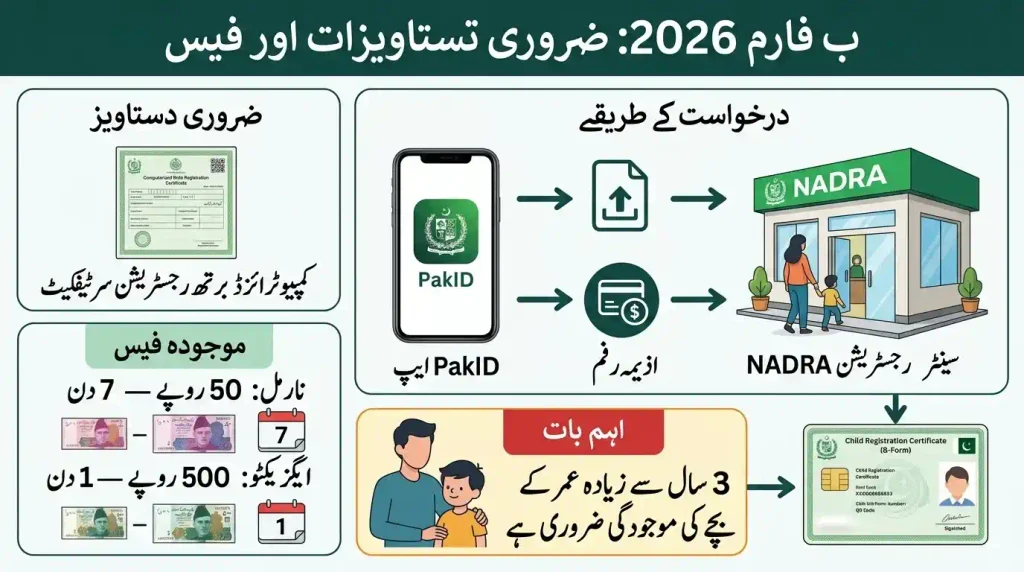
- Computerized Birth Registration Certificate issued by the relevant Union Council, Municipal Committee or Cantonment for births in Pakistan.
- For births abroad, NADRA lists a Detailed Birth Certificate or S-1 Form.
Parents should make sure that the child’s birth registration information is accurate before applying for the CRC.
If the birth record contains an incorrect name, date of birth or parent information, it is better to resolve the underlying registration issue through the relevant authority before proceeding with identity documentation.
Is the Child’s Presence Required at NADRA?
Yes, the child’s presence depends on age and the service being processed.
NADRA currently states that:
- For CRC applications involving children above 3 years, the child’s presence is mandatory.
- For children up to 3 years, the child’s presence is required when the CRC is being processed for passport issuance purposes.
This requirement is particularly important for the age groups where photograph or biometric capture is involved.
Parents should therefore avoid assuming that every CRC application can be completed without taking the child to a NADRA Registration Centre.
Can You Apply for the B-Form Online?
NADRA provides the PakID mobile application as its official digital platform for identity registration and tracking.
The CRC can be processed through supported PakID services, while applications requiring physical photograph or biometric capture may require a visit to a NADRA Registration Centre.
The online route can reduce unnecessary visits when the particular application is eligible for digital processing.
However, online application does not mean that every child can complete every part of the process entirely from home.
How to Apply for NADRA B-Form Through PakID
The general digital process involves:
- Download or open the official PakID mobile application.
- Create an account or sign in.
- Select the relevant CRC service.
- Enter the child’s required information.
- Upload the required documents.
- Complete the applicable verification steps.
- Pay the applicable fee.
- Submit the application.
- Track the application through the available NADRA system.
The exact screens and verification requirements can change as NADRA updates the PakID application, so parents should follow the instructions displayed inside the official application.
How to Apply for B-Form at a NADRA Registration Centre
Parents can also apply through a NADRA Registration Centre (NRC).
The general process is:
- Obtain the child’s computerized birth registration certificate.
- Check that the child’s name and other information are correct.
- Visit the appropriate NADRA Registration Centre.
- Take the required documents.
- Take the child when the applicable age/service requires the child’s presence.
- Complete photograph and biometric capture where required.
- Pay the applicable processing fee.
- Submit the application.
- Keep the receipt or application reference information for tracking.
For children aged 3 and above, NADRA’s current requirements make the child’s presence mandatory for CRC processing.
NADRA B-Form Fee 2026
According to NADRA’s current official fee schedule, the CRC fee is:
| CRC Category | Fee | Processing Time |
| Normal | Rs. 50 | 7 days |
| Executive | Rs. 500 | 1 day |
NADRA lists these charges for CRC (all categories) in its current fee structure.
The fee structure can change, so parents should confirm the amount shown by NADRA before making payment.
What Happens If You Do Not Update the CRC?
Parents should not wait until the last moment when the child approaches an age milestone.
An outdated CRC can create practical difficulties when the document is needed for another identity process, especially where a current photograph or biometric record is required.
Potential issues may include:
- Delays in passport processing
- Additional verification requirements
- Problems when updating child identity records
- Delays during future CNIC processing
- Difficulty completing identity-related applications that require the current CRC
The exact consequences depend on the child’s circumstances and the service being requested.
Why Did NADRA Introduce the New B-Form System?
The revised CRC framework is designed to strengthen child identity verification.
The move toward age-appropriate photographs and biometrics helps establish a more reliable identity record as a child grows.
The 2025 reporting on the revised CRC system linked the changes to stronger child identity verification and efforts to close identity-related loopholes, including concerns involving human smuggling.
The current structure also creates a clearer identity trail before a child reaches the age at which adult CNIC documentation becomes applicable.
How the New B-Form Helps Future CNIC Processing
The CRC is part of a child’s identity record before adulthood.
NADRA states that a CNIC is issued to Pakistani citizens who have attained 18 years of age and who have either not previously been registered with NADRA or hold a CRC/Juvenile Card.
Maintaining accurate child registration information can therefore help establish continuity between the child’s early registration and later adult identity documentation.
Parents should make sure that important information such as the child’s name, date of birth and parentage remains accurate throughout the child’s registration history.
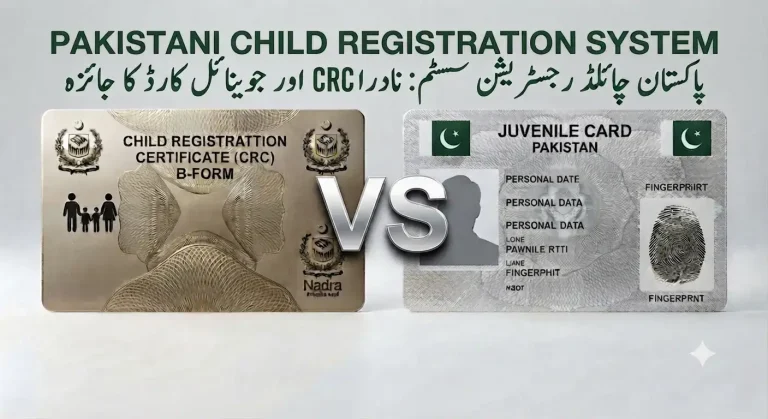
B-Form, CRC and Juvenile Card — Are They the Same?
The terms are related but should not automatically be treated as identical.
Child Registration Certificate (CRC)
The CRC is the child identity document used for registration of children under 18. NADRA’s current page identifies age-specific CRC stages with different photograph and biometric requirements.
B-Form
“B-Form” is the common name widely used in Pakistan for the child’s registration document. In current NADRA terminology, the relevant official document is the Child Registration Certificate (CRC).
Juvenile Card
NADRA also provides a Juvenile Card for eligible children.
NADRA’s current information separately lists Juvenile Card biometric requirements and validity periods. For children up to 10, it lists photograph and iris, while from 10 to 18 it lists photograph, fingerprints and iris.
Parents should therefore select the document appropriate to the child’s situation rather than assuming that every minor identity document has identical requirements.
What Is the Difference Between CRC and Juvenile Card?
Both are child identity documents, but they are not simply two names for the exact same document.
The CRC serves as the child’s initial registration and proof of identity and relationship with the parents or legal guardian.
The Juvenile Card is a separate identity document for eligible minors.
The requirements and validity periods are published separately by NADRA.
New B-Form and Biometric Verification
Biometric verification is one of the most important changes in the revised child identity framework.
For the current CRC structure:
- Up to 3 years: biometrics are not required.
- Age 3–10: photograph and iris are required.
- Age 10–18: photograph, fingerprints and iris are required.
This means that online articles claiming that children aged 3 to 10 require only a photograph are now incomplete.
Why Is Iris Scanning Included?
Iris recognition is part of NADRA’s broader biometric identity framework.
NADRA’s national biometric policy framework includes iris recognition as a biometric modality alongside fingerprints and other identity-verification technologies.
The current CRC page specifically lists iris for children aged 3 to 10 and for children aged 10 to 18.
Is Iris Scanning Required for Every Child?
Under NADRA’s current CRC information, iris is listed for:
- Children aged 3 to 10
- Children aged 10 to 18
Fingerprint capture is added for children aged 10 to 18.
The actual capture process is carried out according to NADRA’s applicable verification procedures.
Can the B-Form Be Used for School Admission?
The CRC is an important child identity document and may be requested during educational and other official processes.
However, individual schools and institutions can have their own documentation requirements.
Parents should therefore follow the requirements of the particular school or institution rather than assuming that every organization uses identical documentation rules.
Can the B-Form Be Used for Passport Applications?
The CRC plays an important role in child passport processing.
NADRA guidance reported in 2026 stated that a CRC without a photograph is no longer accepted for passport purposes.
Parents applying for a child’s first passport or passport renewal should therefore make sure the child’s CRC satisfies the current passport-related requirements before submitting the application.
What If My Child Already Has an Old B-Form?
Do not automatically assume that the old B-Form must be cancelled or replaced immediately.
NADRA spokesperson guidance reported in June 2026 stated that an existing B-Form could remain valid for children who were not travelling abroad, while a new CRC would be required when a passport application or renewal made the updated document necessary.
The child’s age is also important because the current CRC system has validity thresholds at 3, 10 and 18 years.
If your child is approaching one of these milestones, check the current NADRA requirements before relying on the older document.
What If My Child Is Between 3 and 10 Years Old?
A child in the 3–10 age group falls under the second CRC stage.
According to NADRA’s current official information, the CRC for this age group requires:
- Photograph
- Iris
It does not require fingerprints at this stage.
The CRC expires when the child reaches age 10.
What If My Child Is 10 Years Old or Older?
A child aged 10 to 18 falls under the third CRC stage.
The current requirements are:
- Photograph
- Fingerprints
- Iris
The CRC remains valid until the child reaches 18.
Parents should plan this update rather than waiting until another identity document is urgently required.
What If the Child Was Born Outside Pakistan?
NADRA’s current CRC requirements distinguish between inland and overseas births.
For a birth outside Pakistan, NADRA lists a Detailed Birth Certificate or S-1 Form among the relevant requirements.
Parents of children born abroad should follow the applicable NADRA and Pakistani mission requirements for their specific case.
Birth Registration and the B-Form
Birth registration is the foundation of the child’s identity record.
Under Section 9(1) of the NADRA Ordinance, the parent or guardian of a citizen under 18 is required to get the child registered within one month after birth.
The relevant birth-registration document is then used for CRC processing.
Parents should therefore avoid delaying the child’s initial registration.
Can You Apply for B-Form Without a Birth Certificate?
For a normal inland CRC application, NADRA lists a Computerized Birth Registration Certificate issued by the relevant Union Council, Municipal Committee or Cantonment as a requirement.
Therefore, parents should first ensure that the child’s birth has been properly registered and that the computerized birth record is available.
What If There Is an Error in the Birth Certificate?
If the child’s birth certificate contains an incorrect name, date of birth, parent information or another important detail, parents should address the underlying birth-registration record through the relevant issuing authority.
Using incorrect information during NADRA registration can create discrepancies that may later affect identity documents and verification.
It is better to correct the source record before submitting a new CRC application whenever possible.
Can B-Form Details Be Updated?
If the child’s information needs correction or an updated age-stage CRC is required, parents should use NADRA’s official CRC service.
Do not rely on unofficial websites or agents claiming that they can modify NADRA records outside the official system.
What Happens at Age 18?
The CRC is a child identity document and its validity ends when the child reaches 18.
NADRA’s current CNIC information states that CNIC is issued to Pakistani citizens who have attained 18 years and who meet the applicable registration requirements, including citizens holding a CRC or Juvenile Card.
The child’s identity record should therefore be kept accurate throughout childhood to support the transition to adult identity documentation.
New B-Form System 2026 — Important Rules for Parents
The most important points are:
- CRC is the official Child Registration Certificate.
- The CRC is issued for children under 18.
- The CRC system has age-based validity.
- The first stage runs until age 3.
- The second stage runs from age 3 until age 10.
- The third stage runs from age 10 until age 18.
- Children up to 3 generally do not require biometrics.
- A photograph is required for passport purposes even for a child under 3.
- Children aged 3–10 require photograph and iris.
- Children aged 10–18 require photograph, fingerprints and iris.
- The child’s presence is mandatory for CRC processing above age 3.
- A computerized birth registration certificate is a key requirement.
- CRC can be processed through supported PakID services or a NADRA Registration Centre.
- Current NADRA fees list Rs. 50 for normal CRC processing and Rs. 500 for executive processing.
- Existing B-Forms should not automatically be assumed invalid solely because of the new system; passport requirements are an important exception.
- Always check current NADRA instructions before travelling or applying for a passport.
NADRA B-Form Fee and Requirements at a Glance
| Requirement | Current Information |
| Official name | Child Registration Certificate (CRC) |
| Eligibility | Pakistani children under 18 |
| Birth document | Computerized Birth Registration Certificate |
| Up to 3 years | No biometrics generally required |
| Passport use under 3 | Photograph required |
| Age 3–10 | Photograph + iris |
| Age 10–18 | Photograph + fingerprints + iris |
| CRC validity | Until age 3, 10 or 18 depending on stage |
| Child presence | Mandatory above age 3 |
| Normal fee | Rs. 50 |
| Normal processing | 7 days |
| Executive fee | Rs. 500 |
| Executive processing | 1 day |
| Online channel | PakID app, where supported |
| Physical channel | NADRA Registration Centre |
Fee and processing information should be reconfirmed on NADRA’s official fee page because government fees and procedures can change.
Common Mistakes Parents Should Avoid
Waiting Until the Last Moment
Do not wait until a passport, school requirement or another urgent process is already underway before checking the child’s CRC.
Assuming the Old B-Form Is Always Enough
Older B-Forms may remain valid in some circumstances, but passport applications have additional requirements.
Ignoring the Age Milestones
The current CRC structure uses age thresholds at 3 and 10 years. Parents should keep these dates in mind.
Believing Outdated Information About the 3–10 Age Group
Current NADRA information lists iris along with the photograph for children aged 3–10.
Using Unofficial Websites or Agents
Do not provide sensitive child identity information to unofficial websites, social-media accounts or unknown agents claiming to process NADRA documents.
Using an Unofficial APK
Only use the official PakID application and trusted NADRA channels for digital identity services.
Final Words
The NADRA New B-Form System 2026 is based on a three-stage Child Registration Certificate (CRC) structure.
The first stage covers children up to age 3, the second covers ages 3 to 10, and the third covers ages 10 to 18. The identity requirements become stronger with age: children aged 3–10 require a photograph and iris, while children aged 10–18 require a photograph, fingerprints and iris.
The current official fee is Rs. 50 under normal processing and Rs. 500 under executive processing, with NADRA listing 7 days and 1 day respectively.
Parents should also remember that the transition from the old B-Form to the revised CRC is not as simple as saying that every old document became invalid immediately. NADRA’s reported guidance has specifically distinguished ordinary validity from passport-related requirements.
The safest approach is to keep the child’s birth and identity information accurate, monitor the age-based CRC milestones, use the official PakID application or NADRA Registration Centre, and check the latest NADRA requirements whenever a passport or another important identity document is being prepared.