Nikah Nama Registration & Marriage Certificate
A Nikah Nama is one of the most important documents created after a Muslim marriage in Pakistan. It records the marriage contract, the identities of the bride and groom, witnesses, Nikah Registrar and important terms such as Haq Mehr. After the Nikah Nama is properly registered, the relevant local government authority can issue a Computerized Marriage Registration Certificate (MRC).
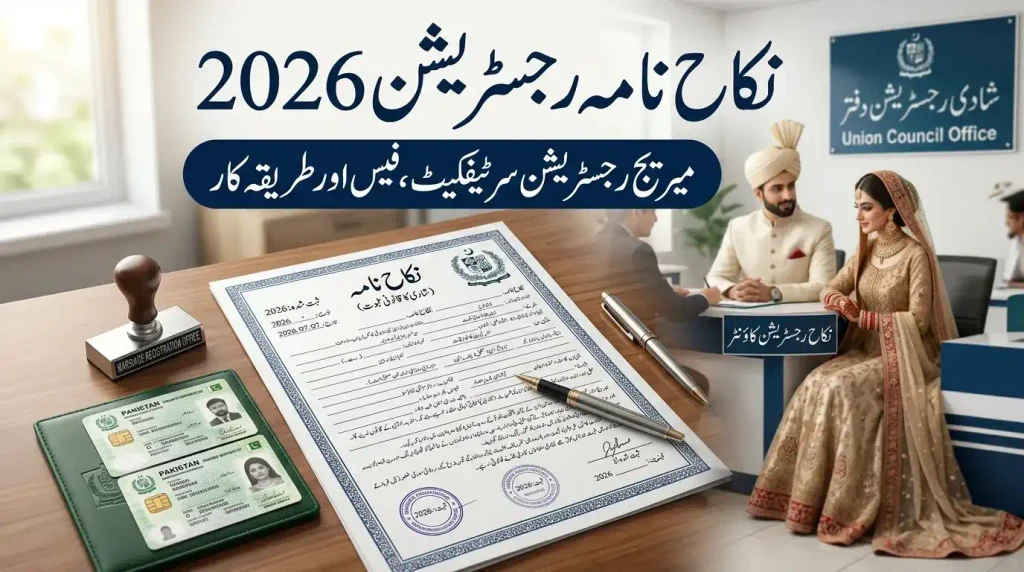
One important point is often misunderstood: NADRA is not generally the issuing authority for the Marriage Registration Certificate itself. The exact issuing authority depends on the local jurisdiction. In Punjab, for example, the official Local Government & Community Development Department states that the Nikah Khuwan has the Nikah Nama registered through the Nikah Registrar, while the concerned Union Council or Municipal Committee issues the Computerized Marriage Registration Certificate.
NADRA becomes important after marriage because the marriage information can affect CNIC/NICOP records, Family Registration Certificate (FRC), spouse details and other identity-related services. NADRA’s FRC service, for example, includes a “By Marriage” category showing spouse and children information when the relevant family members are registered in NADRA’s records.
This guide explains the Nikah Nama registration process in Pakistan in 2026, Marriage Registration Certificate requirements, documents, fees, processing times, Islamabad and Punjab procedures, overseas requirements, late registration, attestation and common mistakes.
What Is a Nikah Nama in Pakistan?
A Nikah Nama is the written marriage contract documenting a Muslim marriage. It contains important information about the spouses, witnesses, marriage date, place of marriage, Haq Mehr and other declarations and conditions included in the prescribed Nikah Nama.
Under Section 5 of the Muslim Family Laws Ordinance, 1961, every marriage solemnized under Muslim law is required to be registered according to the provisions of the Ordinance. The law also provides for licensing of Nikah Registrars by the Union Council and requires marriages not solemnized by the Nikah Registrar to be reported to the registrar for registration.
The Nikah Nama should therefore not be treated as merely a ceremonial document. It is an important legal record that can later be required for identity records, family registration, immigration, visa applications, divorce proceedings, inheritance-related matters and other administrative purposes.
What Is a Computerized Marriage Registration Certificate (MRC)?
The Marriage Registration Certificate (MRC) is a computerized certificate issued by the relevant registration/local-government authority after the marriage has been registered.
In Punjab, official guidance states that:
- The Nikah Khuwan gets the Nikah Nama registered through the relevant Nikah Registrar.
- The concerned Union Council or Municipal Committee issues the Computerized Marriage Registration Certificate.
- The application is supported by the registered Nikah Nama and identity documents of the husband and wife and their parents.
Therefore, the terms “NADRA Marriage Certificate” or “NADRA MRC” are commonly used in online searches, but they can be misleading. For most applicants, the MRC is obtained from the relevant Union Council, Municipal Committee, local-government office, Cantonment Board or other competent authority, depending on jurisdiction.
NADRA may subsequently be involved in updating or reflecting family information through its identity database and FRC services.
Nikah Nama vs Marriage Registration Certificate
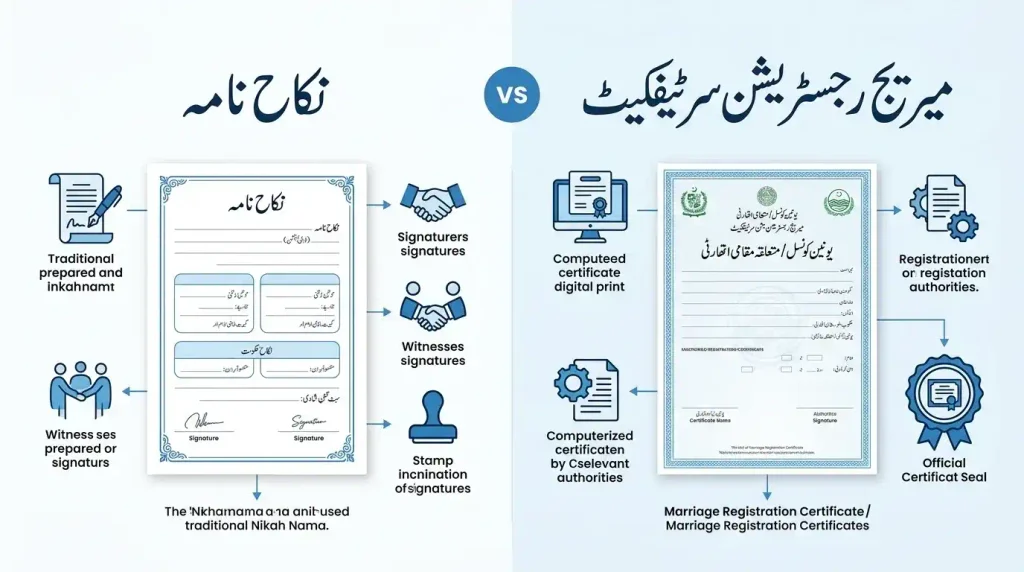
Although both documents relate to the same marriage, they are not exactly the same document.
| Document | Main purpose | Usually associated authority |
| Nikah Nama | Written marriage contract and record of Nikah | Nikah Registrar |
| Computerized MRC | Computerized proof of registered marriage | Relevant local government/registration authority |
| FRC by Marriage | NADRA family-composition record | NADRA |
| CNIC/NICOP | National identity record | NADRA |
The Nikah Nama is the underlying marriage record, while the computerized MRC is an official computerized certificate confirming the registered marriage.
For international use, an authority may ask for both the original Nikah Nama and MRC, depending on the destination country’s requirements. Pakistan’s Ministry of Foreign Affairs specifically lists the original Nikah Nama together with the Marriage Registration Certificate and relevant identity/family documents for certain attestation procedures.
Why Is Nikah Nama Registration Important?
Marriage registration is important because many later legal and administrative processes require documentary proof of marriage.
A registered marriage may be needed for:
- Updating marital status in identity records
- Applying for or updating an FRC
- Spouse visa and immigration applications
- Family sponsorship
- Certain banking and financial matters
- Government benefits and employment records
- Children’s documentation and family-linkage records
- Divorce or family-law proceedings
- Inheritance-related documentation
- Foreign embassy or consular requirements
- Marriage certificate attestation or apostille/legalization
A registered marriage also creates an official documentary trail that can help establish the relationship between the spouses when dealing with government departments or foreign authorities.
Who Registers the Nikah Nama?
The Nikah Registrar is responsible for registration under the applicable marriage-registration framework. Section 5 of the Muslim Family Laws Ordinance provides for Union Councils to license Nikah Registrars and requires Muslim marriages to be registered.
The exact administrative process can vary by province and local-government jurisdiction.
In Punjab, official guidance states that the Nikah Khuwan gets the Nikah Nama registered from the Nikah Registrar within whose jurisdiction the marriage is solemnized. The relevant Union Council or Municipal Committee then issue the computerized Marriage Registration Certificate.
Where Can You Get a Marriage Registration Certificate in Pakistan?
The correct office depends on the jurisdiction in which the marriage was registered.
Depending on the area, the office responsible may be:
- Union Council
- Municipal Committee
- Tehsil/local-government office
- Cantonment Board
- Arbitration Council or relevant ICT authority
- Another designated local-government registration office
You should normally contact the authority where the Nikah Nama was registered, rather than if any NADRA Registration Centre can issue the MRC.
Marriage Registration Certificate in Punjab
Punjab’s Local Government & Community Development Department provides specific guidance for marriage registration.
According to the department:
- The Nikah Nama must be registered by the Nikah Registrar.
- The concerned Union Council or Municipal Committee issues the Computerized Marriage Registration Certificate.
- The application requires a copy of the duly registered Nikah Nama.
- CNICs of the husband and wife and copies of their parents’ CNICs are required.
- The official guidance lists approximately 3 working days for the registration/certificate process.
- The listed certificate fee is Rs. 300.
However, applicants should confirm the current fee and processing arrangements with their local authority because service procedures and fees can change.
Punjab’s e-Khidmat Markaz also lists a marriage-certificate service. Its current service page lists Rs. 200 processing/service fee and 7 working days delivery, while stating that cases are processed from the relevant district and that Cantonment Board cases are handled by the relevant Cantonment Board.
This difference demonstrates why a single nationwide “MRC fee” should not be published as though it applies everywhere.
Marriage Registration Certificate in Islamabad
Islamabad has a separate administrative procedure.
The ICT Administration currently lists the Marriage Registration Certificate service through the Citizen Facilitation Center, G-11/4, Islamabad. The listed dealing authority is the Assistant Director (Local Government).
The ICT Administration lists the following documents:
- Original Nikah Nama
- Attested copy of Nikah Nama
- CNIC copies of bride and groom
- CNIC copies of the bride’s and groom’s fathers
- Passport copy where the other spouse is a foreign national
- B-Form where applicable for a person under 18
- CNIC copy of the applicant
The ICT page also states that documents should be submitted in a file cover and that the applicant must appear personally when submitting the required documents.
The current ICT listing gives:
Processing time: 7 days
Processing fee: Rs. 200
The listed office timing on the ICT page is Monday to Friday, 9:00 AM to 6:00 PM, with a Friday break from 12:30 PM to 2:30 PM. Applicants should verify timings before visiting because government office schedules can change.
Documents Required for Nikah Nama Registration and Marriage Certificate
The exact checklist varies according to the authority and circumstances, but applicants should generally prepare the following:
Basic Documents
- Original Nikah Nama
- Copy of registered Nikah Nama
- CNIC of husband
- CNIC of wife
- Copies of parents’ CNICs were required
- CNIC of the applicant
- Prescribed application form
- Applicable government/service fee
The Punjab government specifically lists the registered Nikah Nama and CNICs of the husband and wife along with copies of their parents’ CNICs.
Additional Documents in Special Cases
Additional documentation may be requested when:
- One spouse is a foreign national
- One spouse holds NICOP rather than a CNIC
- The marriage took place outside the ordinary jurisdiction
- The applicant is applying through an authorized representative
- The marriage is being registered late
- A previous marriage ended in divorce
- A previous spouse died
- The authority needs additional proof of identity or residence
For a foreign spouse, the relevant authority may request a passport and nationality/visa documentation.
What Information Is Recorded in a Nikah Nama?
A Nikah Nama contains important information about marriage and parties. Depending on the prescribed form and applicable rules, it can include:
- Full name of the groom
- Father’s name
- CNIC/identity information
- Address
- Full name of the bride
- Father’s name
- CNIC/identity information
- Address
- Date of marriage
- Place of marriage
- Names and particulars of witnesses
- Nikah Registrar details
- Haq Mehr/dower details
- Details concerning whether the dower is prompt or deferred
- Other prescribed declarations and conditions
- Signatures/thumb impressions where required
Because this information becomes part of the official marriage record, every entry should be checked before the document is finalized.
What Should You Check Before Signing the Nikah Nama?
Before signing or accepting the completed Nikah Nama, carefully check:
- Bride’s full name
- Groom’s full name
- Fathers’ names
- CNIC/NICOP numbers
- Addresses
- Date of birth where recorded
- Date and place of Nikah
- Haq Mehr amount
- Prompt and deferred dower details
- Witness information
- Nikah Registrar details
- Any additional conditions written into the Nikah Nama
- Signatures and thumb impressions
- Spelling of names
Do not sign a document containing blank or incorrectly completed important fields. Punjab’s official material has emphasized the responsibility of Nikah Registrars to correctly complete the Nikah Nama.
Step-by-Step Nikah Nama Registration Process
Step 1: Perform the Nikah
Marriage is solemnized according to the applicable religious and legal requirements.
Step 2: Prepare the Nikah Nama
The prescribed Nikah Nama is completed with information of the bride, groom, witnesses, Nikah Registrar and marriage terms.
Step 3: Sign and Verify the Nikah Nama
The required parties sign or provide thumb impressions as applicable. Carefully verify all identity numbers and names before finalization.
Step 4: Register the Nikah Nama
The Nikah Registrar registers the marriage within the relevant jurisdiction in accordance with the applicable law and local procedure.
Step 5: Apply for the Computerized Marriage Registration Certificate
After registration, submit the required application and documents to the relevant Union Council, Municipal Committee or other designated issuing authority.
Step 6: Pay the Applicable Fee
Pay the current fee prescribed by the relevant authority and retain the receipt.
Step 7: Collect the Marriage Registration Certificate
Collect the computerized MRC after the authority completes record checking, data entry, verification/proofreading and printing.
Can You Apply for a Marriage Certificate Online?
There is no single nationwide NADRA online MRC application system that should be assumed to issue Marriage Registration Certificates for every Pakistani jurisdiction.
Some provinces and government service centers provide digital or facilitation-based services, but the availability depends on location and the authority responsible for the marriage record.
Therefore, before entering personal information on a website claiming to provide an “online NADRA marriage certificate,” verify that the website belongs to the relevant government authority.
For Punjab, official e-Khidmat information provides a government marriage-certificate service, while local-government offices remain involved in the issuance process.
Is There an Online NADRA Marriage Certificate Verification Service?
Be careful with websites claiming that you can enter another person’s CNIC number, name or father’s name to publicly obtain their complete marriage record.
Marriage information is not the same as a publicly searchable database.
A legitimate verification process depends on the relevant government authority and the purpose for which verification is required. Do not upload CNICs, Nikah Namas or family documents to unofficial websites or APKs merely because they advertise “NADRA marriage verification.”
If you need family information recorded with NADRA, the official Family Registration Certificate (FRC) is a relevant NADRA service. NADRA states that FRC can include a By Marriage category showing spouse and children information where the family members are registered in its database.
NADRA FRC by Marriage After Nikah
The Family Registration Certificate (FRC) is different from the Marriage Registration Certificate.
NADRA describes FRC as a certificate showing the family composition data of a registered person. Its available categories include:
- FRC by Birth
- FRC by Marriage
- FRC by Adoption
- FRC by All
The FRC by Marriage category can show the spouse and children associated with the applicant’s NADRA family record.
Therefore:
Nikah Nama → Marriage Registration → NADRA family record/FRC
This sequence helps explain why people sometimes refer to the MRC as a “NADRA marriage certificate” even though the MRC itself is generally issued by the relevant local registration authority.
How Marriage Information Can Affect CNIC and FRC Records
After marriage, the spouse may need to update relevant identity information with NADRA.
Depending on the person’s circumstances, this can involve:
- Marital-status update
- Spouse information
- Change of name, where applicable
- CNIC/NICOP modification
- Family composition/FRC update
NADRA’s FRC service requires registered family members to have valid identification numbers in the relevant circumstances.
A Marriage Registration Certificate should therefore not be confused with CNIC modification or FRC. Each serves a different purpose.
Marriage Certificate for Overseas Pakistanis
Overseas Pakistanis may need a registered Pakistani marriage record for:
- Spouse visa applications
- Family reunification
- Immigration
- Residence applications
- Embassy/consular services
- Family records
- Legal proceedings abroad
The exact procedure for obtaining a Pakistani MRC while living abroad depends on where the marriage was registered and whether the relevant authority permits an authorized representative or requires personal appearance.
Do not assume that simply sending scanned documents through WhatsApp or email automatically completes the legal registration process.
If an authority permits representation, it may require a properly executed Power of Attorney or other authorization.
Marriage Certificate Attestation for Overseas Use
Obtaining an MRC is only one part of using the document abroad.
A foreign government, embassy or immigration authority may require:
- Original Nikah Nama
- Marriage Registration Certificate
- CNIC/NICOP or other identity documents
- Verification by the issuing authority
- Ministry of Foreign Affairs attestation or apostille, where applicable
- Translation into the required language
- Additional embassy/consulate legalization depending on the destination country
Pakistan’s Ministry of Foreign Affairs specifically lists Marriage Registration Certificate/Nikah Nama among documents eligible for attestation/apostille-related services. Its current guidance also specifies documents required for attestation of Nikah Nama/MRC, including the original Nikah Nama and MRC in relevant cases.
For example, the MOFA guidance says that where the marriage involves a foreign national, additional passport, Pakistani visa and date-of-entry documentation may be required for attestation.
Important
The requirements of the destination country should always be checked separately. A document accepted for one country’s immigration process may require additional translation, legalization or apostille for another.
Marriage to a Foreign National
A marriage involving a foreign citizen can require additional documentation.
The relevant authority may request:
- Foreign spouses passport
- Visa/entry information
- Pakistani spouse’s CNIC/NICOP
- Registered Nikah Nama
- Marriage Registration Certificate
- Additional nationality or identity documents
MOFA’s current attestation guidance specifically requires additional documentation for a Nikah Nama/MRC involving a foreign national.
Online Nikah and Marriage Registration
Online or remote Nikah arrangements require particular care.
The fact that a ceremony is conducted through Zoom, WhatsApp, Google Meet or another video platform does not by itself establish that every legal registration requirement has been satisfied.
The registration and documentation requirements still depend on the applicable law and competent authority.
For international attestation, MOFA specifically addresses online marriages and states that the original Nikah Nama must be duly signed by the bride, groom and witnesses, with the required thumb impressions.
Anyone planning an online Nikah especially where one or both parties are outside Pakistan should confirm the procedure with the authorized Nikah Registrar and relevant government authority before the ceremony.
Late Nikah Nama Registration in Pakistan
If a marriage was performed but was not registered on time, the applicant should contact the relevant Nikah Registrar/Union Council/local government authority rather than if a standard MRC application will work.
Late-registration procedures can vary by jurisdiction and may require additional evidence, statements, affidavits or verification.
Possible requirements can include:
- Original Nikah Nama, if available
- Copies of CNICs/NICOPs
- Parents’ identity documents were required
- Witness information
- Proof of marriage
- Affidavit or explanation for delayed registration
- Additional verification by the Nikah Registrar or local authority
- Prescribed late-registration fee, where applicable
There is no single nationwide late-registration fee that should be quoted for every city and province.
If the original Nikah Nama is missing, damaged or never prepared, the case can become substantially more complicated and may require additional verification or legal assistance.
What If the Nikah Nama Is Lost?
If the original Nikah Nama has been lost, contact the Nikah Registrar or local registration authority where the marriage was registered.
Keep any available:
- Photocopy of Nikah Nama
- Marriage Registration Certificate
- CNIC/NICOP copies
- FRC
- Previous official correspondence
- Other marriage-related records
The issuing authority can determine whether a certified copy, duplicate or record extract can be issued.
The procedure for replacement is jurisdiction-specific, so applicants should not rely on a universal “NADRA duplicate Nikah Nama” procedure.
What If There Is an Error in the Nikah Nama?
Errors should be reported as soon as possible.
Common problems include:
- Incorrect CNIC number
- Incorrect spelling of bride’s name
- Incorrect spelling of groom’s name
- Incorrect father’s name
- Wrong marriage date
- Incorrect address
- Incorrect Haq Mehr amount
- Missing witness information
- Incorrect registrar information
Do not simply alter the original document yourself.
The correction must be handled through the authorized registration authority/Nikah Registrar according to the applicable procedure.
If the mistake has already been transferred into other government records, additional correction procedures may be necessary.
What If the Marriage Certificate Is Lost?
If the computerized MRC is lost, contact the authority that issued the certificate.
Take:
- CNICs of husband and wife
- Copy of the Nikah Nama
- Copy of the lost MRC, if available
- Applicant CNIC
- Any receipt or previous application record
The issuing authority can tell you whether it will issue a duplicate/certified copy and what fee and documents are currently required.
A lost certificate does not by itself cancel the marriage. The problem is the loss of documentary evidence, not automatic termination of the marriage.
Nikah Nama and Divorce Proceedings
The Nikah Nama can become particularly important in family-law matters.
It may be used to establish:
- Identity of spouses
- Date of marriage
- Marriage registration
- Haq Mehr/dower terms
- Contractual conditions recorded in the Nikah Nama
- Other information relevant to family proceedings
For divorce-related documentation, the relevant Union Council/Arbitration Council procedures are separated from the original marriage-registration process.
Therefore, a Marriage Registration Certificate should be kept safely even after marriage because it may be needed years later.
Marriage Registration and Children’s Documents
Marriage records can also become important when establishing family relationships for children.
NADRA’s FRC service includes a By Marriage category showing spouse and children information when the family record is properly registered.
Marriage documentation may also be requested when processing certain identity, family-registration or immigration matters involving children.
Is Nikah Nama Enough for International Immigration?
Not necessarily.
A foreign embassy or immigration authority may ask for:
- Original Nikah Nama
- Computerized Marriage Registration Certificate
- Certified translation
- MOFA attestation/apostille
- NADRA FRC
- CNIC/NICOP
- Passports
- Evidence of relationships or additional supporting documents
Pakistan’s Ministry of Foreign Affairs explicitly lists the Nikah Nama and MRC among documents used for official attestation procedures.
The final requirements are determined by the country and immigration authority receiving the documents.
Common Mistakes to Avoid
1. Assuming NADRA Issues Every Marriage Certificate
The MRC is generally issued by the relevant local registration/local-government authority. Punjab’s official guidance clearly identifies the Union Council/Municipal Committee as the issuing authority.
2. Using an Unregistered Nikah Nama
A Nikah Nama should be properly registered according to the applicable legal procedure.
3. Incorrect CNIC Numbers
One wrong digit can create problems when the record is checked against identity documents.
4. Ignoring Spelling Differences
Names should be checked against CNIC/NICOP and other official records.
5. Assuming One Fee Applies Nationwide
Fees differ by authority. For example, Punjab’s official local-government FAQ lists Rs. 300, while ICT Administration lists Rs. 200 and Punjab’s e-Khidmat Markaz currently lists Rs. 200 service fees.
6. Assuming Processing Time Is the Same Everywhere
Punjab’s official guidance lists approximately 3 working days, while ICT Administration lists 7 days.
7. Uploading CNICs to Unofficial Websites
Avoid websites, APKs and social-media accounts claiming they can retrieve private NADRA marriage records.
8. Waiting Until a Visa Application
If you expect to use the marriage documents internationally, arrange the required registration, attestation, translation and legalization well before the visa deadline.
Nikah Nama Registration Checklist
Before leaving the registration office, make sure you have:
- Original Nikah Nama
- Registered Nikah Nama copy
- CNIC/NICOP of bride
- CNIC/NICOP of groom
- Required parents’ CNIC copies
- Applicant CNIC
- Witness information where required
- Correct marriage date
- Correct Haq Mehr details
- Correct names and spellings
- Correct CNIC numbers
- Marriage Registration Certificate application
- Fee receipt
- Computerized Marriage Registration Certificate
- Copies of all submitted documents
Nikah Nama and Marriage Certificate – Quick Comparison
| Feature | Nikah Nama | Marriage Registration Certificate |
| Nature | Marriage contract/record | Computerized registration certificate |
| Main record | Details of Nikah | Registered marriage information |
| Prepared/registered through | Nikah Registrar | Relevant local government authority |
| Language | Commonly Urdu | Often computerized/English, depending on authority |
| Used for immigration | Often required | Often required |
| Used for MOFA attestation | Yes | Yes |
| NADRA FRC connection | Supports family-record documentation | Supports proof of registered marriage |
| Replacement | Through relevant registrar/authority | Through issuing authority |
Final Words
The Nikah Nama and Marriage Registration Certificate are two important parts of Pakistan’s marriage-record system. The Nikah Nama documents the marriage contract, while the computerized MRC provides official documentary evidence of the registered marriage.
For 2026, the most important point for applicants is to identify the correct local registration authority instead of assuming that NADRA itself issues every marriage certificate. Punjab’s official guidance places MRC issuance with the concerned Union Council or Municipal Committee, while Islamabad has its own ICT Administration procedure.
If you need the document for NADRA family records, an FRC, passport/identity purposes, immigration, spouse sponsorship or use abroad, keep the original Nikah Nama, computerized MRC and relevant identity documents safely. For international use, check whether MOFA attestation, apostille, translation or embassy legalization is required before submitting the documents.
Important Disclaimer
Marriage registration procedures, fees, processing times and documentary requirements can vary by province, district and local authority and may change over time. This guide is for general informational purposes. Before applying, confirm the latest requirements with the relevant Union Council, Municipal Committee, Cantonment Board, ICT Administration or other competent government authorities.