
How to Remove Ex-Spouse from NADRA FRC After Divorce
What Does an Ex-Spouse Showing in FRC Actually Mean?
I’ve seen this confuse a lot of people, so let’s clear it up first. Your FRC (Family Registration Certificate) is basically a snapshot of your family relationships as they sit in NADRA’s database at a given moment. Once you’re registered as married, your spouse stays linked to your family record inside this official record until someone actually goes through the procedures to change it. So if you’ve gone through a divorce and your former spouse is still sitting there on the document, that’s not a glitch — it’s just that the update hasn’t been done yet. Many people get genuinely surprised when this appears on a fresh copy of their family records, especially right when they’re submitting documents for visa applications or other time-sensitive matters.
This is exactly where it becomes important to understand the difference between what NADRA has on file versus what you assume is already fixed. An ex-spouse doesn’t just disappear from your record the day a court finalizes a divorce — NADRA needs the required documents and a proper request before removing that entry and issuing an updated family record. Here’s a quick breakdown of where this matters most:
| Where it shows up | Why it’s a problem |
|---|---|
| Immigration processes | Embassies cross-check family relationships |
| Educational admissions | Institutes may ask for current official status |
| Inheritance matters | Wrong spouse info can delay claims |
| Legal procedures | Courts may flag outdated records |
What Is a NADRA Family Registration Certificate (FRC)?
In simple terms, an FRC — short for Family Registration Certificate — is an official document that’s generated straight from NADRA’s system to show the composition of your family. I always tell people to think of it as a snapshot: it’s not something a clerk writes up from scratch, it’s pulled directly from NADRA’s records, specifically the NADRA’s central records that store everyone’s identity documents and civil registrations. Whatever information is sitting in that national database at the time of request is exactly what lands on your certificate, including the family relationships and family information that have been recorded over the years.
This document also comes in different family categories, and knowing which one applies to you matters when you’re trying to fix anything later. Here’s how they break down:
| Category | What It Covers |
|---|---|
| By birth | Children linked to parents |
| By marriage | Spouse added after wedding registration |
| By adoption | Applicable when legally adopted |
The FRC data pulls from these records as proof — and that’s exactly why foreign embassies, immigration authorities, courts, universities, and government departments lean on it so heavily; it’s treated as proof of relationships that institutions can trust. The catch is that if there’s outdated or incorrect information sitting in the database, that same error shows up on your certificate too. That’s the first thing I explain to anyone confused about their FRC — the document is only as accurate as the records behind it, so updating the source is always the real fix, not just requested corrections on paper alone.
Why Does an Ex-Spouse Still Appear on Your NADRA FRC?
A lot of people assume that the moment a divorce is finalized, the former spouse’s name will automatically disappear from every document tied to the family. In real-life cases I’ve reviewed, that’s rarely how it works. Even when a divorce is legally completed, NADRA’s family records don’t always reflect the change right away, which is why the ex-spouse keeps appearing — and sometimes continue appearing for months — in the family structure printed on the Family Registration Certificate (FRC).
The common reasons behind this come down to a gap between paperwork and NADRA’s system. In many situations, the divorce documents or divorce information were never properly submitted, or the Union Council simply never transmitted them forward. Sometimes the certificate is pulled from older records or outdated database records that haven’t been processed to match the new family status change. The result is that older versions of the FRC stay generated the same way until NADRA updates its system — so the name won’t be updated on its own without the right paperwork moving through the right channels.
Documents Required to Remove an Ex-Spouse from NADRA FRC
Before approaching NADRA, gather the necessary documents to support your request. Typically, the required documents include a few key papers that NADRA officials will ask for at the counter. Having them ready, where applicable, can save you a second trip.
Divorce Certificate
The official divorce certificate is your primary proof that the marriage has legally ended. It is the single most important document in this entire process. I’ve seen applications stall for weeks simply because this document was missing.
Divorce Registration Documents
Alongside the certificate, you’ll need the Divorce Registration Documents showing the divorce was officially registered with the Union Council or another authorized body. The certificate alone is not always treated as sufficient by the relevant authority.
CNIC Copies
Keep CNIC copies of your own ID and the CNIC details of your former spouse’s record. Copies of both help speed up the verification process.
Family Record Documents
Bring any Family Record Documents you already have, including existing FRCs or older family records that still show the outdated information. These documents give NADRA a clear before-and-after picture of your family record.
Supporting Court Orders
Supporting Court Orders, meaning certified copies of relevant court judgments if your divorce went through litigation, may also be helpful. Complete documentation like this can significantly reduce processing delays.
How to Register Your Divorce Before Updating FRC?
Before you can update your Family Registration Certificate (FRC), your divorce must be officially registered. NADRA does not accept verbal divorces, private family agreements, or unregistered divorce documents.
To complete this step:
- Register your divorce with the Union Council in the area where the divorce was reported.
- Obtain the official Divorce Certificate after the legal process is completed.
- Ensure all required legal notices have been issued and the registration process has been finalized.
- Confirm that the Union Council has updated its official records, as registration alone does not always mean the information has been processed.
- Verify that the divorce record is available in the government database before visiting NADRA.
If your divorce is officially registered and the records have been updated, NADRA can proceed with updating your FRC. If the divorce registration is missing or incomplete, NADRA will not update your family record, regardless of any other documents you provide.
How to Update Your Marital Status in NADRA Records?
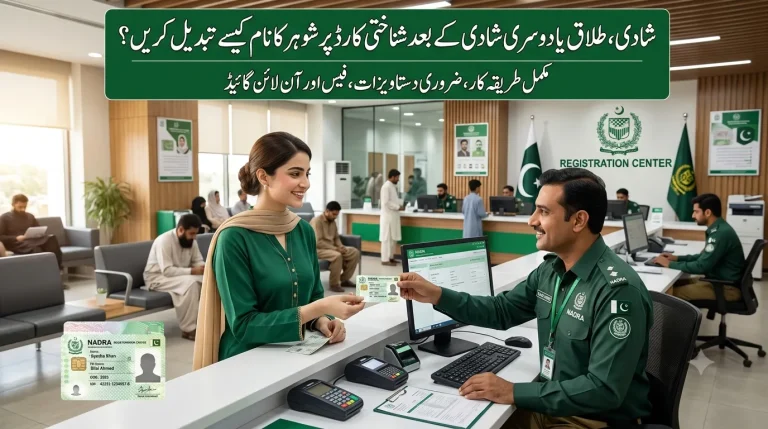
To update your marital status with NADRA after a divorce, visit your nearest NADRA Registration Center with all required supporting documents, including your divorce certificate, divorce registration documents, and any relevant marriage records. NADRA officials will review and verify your documents, identity information, marriage history, and family relationship records before approving the request. Once the verification is complete, NADRA updates your marital status in its database. After the record is updated, all future documents, including your Family Registration Certificate (FRC), will automatically reflect your correct marital status instead of showing your former spouse.
How to Apply for a New Family Registration Certificate After Divorce ?
Once your divorce is successfully processed and your marital status is updated in NADRA’s records, the next move is simple: apply for a new Family Registration Certificate (FRC). This updated document carries the latest information on file, so if everything went through correctly, your ex-spouse should no longer appear under certain family categories on the FRC. You can start this process through NADRA Registration Centers, or applying via Pak Identity services, which are also available for overseas Pakistanis using authorized channels.
From what I’ve seen helping people through this exact situation, the real work isn’t in submitting the request, it’s in what comes after. Always review the generated certificate carefully once it’s issued, since small data-entry slips do happen. Ensure every detail is correct before you rely on this FRC for any official use, because catching an error early saves you a second trip back through the system.
How Divorce Affects Children’s Records in NADRA
A lot of parents worry that once they remove an ex-spouse from FRC, their kids’ details will vanish too. From what I’ve seen while helping families through this, that’s not how it works at all. Divorce does not automatically remove parent-child relationships from NADRA records, even after the former spouse is removed from the marital relationship record. So if you’re staring at your child’s profile after an update and still seeing both names linked, take a breath — nothing has gone wrong on your end.
Here’s the part that actually matters: children born during the marriage will generally remain connected to both parents within the family database, and should not be considered an error. The purpose of family records is to accurately reflect biological and legal family relationships, regardless of marital status changes. Therefore, parents should expect children’s information to continue appearing where applicable — separating from a spouse is one thing, but a child’s lineage on record is a separate matter altogether.
Difference Between FRC by Marriage and FRC by Birth
Before removing an ex-spouse from your record, you need a basic understanding of which certificate type you’re actually dealing with, since this single choice decides whether that name shows up at all. FRC by Marriage is built around relationships established through marriage, so it naturally carries spouse-related information, and this is exactly where an ex-spouse’s appearance depends heavily on record status. FRC by Birth, on the other hand, is based on birth records covering parents, siblings, and children — no marriage angle involved at all, which is why many people are surprised when an ex-spouse simply isn’t part of the picture here in the first place.
From my own experience helping people sort this out, the mix-up usually happens because applicants assume one certificate covers everything, when in reality the result will differ depending entirely on which certificate category is selected at the time of requesting the document. So before you go further, verify with the organization asking for it which exact type is required — that one step alone saves most applicants a second trip back to the counter.
Common Mistakes When Removing an Ex-Spouse from FRC
- Submitting incomplete divorce documents.
- Using an unregistered or unofficial divorce certificate.
- Providing an expired CNIC or other identity documents.
- Applying before your marital status is updated in NADRA’s database.
- Assuming the system updates immediately after the divorce.
- Failing to verify that the divorce is registered with the Union Council.
- Entering incorrect or inconsistent personal information on the application.
- Not carrying all supporting documents during the NADRA visit.
- Requesting a new FRC before completing the marital status update.
- Ignoring follow-up requests from NADRA for additional verification.
Pro Tip: Double-check your documents, confirm your divorce registration, and ensure your marital status has been updated before applying for a new FRC. These simple steps can help you avoid unnecessary processing delays.
How Long Does NADRA Take to Update FRC After Divorce?
NADRA usually updates your Family Registration Certificate (FRC) within a few working days to a couple of weeks after your divorce records and marital status have been successfully updated in its database. The exact processing time depends on the completeness of your documents, any verification requirements, database synchronization, and the workload at the NADRA Registration Center handling your request.
If your application includes missing documents, unregistered divorce records, or requires additional verification, the update may take longer. To avoid unnecessary delays, submit all required documents correctly, keep copies of your paperwork, and regularly check the status of your application until the records are updated.
Expert Tips for a Smooth NADRA FRC Update
Honestly, after handling a few of these cases myself, I can tell you that simple prep work saves people from weeks of back-and-forth at NADRA counters. Before applying, make sure your divorce is officially registered, because nothing slows down the process like an incomplete legal status. Obtain all the required certificates first, and don’t just grab one copy — keep multiple copies of every supporting document, since counters often ask for extras you won’t expect. Take a moment to verify your CNIC information too, as even a small mismatch can stall the entire request.
Once the new FRC is issued, review it carefully rather than tucking it away — I’ve seen people walk away after issuance without checking, only to realize a detail was missed. If something looks off or records remain unchanged, follow up with NADRA directly instead of waiting it out. These small steps make the whole update easier and genuinely prevent common complications down the line, keeping your record clean and accurate from start to finish.
Final Thoughts
Removing an ex-spouse from your Family Registration Certificate after divorce is generally possible, but it requires proper record updates within NADRA’s system. The most important step is ensuring that your divorce has been legally registered and reflected in the national database.
Once your marital status is updated and supporting documents are verified, NADRA can issue an updated Family Registration Certificate that accurately reflects your current family situation. By understanding the process, preparing the required documents, and following the correct procedures, you can avoid unnecessary delays and ensure your family records remain accurate in 2026 and beyond.




One Comment