
Birth Certificate Pakistan — NADRA and Union Council 2026
Few Pakistanis realize that their birth certificate is not merely a piece of paper it is the first official identity record that determines every legal interaction a citizen will have with the state. Having worked closely with families navigating NADRA and Union Council procedures across Karachi, Lahore, Islamabad, Faisalabad, and Quetta, I’ve seen firsthand how the absence of this single official document creates cascading failures: inability to apply for a passport, blocked visa processing, complications in school admissions, and even inability to claim rightful inheritance or property. What surprises most people is that the Birth Registration Certificate commonly called the CRC and the traditional UC-issued certificate are reliant on each other, yet many confuse which authority does what. The Union Council issues the birth certificate, while NADRA uses that birth record to generate the B-Form and Child Registration Certificate. This distinction matters enormously when you’re dealing with embassies, immigration authorities, or foreign governments in the UAE, KSA, UK, Canada, or USA.
What most guides won’t tell you is that late registration is far more common than officially acknowledged countless Pakistanis, particularly women and residents of smaller localities, were simply never registered after birth. The process has evolved significantly: previously, union councils issued certificates on special papers through an offline system, but NADRA has now upgraded its software so that all union councils operate online, issuing computerized birth certificates on plain A4 size papers after receiving online approval from NADRA Islamabad. This shift has made verification faster and certificates more accepted internationally. Whether you’re pursuing education, a work permit, family visa, residency, or child registration abroad, understanding that your legal identity begins with correctly registering at your local Union Council — and that errors in spellings, incorrect birth dates, or missing documents at this stage can affect your CRC, delay your CNIC issuance, and cause serious passport issues is the foundational awareness every Pakistani family needs in 2026.
What is a Birth Certificate in Pakistan?
The birth certificate in Pakistan is far more than a formality it is the foundation of every legal identity a person will ever build. From the moment a child enters the world, this official document begins recording the birth details that will follow them through education, travel, government services, and beyond. It certifies the individual’s date of birth, place of birth, parent information, and full name of applicants creating what becomes the most important and vital record in a Pakistani citizen’s life. Having personally guided families through this process, I’ve seen how a single missing detail at registration creates years of complications. The Government of Pakistan verifies these details through a layered system where the Union Council captures and records information, while NADRA absorbs it into the national database. Completing all NADRA birth certificate requirements correctly from the very beginning is not optional it is the difference between seamless access to services and a lifetime of bureaucratic struggle.
What surprises many people is how this single document determines nationality, age, eligibility, and the ability to interact with virtually every state institution. Without it, families cannot access CNIC issuance, school enrollment, or passport applications. The data recorded here name, date of birth, place of birth, and parent’s detail feeds directly into NADRA’s systems for generating the B-Form and Child Registration Certificate. It is not merely a registration exercise; it is the act of bringing a human being into the legal existence of the state. Whether you are living in a major city or a remote area, whether the birth happened in a hospital or at home, the obligation and the urgency remain identical: register, document, and protect this record with the same care you would give any irreplaceable possession.
Why is a Birth Certificate Important?
Most people only discover the true weight of a birth certificate when they are standing at a counter passport office, embassy, university admission desk and realizing they cannot move forward without it. This record is required for applying to virtually every formal system in Pakistan and abroad. I have personally seen cases where families lost months of time simply because they had never understood that getting a B-Form, enrolling a child in school, or processing a visa all trace back to this one foundational document. The absence of it makes what should be routine tasks difficult, sometimes impossible, and always stressful. For every citizen of Pakistan, the common reasons to need this certificate span the full arc of life from educational institutions at the domestic level to international immigration systems that will not move without verified Pakistani identity documents.
The practical consequences are stark and well-documented. Without a valid birth certificate, you cannot get admission to a university, cannot get married abroad, cannot register your children’s foreign birth with Pakistani authorities, and cannot access critical government services across a lifetime. For overseas Pakistanis pursuing residency in countries like the UAE, KSA, UK, Canada, or USA, an authenticated copy verified through proper channels is not a recommendation it is a hard requirement. Legal identity verification through this document also governs court proceedings involving name correction, inheritance disputes, and property transfers. The problems compound with delay: families who approach this as something they will handle “later” consistently find that later becomes infinitely more complicated. Registering immediately after birth is the single most important administrative act a parent can perform for their child in 2026.
Who Issues Birth Certificates in Pakistan?
There is a widespread misconception that NADRA directly issues the birth certificate in Pakistan. In reality, birth certificate registrations across Pakistan are administered by local government agencies specifically Union Councils, Municipal Committees, and Cantonment Boards and the responsible office depends entirely on birth location. The CDA and TMA office handle their respective jurisdictions, while the Cantonment Board covers cantonment areas. NADRA developed the system and software that powers these registrations and maintains the national database, but the issuance itself flows through local government. This distinction is not merely technical it determines where you go, what you submit, and who has the authority to correct errors. In cities across Pakistan, these offices are now fully authorized to issue certificates through NADRA’s linked platform, making the process more traceable and consistent than it has ever been.
What has changed significantly is the technical infrastructure behind issuance. NADRA representatives worked with local government systems across Pakistan to transition all union councils from an offline model where certificates were printed on special papers supplied by NADRA to a fully online framework. Today, after the upgraded software rollout, all union councils generate certificates after online approval from NADRA Islamabad, with no need for those special papers anymore. This shift means greater accountability and easier verification for immigration purposes. For residents of Karachi, birth registrations flow through respective Union Committees within the city’s local government system. The important document that emerges from this process whether you call it the English Computerized NADRA Birth Certificate or the official digital birth certificate is the NADRA-linked output of a civil registration system that has been decades in the making and is now, in 2026, closer to full national digitization than at any point in Pakistan’s history.
Difference Between NADRA and Union Council Birth Certificate
The confusion between a Union Council birth certificate and a NADRA certificate is one of the most commonly referred misunderstandings I encounter when helping families navigate Pakistani identity documentation. Understanding the Authority and Role of each is essential. Technically, NADRA does not directly issue the traditional birth certificate that most people picture the actual document recording the birth event is issued by the Union Council. What NADRA does is use that birth record for family registration, record verification, and to generate the B-Form and CRC through its systems. The information captured and recorded by Birth Registrars at the Union Council level feeds upward into NADRA’s national database, creating the link between local registration and national identity.
What makes this relationship even more nuanced is that both certificates are deeply reliant on each other in practice. When you apply for a B-Form or Child Registration Certificate, NADRA cross-references the Union Council registration data. If there are discrepancies wrong spellings, mismatched dates, or incorrect parent details between the two records the entire process stalls. This is why experts consistently advise families to register their child at the Union Council as soon as possible after birth, before applying for any NADRA document. The term “NADRA birth certificate” that circulates widely is technically referring to the Birth Registration Certificate associated with NADRA’s system, but its roots are firmly in Union Council registration. Treating them as interchangeable is a mistake that causes real, measurable delays in obtaining every subsequent identity document a Pakistani citizen will ever need.
Documents Required for Birth Certificate
Walking into a Union Council office without the right documents is one of the most common reasons families leave empty-handed sometimes multiple times. The core requirement is the birth slip issued by the hospital, but the full documentation picture is more layered than most people expect. You will need CNIC copies of both parents, a vaccination card where available, a properly filled application form, the Nikah Nama for parental verification, and for children who already have one the child’s existing B-Form. If you have an old, manual birth certificate, bring it. If a NICOP is available instead of a standard CNIC, that is also accepted. The critical rule is that all details must match across documents even a slight variation in spelling will cause delays that could have been avoided entirely.
The application form itself requires a detailed breakdown of birth circumstances: the sex of child male or female the exact date and hour of birth, the name of the clinic, hospital, doctor, or midwife who attended the delivery, and an attested photocopy of supporting records. The address of the mother, her religion, caste, and nationality, alongside the father’s place of residence, occupation, profession, and the name and address of the person making report, must all be documented with the date of report. For digital or online applications, you will need a copy of the NICOP or CNIC, the hospital birth record if available, and an old birth certificate or passport copy if the child is being registered late. If none of these exist, a copy of the grandfather’s CNIC or NICOP can serve as supporting documents for delayed registration cases a provision that has helped many families with incomplete record histories finally complete this long-overdue process.
How to Apply for a Birth Certificate
The application process is more navigable than its reputation suggests, provided you approach it with complete preparation. The first step is to register birth by visiting the relevant Union Council for the area where the child was born jurisdiction matters enormously here, and applying at the wrong office will result in rejection. Once there, submit required documents, provide all necessary proof, and allow the authorities to verify the submitted information before certificate issuance proceeds. For those applying through the ICT Islamabad process, the steps are more structured: complete your documents, download the application form, fill it properly, and visit the Citizen Facilitation Center at the Mauve Area, G-11/4 in Islamabad for documents submission, after which you receive a date and time for collection. Once the application is sent to NADRA with completed documentation, a digitally generated certificate is printed and issued with a tracking number.
For parent or guardian applicants navigating the Karachi Union Council process, the sequence involves confirming jurisdiction, submitting the application form along with all required documents, and then passing through the verification process covering parent identity, birth details, hospital records, and residence. Fee payment follows verification, and the certificate is issued with an official UC seal. Where a birth was not registered previously, documented evidence typically an affidavit is required to support the application. The authority then reviews and validates all information before issuing the certificate. Cases involving further verification required follow a longer timeline, but once all procedural steps are followed, issuance can be fast-tracked when documentation is complete and consistent. The most important thing I tell families: never go unprepared, because a single missing document resets the entire clock.
Birth Certificate Fee and Processing Time
One of the most practical questions families ask is simply: how much does this cost and how long will it take? The fee stands at approximately PKR 200 for standard registration, though the processing fee can range from Rs. 200 to Rs. 1500 depending on the age of child and the nature of the application. Fees vary across different locations, so always confirm with your specific office. Processing time under the normal track runs 7 working days or 5–7 working days depending on the city, while urgent applications are typically completed within 1–3 days. Service hours run Monday through Friday, 09:00 AM to 09:00 PM at the Citizen Facilitation Center location in Islamabad. The fee ultimately depends on your city, the age of the applicant, and the completeness of your documents factors that make it worth calling ahead to confirm exact costs before visiting.
Online Birth Certificate Application
Pakistan’s digitalization journey has made the process of acquiring and verifying a birth certificate significantly simpler in 2026, but the reality on the ground is more uneven than official narratives suggest. Online services are available in some areas, driven by digitization initiatives across provinces, but not all districts fully support online applications. In many cases, families still require physical submission for at least part of the process, so always confirm availability in your local area before planning around a fully remote experience. Cities with more developed infrastructure offer partial online processing through provincial portals, with final issuance still handled by local authorities. The online service for birth certificate applications in Pakistan is now available in many areas through e-governance initiatives that genuinely require very little time compared to standing in queues at government offices.
For digital services already available in some regions of Pakistan, it is worth confirming the availability of a digital submission service in your specific district prior to applying. Areas across Pakistan are gradually introducing online municipal services, though many Karachi Union Councils still require physical visits for complete verification and document submission. The hybrid model where initial applications are submitted online but verification and pickup remain in-person is likely to remain the standard for most of Pakistan through the near term. My practical recommendation: use online channels where available to reduce trips, but always have physical copies of every document ready regardless.
Late Registration of Birth Certificate
Late registration is not an edge case in Pakistan it is the daily reality of millions of families, and the process in 2026 has specific pathways built around this reality. The critical timeline works as follows: within 60 days of birth, the normal process applies with no additional burden. After 60 days, additional verification required comes into play. After 7 years, court approval may be required, and the complexity increases substantially with delay. For the late birth certificate application process, the documents needed include an affidavit from both parents or the applicant, B-Form copies of parents where available, school records, vaccination record, and if there is no hospital record, a utility bill, lease agreement, or NADRA Family Registration Certificate (FRC) as proof of identity and residence. A written application explaining the cause of delay must accompany the submission to the focal point area Union Council office.
In cities like Lahore, Karachi, Rawalpindi, and others with NADRA-linked Union Councils offering computerized birth certificates, overseas Pakistanis can have their documents applied through a Power of Attorney so that someone in Pakistan manages the processing while they remain overseas. The processing time for a late certificate through the manual birth certificate route runs 3–5 working days, while MOFA and Embassy Attestation adds another 7–14 working days on top. Where no hospital or school record exists, a sworn affidavit from both parents or guardian, supported by a school admission record, vaccination card, NADRA FRC confirming family relationship, and statements from a witness or neighbor who can attest the birth particulars, form the evidentiary backbone of the application. Delayed registration in Karachi specifically often requires an affidavit and in some cases a court order. Bringing school documents, vaccination records, and witness statements together in a single complete package makes the process significantly smoother, though it inevitably gets stricter as age increases.
Common Problems and How to Fix Them
The largest cause of delay in birth certificate processing is not bureaucratic slowness it is applicants providing inaccurate data. Incorrect spelling of names, incorrect date entries, and failure to provide complete parent information account for the overwhelming primary reason why families make multiple trips to the same Union Council without resolution. Common problems include wrong spellings in names and dates that often contain errors carried forward from hospital slips, so always check carefully before submission. Jurisdiction issues applying at the wrong Union Council lead to immediate rejection, and missing hospital records in older cases sometimes lack proper documentation entirely, requiring affidavits and occasionally court involvement to resolve. Delayed registration complications consistently require legal support, and seeking legal advice early rather than after repeated rejections saves considerable time and money.
The practical solutions are straightforward once you know them. Submit a thorough affidavit to correct records before applying if you know there are discrepancies. Verify all information carefully against existing NADRA records before submission the spellings must match precisely. Keep multiple CNIC copies ready at all times, verify your Union Council jurisdiction first, and submit complete documentation in a single visit rather than piecemeal. Apply early for newborn registration the window closes faster than most parents expect, and the complications that follow are entirely avoidable with timely action. For common issues involving wrong date of birth or missing documents, the tips experienced practitioners consistently offer come down to one principle: preparation eliminates problems that no amount of follow-up can easily fix once they enter the system.
Birth Certificate for Overseas Use — Attestation and Verification
For Pakistanis living or intending to live, work, or settle in another country, a birth certificate that has not been through the proper attestation chain is essentially non-functional. Visa applications, immigration processing, and embassy verification across Saudi Arabia, Qatar, Kuwait, the UAE, and KSA all require documents that have been attested and verified through a specific sequence. The issuing authority your Union Council or Municipal Corporation Office is the first step, followed by MOFA attestation through the Ministry of Foreign Affairs of Pakistan, and then embassy verification or legalization by the relevant embassies in Pakistan. Notary Public or First Class Magistrate attestation may also be required depending on the destination country. A translation into the required language Arabic or English is compulsory for individuals intending to move to foreign countries for education, family reunion, or employment.
Overseas Pakistanis without birth certificate documentation face a particularly difficult path. The recommended approach is to file application at your home Union Council, draft the required affidavits, collect evidence from hospital or school records, complete MOFA attestation, and then complete embassy verification for the UAE, KSA, or whichever destination applies before you attempt to deliver documents to the receiving country. Services that assist with attestation from Notary Public preparation through Saudi Embassy, Qatar Embassy, and UAE Embassy submission exist specifically because this chain is easy to break at any link. The attestation process performed through local Union Council, Ministry of Foreign Affairs, and relevant embassies in Pakistan signifies that the birth certificate was issued by an authorized source. Without an attested copy, any application to live or work in another country will be immediately dismissed a hard lesson that is far better learned before departure than after arrival.
Duplicate Birth Certificate — Lost Certificate
Losing a birth certificate is more common than people admit, and the recovery process is more straightforward than most fear. If you previously had a birth certificate and have now lost the original, the path to an attested copy begins at the issuing Union Council where the registration was first recorded. Apply for a duplicate copy by providing your CNIC or NICOP, parents’ details, and any supporting records the office requests, then submit the application for re-issuance and wait approximately 3–5 days for processing. Once received, the duplicate birth certificate can be taken through the same MOFA and Embassy attestation processes as any new one the process and requirements are identical whether you are obtaining a first-time certificate or replacing a lost document. The important thing is to act promptly rather than continuing to operate without it, since the absence of this document creates compounding problems the longer it goes unaddressed.
NADRA New Rules — Date of Birth Changes (2026)
NADRA has issued fresh instructions in 2026 that significantly tighten the rules around correction and change of date of birth on official documents. Under the rules introduced in coordination with the Government of Punjab, any change or correction to the date of birth as recorded in a birth certificate can only be made through an order from a competent court. The relevant Union Council, Cantonment Board, or Municipal Corporation must receive this legal requirement in writing before NADRA will process any requests to change or correct the date of birth on a Computerized National Identity Card, NICOP, Child Registration Certificate, or Juvenile Card. The applicant must submit a formal court order along with a verified, computerized birth registration certificate to initiate the correction process.
NADRA New Policy — CNIC Without Birth Certificate (2026)
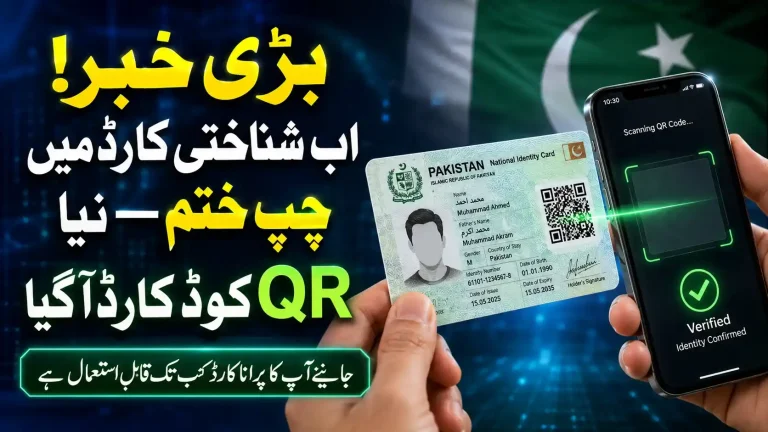
In a significant policy shift, NADRA has introduced a conditional facility for eligible citizens to obtain a Computerized National Identity Card even if they do not possess a computerized birth certificate issued by local governments. This comes in the context of NADRA having registered approximately 98.3 percent of the adult population, leaving 1.7 percent of adults who remain without identity cards a large proportion of whom are unregistered individuals, particularly women. This facility will remain effective until December 31, 2026, during which time applicants without birth certificates may obtain identity cards after completing strict verification, including biometric confirmation from registered close family members. Married women aged 18 or above must provide a valid marriage certificate, the computerized identity card of one parent, their husband’s identity card, and biometric verification of one parent or husband. Unmarried women aged 18 or above must present one parent’s identity card and biometric verification of that parent to complete the process.
Union Council Areas in Karachi
Karachi operates across multiple Union Councils covering distinct areas including Gulshan-e-Iqbal, North Nazimabad, DHA, Clifton, Korangi, Malir, Saddar, and Gulistan-e-Johar. Always confirm your jurisdiction before applying — submitting at the wrong Union Council is one of the most avoidable causes of delay in the city.
Computerized Birth Certificate Karachi
Many Union Councils across Karachi now issue computerized birth certificates that are significantly easier to verify, better suited for immigration purposes, linked to official government records, and consistently preferred over handwritten documents by foreign authorities and embassies.
Territorial Authority for Issuing Birth Certificates
Birth certificate registrations across Pakistan are administered by local government agencies including Municipal Committees, with the responsible office depending on where the birth occurred. Digitalization has improved the ability to process registrations for individuals living in or born in larger cities, though misspelled names and incorrect birth dates continue to cause future complications when applying for NADRA documents or pursuing overseas attestation.

One Comment