
Pakistan Embassy NADRA Biometric Services Abroad – Complete Guide 2026
Almost every NADRA service ends at the same step: proving that you are really you. For a NICOP, a Pakistan Origin Card or a Family Registration Certificate, NADRA records your fingerprints, photograph and signature, and matches them against the national database. In Pakistan you do this at a NADRA Registration Centre. Abroad, the question follows: can a Pakistani embassy or consulate take your biometrics, and what happens there?
The honest answer is that it depends on the mission. Some embassies run a full NADRA Registration Centre or a dedicated NADRA counter where trained staff capture your biometrics on the spot. Some run only a NADRA Facilitation Desk that helps you complete an online application. A few do not process NADRA applications at all and send everyone to the Pak ID app instead. This guide explains all three models from official mission websites, the services that need capture, the documents to carry, the fees and times real missions publish, and the mistakes that waste a journey.
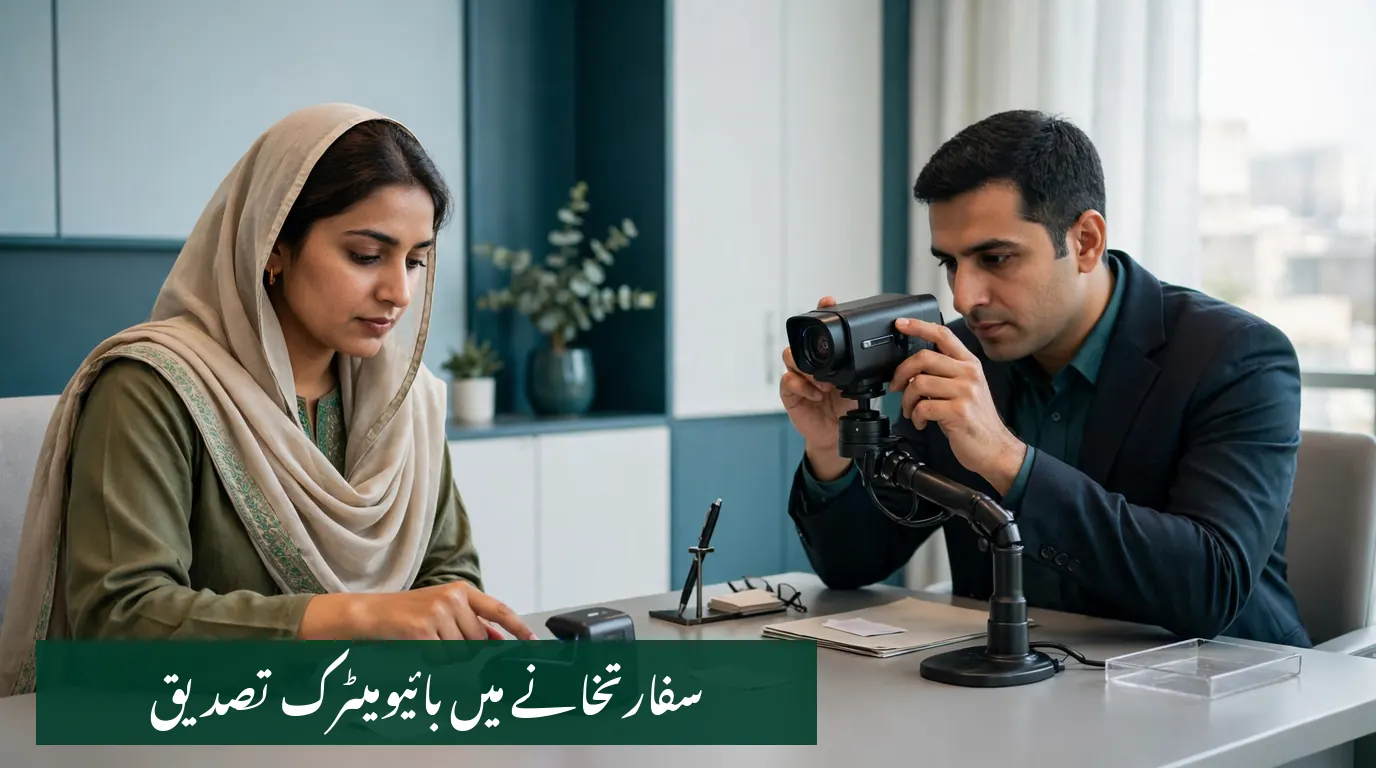
What Are NADRA Biometric Services at Embassies Abroad?
NADRA biometric services abroad means the capture of your fingerprints, live photo and signature by NADRA or by a Pakistani mission acting for NADRA, inside an embassy, high commission or consulate in your country of residence. The captured data enters the same NADRA system used in Pakistan, so an application processed at a mission is a real NADRA application, not a local substitute.
Biometrics are the point where an application becomes personal. Forms can be filled by anyone and documents can be copied, but personal appearance for biometric capture ties the application to a living person standing in front of an officer. That is why first time applications, and most changes to an existing record, cannot be completed on paper alone.
The Three Ways Pakistani Missions Handle NADRA Biometrics
Before you travel to any mission, work out which of the three models it follows, because the model decides whether your fingerprints can be taken there at all.
| Mission Model | What Happens There | Official Examples |
| Full NADRA Registration Centre or NADRA counter | Your photograph, fingerprints and signature are captured, your data is entered and your form is printed for review at the mission itself | Embassy of Pakistan in Doha; NADRA offices under the Pakistan High Commission in London and its consulates in Manchester, Birmingham and Bradford; the Consulate General in Toronto |
| NADRA Facilitation Desk | The application is submitted online through Pak ID; the desk helps applicants who are stuck with online processing, and some desks also take biometrics for succession cases | Embassy of Pakistan in Washington DC and the Consulate General in Houston, where NADRA keeps no permanent office and the desk works by appointment only |
| Online only, no NADRA processing | The mission does not accept or process NADRA applications and cannot give status updates; you apply through the Pak Identity portal and documents are dispatched to your home | Consulate General of Pakistan in Sydney, which states this plainly in its own FAQ |
The network is still growing. In a NADRA announcement of October 2025, the authority confirmed that NADRA counters had become operational at Pakistani embassies in Montreal and Vancouver in Canada, Milan in Italy, Manama in Bahrain and Amman in Jordan, with a Rome counter announced as coming soon, and it already operated centres in Dubai and Abu Dhabi. Because arrangements change, always confirm your mission’s current model on its official website before you travel.
Which Services Need Biometric Capture at a Mission?
At a full centre or counter, the biometric step sits inside these services:
- Smart NICOP issuance for a first card, whether you were born in Pakistan or abroad. Our complete NICOP guide explains the card in detail.
- Smart NICOP renewal, modification and reprint or duplicate of a lost card, all listed as counter services at the Doha centre.
- Pakistan Origin Card (POC) applications, which missions such as Washington and Los Angeles process alongside NICOP. See our Pakistan Origin Card guide for eligibility.
- Family Registration Certificate (FRC) issuance, including the fingerprint form Doha requires for FRC applications.
- Biometric verification for Succession Certificates, where legal heirs living abroad give biometrics at a consulate for a case that was initiated in Pakistan.
- DUP clearance and similar record corrections at centres listing them.
Two supporting rules matter as much as the service list. First, a mission may require a blood relative to be physically present for a fresh application: Toronto asks first time applicants to bring a father, mother or sibling holding a NICOP or CNIC, and Doha allows a parent or sibling to appear for biometric verification in support of the application. Second, children are not exempt by default: Los Angeles states that biometric capture is mandatory for children aged 10 years and above, while for infants under 18 months a recent digital photo is acceptable and the baby’s presence is not mandatory.
How to Give Biometrics at an Embassy or Consulate: Step by Step
The sequence below combines the published procedure of the Doha Registration Centre with the appointment system described by the Pakistan High Commission in London. Missions vary in detail, but the shape of the visit is the same almost everywhere.
Step 1: Confirm the Mission’s Model and Book an Appointment
Check the mission’s official website, confirm it captures biometrics, then book through its online Appointment Management System where one exists. London states plainly that NADRA staff cannot serve walk-in applicants without an appointment, Los Angeles and Washington work by appointment only, and Dubai’s NADRA section is strictly on a prior appointment basis. If your mission is a facilitation desk, start the application online first and take your login credentials with you, as Houston asks.
Step 2: Take a Token and Submit the Fee
At the Doha centre the visit begins with an NRC token and fee submission; the fee is collected by debit card or credit card only and the receipt is valid for the same day only. Payment methods differ by mission: Los Angeles takes the NADRA fee by credit card or Visa Debit and the consulate’s own fee by money order or cashier’s check, while Washington collects fees online by card and adds an embassy service charge of US$26 per application. Almost every mission states that fees are non-refundable, so confirm the service and category before you pay.
Step 3: Photograph, Fingerprints and Signature Are Captured
This is the biometric step itself. London describes it in one line: your biometrics and photograph are captured by trained staff. Doha’s published order is photograph first, then your fingerprints and signature are taken. Los Angeles calls it live photo and biometric capture and makes personal appearance mandatory for it. There is no postal or representative substitute; the person whose record is being created or changed must stand at the counter.
Step 4: Data Entry and Form Review
Your required data entry is done at the counter and the application form is printed for you to review, as at Doha. Read every spelling and date before you sign: the printed form is your chance to catch an error while correction costs nothing.
Step 5: Attestation and Form Submission
The final counter step is attestation and form submission with your supporting documents. Some applications also need people behind them: Los Angeles and Washington both require two references or verifiers, with name, CNIC or NICOP number and contact number. Verifiers cannot be your parents, children, spouse or siblings, although their physical presence is not required. After submission, your card is processed by NADRA and delivered in the category you paid for.
Documents to Bring for Biometric Capture
Missions publish slightly different lists, but the core set below is what the London, Los Angeles, Washington and Toronto pages ask for. Carry originals, plus copies where the mission asks for them.
- Your existing NICOP or CNIC, or your manual NIC if that is what you hold.
- Your Pakistani passport, valid or expired, and your foreign passport or proof of legal status abroad (residence permit, PR card, work or study permit).
- Birth certificate showing both parents’ names for a fresh application; the S-1 Form for a child born abroad where the mission asks for it; matriculation certificate where relevant.
- Parents’ CNIC or NICOP and, if married, your spouse’s CNIC or NICOP with a marriage certificate; divorce or death certificates where they apply.
- Siblings’ CNIC or NICOP copies if the parents’ cards are not available.
- Details of your two verifiers: copies of their CNIC or NICOP and their contact numbers.
- For a reprint of a lost card, a copy or the number of the lost card, as Doha requires.
One London rule catches many families out: to process any NADRA card, the parents’ and spouse’s NADRA cards must be valid. If a parent’s or spouse’s card has expired, it must be renewed first, and if a parent or spouse has died, that card is cancelled first, for which a death certificate is mandatory. Before you travel to update your NADRA record from abroad, check the validity of the family cards your application depends on.

NADRA Mobile Registration Teams: Biometrics That Come to You
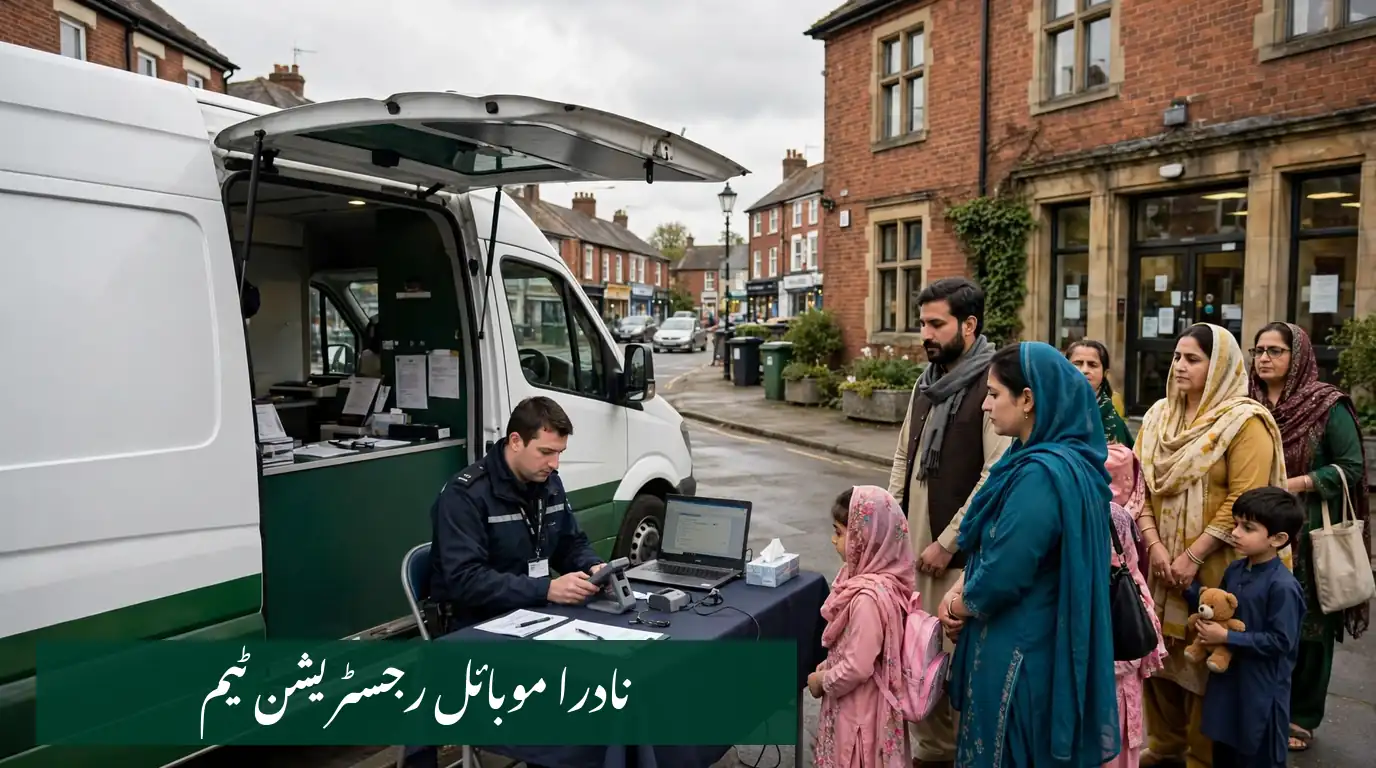
If you live far from any mission, watch for the NADRA Mobile Registration Team, known as the MRT. The Pakistan High Commission in London explains that Mobile Registration Teams provide NADRA services to Pakistanis living in far-flung areas under the jurisdiction of the High Commission and its consulates, and that the facility also helps old and disabled applicants who cannot easily visit NADRA offices. The High Commission publishes an MRT visit schedule and a route to request a visit in your area.
The pattern is not limited to the UK. NADRA announced a Mobile Registration Team visit, together with the Pakistan Embassy team, to Dhahran in Saudi Arabia, at Tamimi New Camp on 7 and 8 November from 9 AM to 3 PM, offering new identity cards, changes and renewal. An MRT visit gives you the full counter service, including biometric capture, without the journey to the mission, but visits are occasional and announced in advance, so follow your mission’s official announcements and arrive exactly as the announcement directs.
Fees and Processing Time: Two Published Examples
There is no single worldwide mission fee. Each mission publishes its own table in local currency, under the familiar Normal, Urgent and Executive categories. The two tables below come from official mission pages, as examples of the shape of the charges before you check your own mission’s current table.
| Embassy of Pakistan, Doha (Qatar): Smart NICOP | Fee (QR) | Delivery Time |
| New, modification, duplicate or renewal, Normal | 75 | 30 days |
| New, modification, duplicate or renewal, Urgent | 110 | 20 days |
| New, modification, duplicate or renewal, Executive | 150 | 7 days |
Doha adds a bank fee of QR 3 per transaction, and charges QAR 40 for an FRC. The London table for a new Smart NICOP reads differently because it is a different country and currency:
| Pakistan High Commission, London: New Smart NICOP | Fee | Delivery Time |
| Normal | £51.50 | 6 to 8 weeks |
| Urgent | £64.50 | 4 to 5 weeks |
| Executive | £79.50 | 2 weeks |
Los Angeles publishes delivery times for a new Smart NICOP of six weeks Normal, four weeks Urgent and two weeks Executive. Treat every figure here as an example from the named mission: fees and times change, and the only table that governs your application is the one on your own mission’s website or the Pak ID portal.
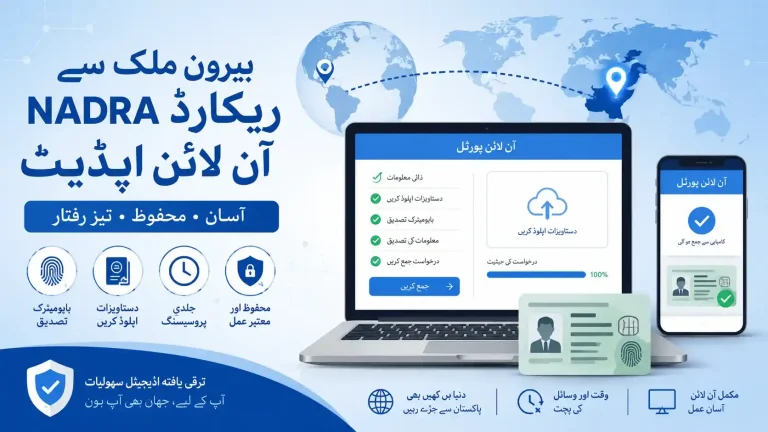
The Alternative: Biometric Verification Through the Pak ID App
Not every biometric step needs a building. The Pak ID mobile app and the Pak Identity portal at id.nadra.gov.pk are built for overseas applicants, and the Los Angeles consulate’s Pak Identity page notes that even fingerprints and documents can be uploaded via the Pak Identity Mobile App. In its October 2026 clarification, NADRA confirmed that overseas Pakistanis can apply for a first NICOP through the Pak ID app, providing personal and family details, uploading documents, completing biometric verification and paying the fee inside the process, then track the application in the app.
The app route is also spreading beyond identity cards: in September 2026 the Pakistan Single Window integrated with the PakID app so its users, including overseas Pakistanis in trade, could complete biometric verification remotely through the app instead of visiting a NADRA e-Sahulat centre. Two honest limits apply. First, NADRA may request additional documents or an in-person visit if online verification is unsuccessful, so the app does not guarantee that no visit will ever be needed. Second, facilitation desks exist precisely for the cases the app cannot finish, which is why Washington and Houston ask stuck applicants to bring their login credentials to an appointment.
Succession Certificate Biometrics for Legal Heirs Abroad
One biometric service abroad exists only because of a process back home. A Succession Certificate is applied for in Pakistan, but a legal heir living overseas cannot fly back just to prove identity. Missions therefore offer biometric verification for succession cases as a standalone service: Washington lists it among its facilitation desk services, Houston publishes its requirements, and Los Angeles gives it a dedicated section.
The pattern is consistent. The succession application must be initiated in Pakistan first. The heir then books an appointment at the consulate and attends with the required documents: Los Angeles asks for the Family Registration Certificate and the deceased’s death certificate, and requires that all legal heirs named on the application attend with their valid original ID cards; Houston asks for the heir’s NICOP or CNIC and the Succession Certificate application Tracking ID. Our guide to a NICOP application pending explains how NADRA applications move through their stages while you wait.
Common Problems and Solutions
| Problem | What Is Actually Happening | Solution |
| Your embassy says it cannot take your biometrics | Your mission follows the online only model and does not process NADRA applications, as Sydney states openly | Apply through the Pak ID app or portal instead, and use NADRA channels for status updates |
| Your online application is stuck and the consulate will not process a fresh one | A pending application on the Pak-Identity app blocks consulate processing; Vancouver states this rule explicitly | Cancel the previous application on the app first, then book the consulate appointment |
| You reached the mission without an appointment | Most NADRA counters and desks abroad are appointment only, and London states walk-in applicants cannot be served | Book through the mission’s appointment system and attend at the booked time with your documents and login credentials if your case began online |
| Your application is refused because a parent’s or spouse’s card has expired | London requires the parents’ and spouse’s NADRA cards to be valid before any card is processed | Renew the expired family card first; if the relative has died, arrange cancellation of that card with the death certificate |
| An agent offers to arrange your NADRA work for a fee | NADRA has clarified that it has no authorized consultants, agents or dealers, and such offers are a known fraud pattern against overseas Pakistanis | Use only the Pak ID app, official websites ending in gov.pk, a NADRA centre or an embassy counter, and report fraud through NADRA’s complaint channels |
Common Mistakes to Avoid
Assuming Every Embassy Has a NADRA Counter
The most expensive mistake is travelling to a mission that never offered the service. The three models in this guide exist side by side, sometimes in neighbouring countries. Read your mission’s NADRA page first, and if it describes a facilitation desk or online only processing, plan for the Pak ID route instead.
Leaving a Stuck Online Application Open
A half finished application feels harmless, but it can block the consulate from processing your case at all. If a counter agrees to take your application, clear the pending online one first, exactly as the Vancouver consulate instructs.
Paying an Agent Who Claims NADRA Links
NADRA’s own clarification could not be clearer: there are no authorized consultants, agents or dealers. Anyone charging you to submit an application or arrange biometrics is taking money for a service that is either free to do yourself or impossible for them to deliver, and collecting your personal data in the process.
Forgetting the Family Cards Behind Your Application
Your own documents can be perfect and the application can still stop, because a parent’s or spouse’s card is expired or a deceased relative’s card was never cancelled. Check the family records your application depends on before you book.
Quick Checklist Before You Visit a Mission
- Confirmed on the mission’s official website that it captures biometrics, and which model it follows
- Appointment booked through the mission’s appointment system
- Original NICOP or CNIC, Pakistani passport and proof of legal status abroad
- Parents’ and spouse’s cards checked for validity, with marriage, divorce or death certificates where they apply
- Birth certificate or S-1 Form for a fresh application or a child
- Names, ID numbers and contact numbers of two verifiers who are not close family
- Login credentials of your Pak ID account if your application began online, and any stuck application cancelled first
- A payment card the mission accepts, knowing that fees are generally non-refundable
Final Words
NADRA biometric services abroad are real and expanding, from the full Registration Centre inside the embassy in Doha and the NADRA offices under the London High Commission to the new counters NADRA announced for Canada, Italy, Bahrain and Jordan. But they are not uniform.
Your mission might capture your fingerprints at a counter, help you finish an online application at a facilitation desk, host a Mobile Registration Team visit in your city, or send you to the Pak ID app because it processes nothing itself. Ten minutes on your mission’s official website, checking which position applies, is the difference between a completed application and a wasted journey. And whatever route you take, use official channels only: NADRA has no agents, and your fingerprints and family data are worth far more than any shortcut promises.
Official Sources
- Pak Identity, NADRA (online applications, Pak ID app and application tracking)
- NADRA services, Pakistan High Commission London (NADRA offices, appointments, Mobile Registration Teams, fees)
- NADRA services, Consulate General of Pakistan, Los Angeles (biometric capture rules, succession biometrics, processing times)
- NADRA Services, Embassy of Pakistan, Doha, and NADRA Facilitation Desk, Embassy of Pakistan, Washington DC (Ministry of Foreign Affairs, mofa.gov.pk)
- NADRA counter announcement, October 2025, and NADRA clarification on unauthorized agents, October 2026 (NADRA, nadra.gov.pk)


One Comment