Khula vs Talaq in Pakistan 2026
Khula and Talaq are two different ways through which a Muslim marriage may come to an end in Pakistan. Although both can result in the termination of a marriage, they differ in who initiates the process, the legal procedure, the role of the Family Court or Union Council, the treatment of Haq Mehr, reconciliation requirements and the documentation issued after dissolution.
For people searching for Khula vs Talaq in Pakistan, Khula procedure, Talaq procedure, Khula certificate, divorce certificate, NADRA divorce update, Haq Mehr after Khula or Talaq and Iddat after divorce, understanding these distinctions is important.
Pakistan’s legal framework includes the Muslim Family Laws Ordinance, 1961, the Dissolution of Muslim Marriages Act, 1939, and the Family Courts Act, 1964, together with applicable provincial rules and court decisions. The exact procedure can also depend on whether the matter involves a Union Council, Family Court, overseas Pakistani, delegated divorce or another form of dissolution.
Important: This article is for general information about Pakistani family law. It is not a substitute for advice from a qualified family lawyer or the relevant Family Court, Union Council or local government authority.
Khula and Talaq: What Is the Difference?
The simplest distinction is that Talaq is a divorce pronounced by the husband, while Khula is a form of dissolution sought by the wife through the legal process, normally involving the Family Court.
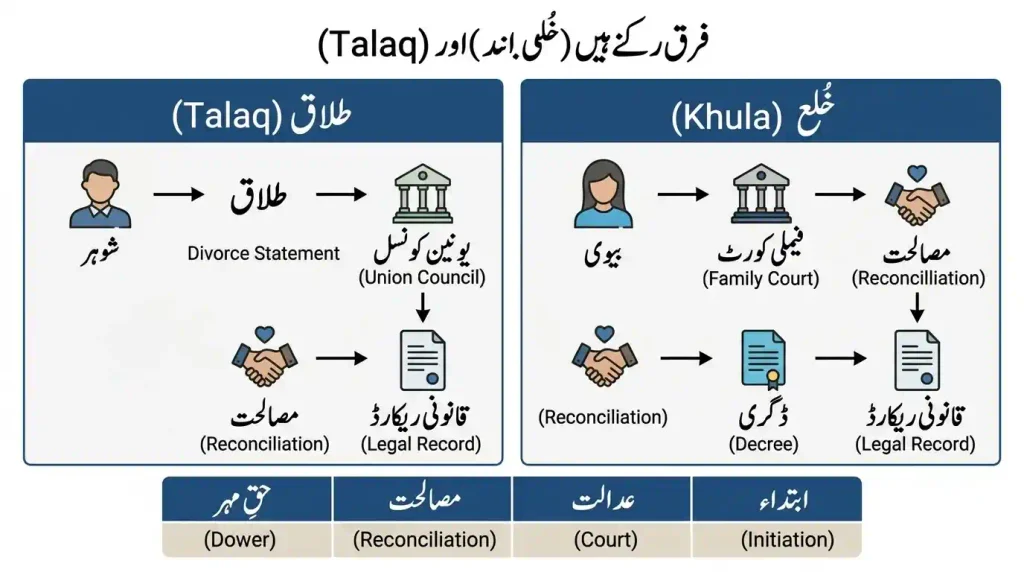
| Point | Talaq | Khula |
| Usually initiated by | Husband | Wife |
| Basic nature | Husband’s pronouncement of divorce | Wife’s request for release from marriage |
| Main legal route | Muslim Family Laws Ordinance, 1961 | Family Court process and applicable Muslim family law |
| Court normally required to initiate | No | Generally yes |
| Union Council role | Notice and reconciliation process | Registration/effectiveness process after judicial dissolution, where applicable |
| Husband’s consent | Not required for a husband to pronounce Talaq | His agreement is not the same thing as the wife’s right to seek Khula |
| Reconciliation | Arbitration Council process after Talaq notice | Family Court attempts reconciliation |
| Haq Mehr | Rights depend on circumstances and the type of divorce | Khula may involve return/restoration of Haq Mehr, subject to the applicable law and circumstances |
| Child custody | Separate issue | Separate issue |
| NADRA record | Marital status can be updated after legally recognized documentation | Marital status can be updated after legally recognized documentation |
The legal distinction is important because a court should not automatically label every dissolution as Khula, and a woman seeking dissolution on a statutory ground such as cruelty may have different rights from a case based purely on Khula. The Supreme Court has also emphasized that Khula must be expressly sought by the woman rather than being imposed by a court on its own.
What Is Talaq in Pakistan?
Talaq generally refers to divorce pronounced by the husband under Muslim law.
However, in Pakistan, the legal consequences of Talaq are not determined only by the religious pronouncement. The Muslim Family Laws Ordinance, 1961 establishes a statutory notification and reconciliation mechanism.
Under Section 7, after pronouncing Talaq, the husband must give written notice of the pronouncement to the Chairman of the relevant Union Council and provide a copy to his wife. The law also provides a statutory period before the Talaq becomes effective and requires an Arbitration Council to attempt reconciliation.
This means that simply announcing Talaq verbally does not remove the importance of the statutory procedure.
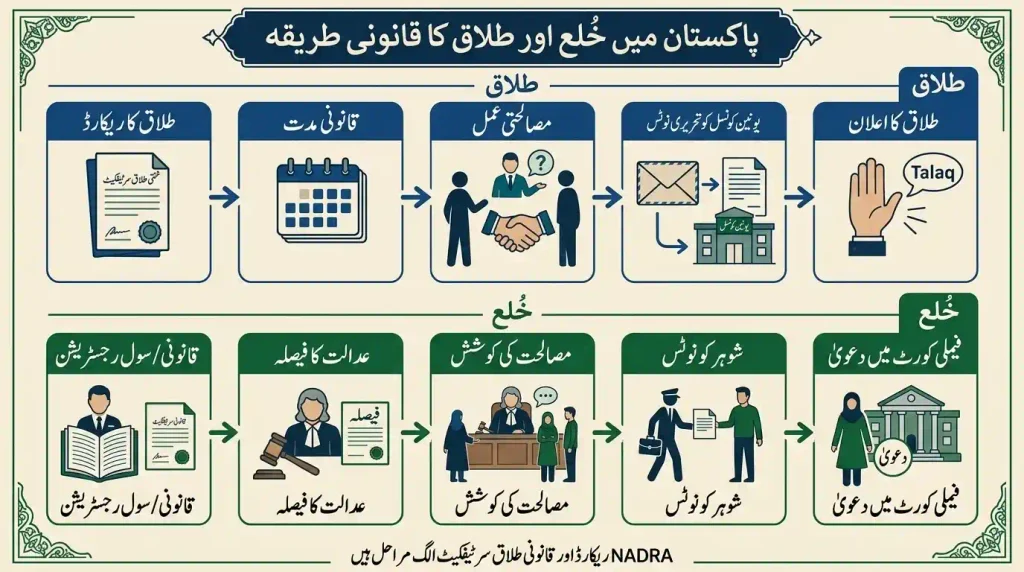
Talaq Procedure in Pakistan 2026
The general statutory process can be summarized as follows:
Step 1: Pronouncement of Talaq
The husband pronounces Talaq in accordance with the applicable Muslim law.
Step 2: Written Notice to the Union Council
Section 7 of the Muslim Family Laws Ordinance requires the husband to give written notice to the Chairman of the relevant Union Council after the pronouncement and provide a copy to the wife.
Step 3: Arbitration Council and Reconciliation
Within 30 days of receiving the notice, the Chairman is required to constitute an Arbitration Council for attempting reconciliation between the spouses.
Step 4: Statutory 90-Day Period
Under Section 7, Talaq generally does not become effective until the expiry of 90 days from delivery of the notice to the Chairman, unless it is revoked earlier. If the wife is pregnant when Talaq is pronounced, the law provides that effectiveness may be delayed until the statutory period or pregnancy ends, whichever is later.
Therefore, the commonly repeated statement that “Talaq is automatically final immediately after three pronouncements” should not be used as a description of the Pakistani statutory process.
Step 5: Divorce Documentation
After completion of the applicable legal and registration process, the relevant local authority can issue documentation confirming the divorce/dissolution according to the applicable civil-registration system.
NADRA’s own description of Pakistan’s registration ecosystem explains that birth, death, marriage and divorce certificates are issued through the provincial/local civil-registration system, while NADRA uses civil-registration data as part of the national identity ecosystem.
Is Talaq Without Union Council Notice Valid in Pakistan?
This issue requires careful wording.
Section 7 clearly imposes a legal obligation on the husband to provide written notice to the Chairman of the Union Council and specifies a penalty for contravention. It also establishes the 90-day statutory effectiveness period following delivery of notice.
Therefore, it is incorrect to simplify the law by saying that “Talaq without notice is automatically invalid in every case.”
The safer practical approach is to complete the statutory notification and registration process rather than relying only on an oral pronouncement. Where a dispute has already arisen, the legal effect of a particular pronouncement should be determined by a qualified family lawyer or competent court.
What Is Khula in Pakistan?
Khula is a form of dissolution of marriage sought by a Muslim wife.
In a Khula case, the wife approaches the Family Court and asks for dissolution of the marriage. The Family Court follows the applicable procedure and attempts reconciliation.
The Family Courts Act gives Family Courts jurisdiction over family matters and specifically provides for dissolution of marriage. A plaint for dissolution can also contain claims relating to dower, maintenance, dowry, personal property, custody and visitation.
The Supreme Court has described the right to seek Khula as belonging to the woman and has emphasized that a court should not grant Khula on its own where the woman has not actually sought it.
Khula Procedure in Pakistan 2026
The exact court process can vary depending on the jurisdiction and circumstances, but the general process includes the following stages.
Step 1: File a Suit for Dissolution of Marriage
The wife files a suit for dissolution of marriage/Khula before the competent Family Court.
The petition normally identifies the marriage, the parties, relevant circumstances and the relief being requested.
Step 2: Attach Supporting Documents
Common documents can include:
- CNIC copies of the wife and husband, where available
- Nikah Nama or certified marriage record
- Details of the marriage
- Address and contact information of the husband
- Children’s documents, where custody or maintenance is also claimed
- Evidence relevant to additional claims, where applicable
- Other documents required by the particular Family Court
The exact documentary requirements can differ by court and case.
Step 3: Notice to the Husband
The Family Court serves notice/summons on the husband in accordance with the applicable procedure.
The Family Courts Act provides mechanisms for service and allows the court to proceed in certain circumstances where a defendant does not appear despite proper service.
Step 4: Reconciliation Attempt
The Family Court attempts to bring about compromise or reconciliation between the spouses.
Section 10 of the Family Courts Act expressly requires the court to attempt reconciliation at the pre-trial stage where possible.
Step 5: Dissolution if Reconciliation Fails
Where reconciliation is unsuccessful, the Family Court proceeds according to the applicable statutory provisions and the circumstances of the case.
The Family Courts Act contains a specific provision concerning dissolution and restoration of Haq Mehr in a Khula case where reconciliation fails.
However, the financial consequences should not be reduced to the blanket statement that every woman automatically loses every form of Haq Mehr whenever she seeks Khula. The nature of the claim, the grounds pleaded, the decree and applicable law all matter.
Step 6: Registration and Record Update
After the Family Court decree, the relevant civil-registration authority/Union Council process may be required to record the dissolution and issue the applicable certificate.
The Family Courts Act also contains provisions concerning communication with Union Councils regarding marriage records.
Khula vs Talaq — Complete Comparison
| Feature | Talaq | Khula |
| Initiated by | Husband | Wife |
| Primary legal framework | Muslim Family Laws Ordinance 1961 | Family Courts Act and applicable Muslim family law |
| Family Court | Not normally required for the husband’s initial pronouncement | Normally involved |
| Union Council | Written Talaq notice required | Registration/recording may follow court dissolution |
| Reconciliation | Arbitration Council | Family Court |
| Statutory 90-day mechanism | Section 7 | Relevant statutory provisions may apply depending on form of dissolution |
| Haq Mehr | Depends on facts and applicable law | May involve restoration of Haq Mehr under Khula provisions |
| Wife’s consent | Not applicable to husband’s unilateral pronouncement | Khula must be sought by the wife |
| Husband’s agreement | Not necessary for husband to pronounce Talaq | Husband’s refusal does not by itself end the wife’s ability to seek judicial relief |
| Court decree | Generally not the mechanism for ordinary Talaq | Family Court decree is central |
| Certificate/registration | Local civil-registration process | Local civil-registration process following decree |
| NADRA update | Possible after supporting legal documentation | Possible after supporting legal documentation |
| Child custody | Separate legal issue | Separate legal issue |
What Is the Difference Between Khula and Dissolution on Statutory Grounds?
This distinction is frequently missed in online articles.
A wife may seek dissolution through Khula, but Pakistani law also provides specific statutory grounds on which a woman can obtain a decree for dissolution.
The Dissolution of Muslim Marriages Act, 1939, lists several grounds, including:
- Husband’s whereabouts being unknown for four years
- Failure to provide maintenance for two years
- Certain circumstances involving an additional wife in contravention of the Muslim Family Laws Ordinance
- Husband’s imprisonment for seven years or more
- Failure to perform marital obligations for three years without reasonable cause
- Impotence, subject to statutory conditions
- Certain forms of mental illness or specified diseases
- Option of puberty subject to the statutory conditions
- Lian
- Cruelty
- Other grounds recognized as valid under Muslim law
The Act also specifically states that nothing in it affects a married woman’s rights to dower or any part of her dower under Muslim law.
This is why an article should not treat Khula and every form of judicial dissolution as exactly the same legal claim.
Grounds of Cruelty Under Pakistani Law
Section 2(viii) of the Dissolution of Muslim Marriages Act includes several forms of cruelty.
These include, among other circumstances:
- Habitual assault or conduct making the woman’s life miserable
- Association with women of ill repute or leading an infamous life
- Attempts to force the wife to lead an immoral life
- Disposal of the wife’s property or interference with her legal rights over it
- Obstruction of religious practice
- Failure to treat multiple wives equitably where the husband has more than one wife
A woman who has a legally recognized ground for dissolution should therefore understand the difference between seeking dissolution on that ground and seeking Khula.
What Happens to Haq Mehr After Khula?
Haq Mehr, or dower, is one of the most important financial issues in divorce cases.
The result can depend on whether the marriage is dissolved through:
- Husband’s Talaq
- Khula
- Dissolution on a statutory ground
- Delegated divorce
- Another recognized form of dissolution
In a Khula case, restoration of Haq Mehr can form part of the legal consequences of the decree under the Family Courts Act. The statute specifically refers to restoration of the Haq Mehr received by the wife in consideration of marriage where reconciliation fails in a dissolution case to which the relevant provision applies.
However, it is not accurate to tell every reader that all dower automatically disappears after every Khula case. The facts, pleadings, type of dissolution and court decree matter.
The Dissolution of Muslim Marriages Act also expressly protects a woman’s rights to dower in proceedings under that Act.
Does a Wife Lose Her Haq Mehr in Every Divorce?
No single rule should be applied to every divorce case.
For example, Talaq by the husband, Khula, and dissolution based on cruelty or another statutory ground are legally distinct situations.
The treatment of dower should therefore be determined from:
- The type of dissolution
- The terms of the Nikah Nama
- Whether Haq Mehr was paid or remains unpaid
- The grounds pleaded
- The relief requested
- The Family Court’s decree
- Applicable statutory and case law
This is particularly important where substantial property, gold, deferred dower or other assets form part of the marriage contract.
Iddat After Talaq and Khula
Iddat is a separate concept from the statutory notice period under the Muslim Family Laws Ordinance.
Readers should not automatically treat the 90-day Talaq notice period and Iddat as exactly the same legal concept.
Iddat is governed by the applicable rules of Muslim personal law and can depend on circumstances such as pregnancy and menstruation.
A pregnant woman may have different Iddat consequences from a woman who is not pregnant. Similarly, the applicable rules can differ according to the circumstances of the marriage and dissolution.
For an individual case, especially where remarriage is being considered, a qualified family lawyer and an appropriate religious authority may need to be consulted.
Can the Husband Refuse Khula?
A husband can contest a Khula case, appear before the Family Court and present his position.
However, his refusal should not be described as giving him an absolute veto over a wife’s legal ability to seek dissolution.
The Family Court follows the statutory procedure, attempts reconciliation and decides the matter according to the applicable law.
The Supreme Court has recognized Khula as a right that must be expressly sought by the woman.
Therefore, the correct explanation is that the husband’s disagreement does not automatically prevent the wife from approaching the Family Court, but the case must still proceed through the legal process.
Can Khula Be Revoked?
Khula should not simply be treated as identical to a husband’s Talaq.
Whether a dissolution can be reversed, whether a new marriage would be required, and what effect a decree has depend on the form of dissolution and the circumstances.
Once a Family Court decree has dissolved a marriage, the parties should not assume that they can simply cancel it privately.
Anyone considering reconciliation after a decree should obtain legal advice about whether a new Nikah, fresh documentation or another legally required step is necessary.
Can Talaq Be Revoked During the 90-Day Period?
Section 7 of the Muslim Family Laws Ordinance expressly states that Talaq generally does not become effective until the expiry of 90 days from delivery of notice to the Chairman, unless revoked earlier.
The legal consequences can therefore differ depending on whether reconciliation or revocation takes place during the statutory period.
Proper communication with the Union Council and maintenance of documentary records are important.
Talaq Types: Ahsan, Hasan and Biddat
Islamic jurisprudence recognizes different forms and classifications of Talaq, including terms such as:
Talaq-e-Ahsan
This is traditionally described as a form involving a single pronouncement followed by the relevant waiting period.
Talaq-e-Hasan
This is traditionally described as pronouncements made in successive periods in accordance with the relevant rules.
Talaq-e-Biddat
This term is used in Islamic jurisprudence for a form of Talaq involving multiple pronouncements in a manner considered irregular or bid’ah by relevant schools of thought.
However, these religious classifications should not be confused with the Pakistani statutory procedure.
Section 7 of the Muslim Family Laws Ordinance applies to a Talaq “in any form whatsoever” and establishes the statutory notice and effectiveness mechanism.
Because interpretations can differ among schools of Islamic jurisprudence, readers should consult a qualified scholar for religious questions and a family lawyer for the legal consequences in Pakistan.
Sunni and Shia Considerations
Pakistan’s Muslim population includes different schools of Islamic jurisprudence, and religious rules concerning Talaq, Khula, witnesses, revocation and related matters can differ.
The civil legal process in Pakistan should not be confused with a particular school’s religious interpretation.
For legal registration and enforceability, the relevant Pakistani statutes, court orders and civil-registration procedures are important.
For a question specifically about whether a particular pronouncement constitutes Talaq under a particular school of Islamic jurisprudence, a qualified religious scholar should be consulted in addition to legal counsel.
Documents Required for Talaq in Pakistan
Requirements can vary by Union Council and circumstances, but commonly relevant documents include:
- Husband’s CNIC copy
- Wife’s CNIC copy
- Nikah Nama or marriage registration record
- Written Talaq notice
- Wife’s address/contact details
- Relevant Union Council information
- Additional documents requested by the local authority
It is advisable to keep copies of:
- Talaq notice
- Proof of submission
- Union Council correspondence
- Arbitration Council documents
- Final divorce certificate
- Any reconciliation or revocation documentation
Do not rely only on verbal statements when a formal legal record is required.
Documents Required for Khula
A Khula case commonly requires documents such as:
- Wife’s CNIC
- Husband’s CNIC copy, if available
- Nikah Nama
- Marriage registration evidence
- Husband’s address for service
- Children’s documents where custody/maintenance is claimed
- Evidence supporting additional legal claims, where relevant
- Any previous court orders or family-law documents
The Family Court can require additional information or documents depending on the case.
Khula and Talaq Certificate: Who Issues It?
This is an important correction to many online articles.
NADRA should not be described as the ordinary originating authority that grants a divorce or Khula.
Pakistan’s civil-registration ecosystem involves local/provincial authorities for vital events. NADRA explains that the Provincial Civil Registration and Management System operates through Union Councils and facilitates registration and issuance of birth, death, marriage and divorce certificates. NADRA then uses civil-registration information within the national identity ecosystem.
For Talaq, the relevant Union Council/Arbitration Council process is therefore important.
For Khula, the Family Court decree is a key legal document, followed by the applicable civil-registration process.
NADRA Divorce Status Update After Talaq or Khula
NADRA maintains national identity records, and its PakID services include a divorce-related cancellation certificate service.
This should be distinguished from the underlying divorce decree or civil divorce certificate.
A person may therefore need to deal with two related but different records:
1. Legal/civil record:
The divorce or dissolution is established through the relevant court and/or civil-registration authority.
2. NADRA identity record:
The marital-status information may need to be updated in the national identity database based on the required documentation.
Before visiting NADRA, applicants should verify the current documentary requirements because services and procedures can change.
Does NADRA Issue a Divorce Certificate?
NADRA’s role should be understood carefully.
The official NADRA ecosystem information states that civil-registration systems facilitate the registration and issuance of birth, death, marriage and divorce certificates, while NADRA provides the identity and database infrastructure connected with those records.
Therefore, describing every divorce certificate as a certificate “issued by NADRA” can be misleading.
A better description is:
The divorce/dissolution is processed through the legally competent court and/or civil-registration authority, while NADRA records can be updated through its identity services based on the relevant documentation.
NADRA Divorce-Related Fees in 2026
There should not be a fixed statement such as “NADRA divorce certificate fee is PKR 15,000” unless an official current fee schedule specifically supports it.
NADRA’s current published fee schedule includes identity-document and cancellation-related services, but local government/civil-registration fees and private legal-service fees are separate matters.
The total cost of a divorce or Khula case can include:
- Court-related fees
- Certified copies
- Union Council/civil-registration charges
- Stamp or documentation charges where applicable
- Lawyer’s professional fee
- Service/postal expenses
- Translation or attestation costs for overseas use
- NADRA charges for a separate identity service, if applicable
Because these amounts can vary by jurisdiction and service, readers should confirm the current fee with the relevant authority before paying.
How Long Does Khula Take in Pakistan?
There is no single guaranteed Khula duration that applies to every case.
The time can depend on:
- Court workload
- Whether the husband is properly served
- Whether he appears
- Whether reconciliation succeeds or fails
- Whether the case becomes contested
- Whether additional claims are included
- Evidence and documentation
- Jurisdiction
- Appeals or other proceedings
Therefore, claims such as “Khula always takes one year” or “Khula always takes three months” should be avoided.
The Family Courts Act contains procedures concerning institution of suits, service, written statements, pre-trial proceedings and reconciliation.
How Long Does Talaq Take in Pakistan?
Section 7 establishes a statutory 90-day period from delivery of the Talaq notice to the Chairman, subject to the statutory provisions concerning revocation and pregnancy.
However, the practical completion of documentation can involve additional administrative time.
Therefore:
Statutory period: generally 90 days under Section 7
Administrative completion: may vary by Union Council and circumstances
Readers should not confuse the statutory 90-day mechanism with the separate concept of Iddat.
Can a Wife Claim Maintenance After Divorce?
Maintenance is a separate financial issue from the question of whether the marriage is dissolved.
Depending on the circumstances and applicable law, claims can arise concerning:
- Maintenance during the marriage
- Maintenance during Iddat where legally applicable
- Children’s maintenance
- Unpaid dower
- Dowry/personal property
- Other financial claims
The Family Courts Act expressly allows a dissolution suit to include claims concerning maintenance, dower, dowry, personal property, custody and visitation.
The result depends on the facts and the court’s determination.
Child Custody After Khula or Talaq
Divorce does not automatically determine child custody.
Custody, visitation and maintenance of children are separate matters.
The Family Courts Act allows claims relating to custody and visitation to be included in a dissolution case.
It is therefore misleading to state a universal rule such as:
“Sons automatically stay with the mother until seven and daughters until puberty.”
Traditional personal-law principles can be relevant, but courts consider the circumstances and welfare of the child. The specific facts, child’s age, parental circumstances, allegations, existing arrangements and applicable law can affect the outcome.
Parents should therefore obtain case-specific legal advice instead of relying on fixed age rules found in social-media posts.
Child Maintenance After Divorce
The end of a marriage does not automatically end a parent’s financial responsibilities toward children.
A Family Court can deal with children’s maintenance, and a dissolution suit can include maintenance-related claims.
The amount can depend on factors such as:
- Children’s needs
- Parents’ financial circumstances
- Educational expenses
- Medical requirements
- Living arrangements
- Other relevant evidence
Can Divorce and Khula Be Filed Together With Other Claims?
Yes, Pakistani Family Court procedure allows a dissolution suit to include several related claims.
Depending on the circumstances, these can include:
- Dissolution of marriage
- Dower/Haq Mehr
- Maintenance
- Dowry articles
- Personal belongings
- Child custody
- Visitation rights
The Family Courts Act expressly recognizes these claims in the context of a dissolution plaint.
This can be important for readers because filing a dissolution case does not necessarily mean that every other financial or family issue must be ignored.
What Happens If the Husband Does Not Appear in a Khula Case?
The husband’s absence does not necessarily mean that the case automatically disappears.
The Family Courts Act contains provisions for service of notice and proceedings where a defendant fails to appear after proper service. In appropriate circumstances, the Family Court may proceed ex parte, subject to the statutory requirements.
However, the wife should not assume that simply filing a case guarantees an immediate decree. Proper service and compliance with court procedure remain important.
Khula When the Husband Lives Abroad
A husband living outside Pakistan can create additional procedural issues.
The court may need to address:
- Proper service of notice
- Overseas address
- Power of attorney
- Authorized representation
- Attestation/legalization of documents
- Foreign residence documents
- Translation requirements
- Recognition or use of the Pakistani decree abroad
The procedure can vary depending on the country and the court.
Pakistan’s courts also maintain digital and overseas-related services in certain jurisdictions. For example, the Islamabad District Judiciary provides online case information and digital judicial services, while the Lahore High Court has an Overseas Pakistanis Cell for matters within its jurisdiction.
Can Khula Be Done Completely Online?
Readers should be careful with websites advertising “100% online Khula” or guaranteed divorce certificates.
Online communication, digital case information, remote representation and electronic court services may be available in some circumstances, but these do not automatically eliminate statutory requirements such as:
- Filing the appropriate case
- Service of notice
- Court proceedings
- Verification of identity
- Production of documents
- Reconciliation proceedings
- Issuance of the court decree
- Civil registration
The availability of remote services also varies by jurisdiction.
A website claiming to provide a guaranteed “online divorce” should not be treated as an official government service without verification.
Divorce for Overseas Pakistanis
Overseas Pakistanis may need additional documentation where the marriage or divorce has a connection with another country.
Possible requirements can include:
- CNIC/NICOP
- Pakistani marriage record
- Foreign passport
- Residence permit
- Power of attorney
- Attested documents
- Certified copies of court orders
- Translation
- Embassy/consular formalities
- Local registration in the foreign country
The requirements depend heavily on the country where the divorce will be used.
A Pakistani divorce document may also need authentication, attestation or recognition before it can be used for immigration, remarriage or civil-status purposes abroad.
Talaq, Khula and Nikah Nama
The Nikah Nama is an important document because it records the terms and conditions of the marriage.
Before filing any family-law case, both parties should obtain a clear copy of the Nikah Nama and check:
- Names
- CNIC numbers
- Marriage date
- Haq Mehr
- Deferred dower
- Conditions entered into the marriage contract
- Any delegated right of divorce
- Signatures and witnesses
- Registration details
Where the Nikah Nama contains a delegated power of divorce, the legal route can differ from an ordinary Khula case. The wording of the actual Nikah Nama and applicable law should therefore be examined.
Common Mistakes to Avoid in Khula and Talaq Cases
Mistake 1: Relying only on verbal Talaq
A verbal pronouncement should not be treated as a substitute for the statutory notification and registration process.
Mistake 2: Assuming Union Council notice is optional
Section 7 specifically requires written notice after Talaq.
Mistake 3: Assuming Khula and statutory dissolution are identical
They can involve different legal grounds and financial consequences.
Mistake 4: Assuming every Khula means automatic loss of all Haq Mehr
The treatment of dower depends on the legal basis and circumstances of the case.
Mistake 5: Assuming NADRA grants the divorce
The legal dissolution and NADRA identity record are different matters.
Mistake 6: Relying on fixed online fees
Government charges, court expenses and lawyer fees should be separately verified.
Mistake 7: Believing custody is automatically decided by the divorce
Custody and visitation are separate legal issues.
Mistake 8: Posting CNIC information publicly
Do not upload CNIC numbers, family documents, court documents or personal information to unverified websites or social-media pages.
Mistake 9: Using fake online divorce services
Check whether the service is connected to an actual lawyer, court or government authority before providing documents or making payments.
Khula vs Talaq: Which Process Applies?
Instead of asking which option is “better,” the more useful question is which legal route matches the circumstances of the marriage.
A person should consider:
- Who is seeking dissolution?
- Has Talaq already been pronounced?
- Is there a dispute about whether Talaq occurred?
- Does the wife want to seek Khula?
- Are there grounds under the Dissolution of Muslim Marriages Act?
- Is Haq Mehr unpaid?
- Are children involved?
- Are maintenance or dowry claims involved?
- Is one spouse living abroad?
- Is there delegated divorce authority in the Nikah Nama?
- Has a previous case already been filed?
These facts can materially change the appropriate legal procedure.
Final Takeaway
Khula and Talaq are not the same legal process in Pakistan. Talaq ordinarily begins with the husband’s pronouncement and is followed by the statutory notice and reconciliation mechanism under Section 7 of the Muslim Family Laws Ordinance, 1961. Khula is sought by the wife and generally proceeds through the Family Court, where reconciliation is attempted before the court deals with dissolution according to the applicable law.
The treatment of Haq Mehr, maintenance, custody, Iddat and other rights depends on the legal basis of the dissolution and the circumstances of the case. The Dissolution of Muslim Marriages Act also provides specific grounds for judicial dissolution and protects applicable dower rights.
After dissolution, readers should distinguish between the Family Court decree or Talaq documentation, civil-registration/divorce certificate and NADRA identity record. NADRA’s official information confirms that civil-registration systems handle vital-event registration while NADRA maintains the connected national identity infrastructure and provides related identity services.
Because family-law cases can involve significant rights concerning marriage, dower, maintenance, children and property, anyone dealing with an actual Khula or Talaq case should verify the current procedure with the relevant Family Court, Union Council/civil-registration authority or qualified Pakistani family lawyer rather than relying solely on a general online article.