CNIC Numbers Structure Pakistan: What Every Digit Means
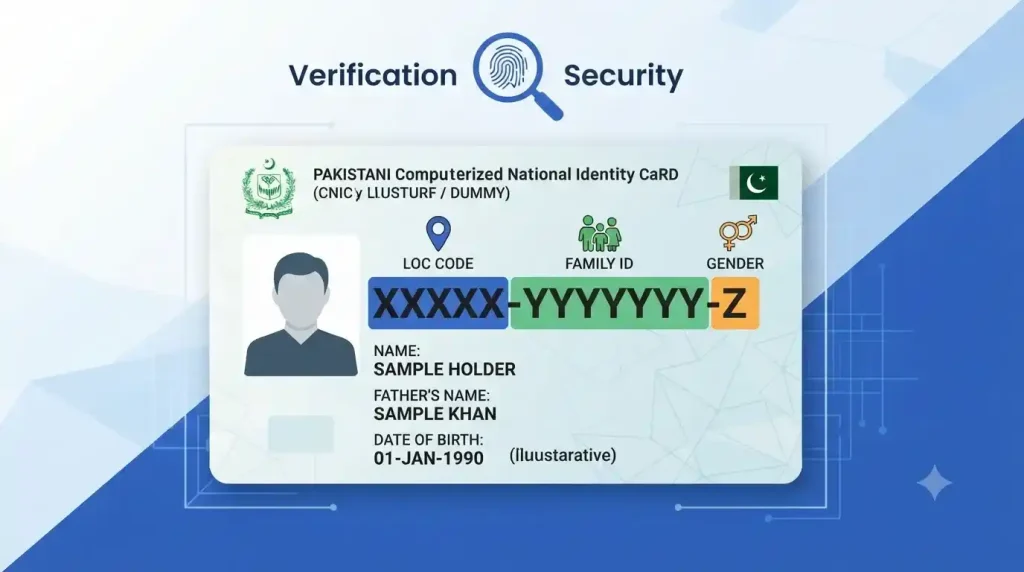
Every Pakistani CNIC follows a fixed 13-digit structure: XXXXX-YYYYYYY-Z. The first 5 digits reveal your registration location, the next 7 are tied to your family record, and the last digit encodes your gender. This structure is what allows NADRA (the National Database & Registration Authority) to keep Pakistan’s identity data organized and traceable.
CNIC is the primary national identity document issued by NADRA to every citizen aged 18 and above. It controls access to SIM registration, bank accounts, mobile wallets, government services, property ownership, passport issuance, and voter registration virtually every official transaction in the country.
| Metric | Figure |
| CNICs issued | 127 million+ |
| SIM cards linked via biometric database | 197 million+ |
| SIM registration fraud cases | 4.7 million |
| Identity-related fraud losses | Rs 22.3 billion |
| SIM swap attack surge (2025) | 127% |
What Does CNIC Stand For?
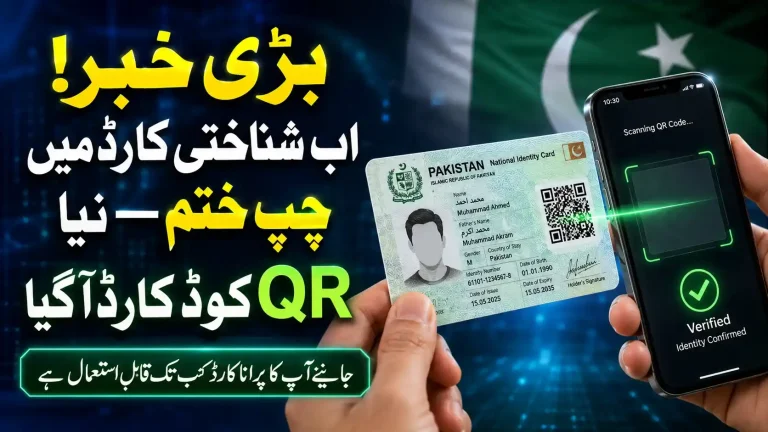
CNIC stands for Computerized National Identity Card a smart card issued by NADRA that holds personal information, photographs, fingerprints, and a unique 13-digit identification number. It replaced the older manual NIC system in 2000.
The modern CNIC is a polycarbonate smart card embedded with a secure microchip storing biometric data fingerprints, facial geometry, a digital photograph, and cryptographic security keys. It is tamper-proof, machine-readable, and compliant with ICAO (International Civil Aviation Organization) standards.
Mandatory For
- Opening bank accounts
- Obtaining SIM cards
- Voting in elections
- Purchasing property
- Applying for passports and government programs
2. What Is the Format of a CNIC Number? (XXXXX-YYYYYYY-Z)
Every CNIC follows a fixed structure: XXXXX-YYYYYYY-Z and understanding each section and its meaning is simpler than most people think. The first 5 digits form the location code, the next 7 digits carry the family identifier, and the last digit is the gender indicator. The pattern maps to XXXXX for location covering province, district, and tehsil; YYYYYYY as the family record identifier; and Z as the gender digit.
| Segment | Digits | Represents |
| Location Code | First 5 digits (XXXXX) | Province, district, and tehsil |
| Family Identifier | Next 7 digits (YYYYYYY) | Family registration record |
| Gender Indicator | Last digit (Z) | Male, female, or transgender designation |
What makes this format powerful is that no CNIC number is random, every segment carries specific geographic and identification information. Once you know how to read it, you can verify CNIC authenticity and even detect potential fraud just by analyzing the digits in front of you.
3. What Do the First 5 Digits of CNIC Mean? (Regional Code)
The first 5 digits of any Pakistani CNIC encode geographic identity with surprising precision. The very first digit tells you the province or territory: 1 for Khyber Pakhtunkhwa, 2 for FATA now merged with KP, 3 for Punjab, 4 for Sindh, 5 for Balochistan, 6 for Islamabad Capital Territory, 7 for Gilgit-Baltistan, and 8 for Azad Jammu Kashmir. The second digit then identifies the division within that province — so even if two people share a common province, their second digit will be different.
Digits 3–5 continue to narrow down to your exact district, tehsil, and union council, creating a precise location mapping unique to every registration area. The CNIC starting codes for Pakistani provinces and territories follow this pattern: 1XXXX-XXXXXXX-X, 2XXXX-XXXXXXX-X, 3XXXX-XXXXXXX-X, 4XXXX-XXXXXXX-X, 5XXXX-XXXXXXX-X, 6XXXX-XXXXXXX-X, 7XXXX-XXXXXXX-X, 8XXXX-XXXXXXX-X.
Province Codes
The first digit identifies the province or territory:
| First Digit | Province / Territory |
| 1 | Khyber Pakhtunkhwa |
| 2 | FATA (now merged with KP) |
| 3 | Punjab |
| 4 | Sindh |
| 5 | Balochistan |
| 6 | Islamabad Capital Territory |
| 7 | Gilgit-Baltistan |
| 8 | Azad Jammu & Kashmir |
The second digit identifies the division within that province, and digits 3–5 narrow down to the exact district, tehsil, and union council.
Location Code Ranges
| Range | Region | Example |
| 11000–19999 | Khyber Pakhtunkhwa | 11101 = Peshawar |
| 21000–29999 | FATA / Tribal Areas | 21401 = North Waziristan |
| 31000–39999 | Punjab | 35202 = Lahore |
| 41000–49999 | Sindh | 42201 = Karachi |
| 51000–59999 | Balochistan | 51401 = Quetta |
| 61000–69999 | Islamabad Capital Territory | 61101 = Islamabad |
| 71000–79999 | Azad Jammu & Kashmir | 71401 = Muzaffarabad |
| 81000–89999 | Gilgit-Baltistan | 81101 = Gilgit |
4. CNIC Division Codes in Pakistan
Each province is further broken down into divisions, each with its own CNIC code range.
Khyber Pakhtunkhwa Divisions
| Division | Code Prefix |
| Bannu | 11XXX-XXXXXXX-X |
| Dera Ismail Khan | 12XXX-XXXXXXX-X |
| Hazara | 13XXX-XXXXXXX-X |
| Kohat | 14XXX-XXXXXXX-X |
| Malakand | 15XXX-XXXXXXX-X |
| Mardan | 16XXX-XXXXXXX-X |
| Peshawar | 17XXX-XXXXXXX-X |
Punjab Divisions
| Division | Code Prefix |
| Bahawalpur | 31XXX-XXXXXXX-X |
| Dera Ghazi Khan | 32XXX-XXXXXXX-X |
| Faisalabad | 33XXX-XXXXXXX-X |
| Gujranwala / Gujrat | 34XXX-XXXXXXX-X |
| Lahore | 35XXX-XXXXXXX-X |
| Multan / Sahiwal | 36XXX-XXXXXXX-X |
| Rawalpindi | 37XXX-XXXXXXX-X |
| Sargodha / Mianwali | 38XXX-XXXXXXX-X |
Sindh Divisions
| Division | Code Prefix |
| Hyderabad | 41XXX-XXXXXXX-X |
| Karachi | 42XXX-XXXXXXX-X |
| Larkana | 43XXX-XXXXXXX-X |
| Mirpur Khas | 44XXX-XXXXXXX-X |
| Sukkur / Shaheed Benazirabad | 45XXX-XXXXXXX-X |
Balochistan Divisions
| Division | Code Prefix |
| Kalat / Rakhshan | 51XXX-XXXXXXX-X |
| Makran | 52XXX-XXXXXXX-X |
| Nasirabad | 53XXX-XXXXXXX-X |
| Quetta | 54XXX-XXXXXXX-X |
| Sibi | 55XXX-XXXXXXX-X |
| Zhob / Loralai | 56XXX-XXXXXXX-X |
ICT, Gilgit-Baltistan & AJK
| Region | Code Prefix |
| Islamabad Capital Territory | 61XXX-XXXXXXX-X |
| Gilgit-Baltistan (Gilgit, Baltistan, Diamer) | 71XXX-XXXXXXX-X |
| AJK — Mirpur | 81XXX-XXXXXXX-X |
| AJK — Poonch / Muzaffarabad | 82XXX-XXXXXXX-X |
5. What Do the Middle 7 Digits Represent? (Family Registration Number)
The middle 7 digits are the least understood part of the CNIC, yet they carry one of its most meaningful layers they are linked to family registration records and are not random. NADRA uses this number to link parents, spouses, and children within its database.
This system enables NADRA to maintain family lineage, record consistency, and end-to-end identity verification something that becomes critical in inheritance, succession, and legal proceedings.
6. What Does the Last Digit of CNIC Represent? (Gender Identifier)
The last digit of every CNIC is perhaps the easiest to decode it identifies gender. Odd numbers 1, 3, 5, 7, 9 indicate male, while even numbers 0, 2, 4, 6, 8 indicate female. It’s a quick and reliable way to cross-check identity when reviewing documents.
Following the 2018 Supreme Court ruling, transgender individuals are now permitted to choose their designation, adding a layer of inclusivity to the system. On a practical level, this single digit helps verify CNIC authenticity when receiving copies from unknown parties a trick I personally use during tenant verification.
| Last Digit | Gender |
| Odd (1, 3, 5, 7, 9) | Male |
| Even (0, 2, 4, 6, 8) | Female |
Following the 2018 Supreme Court ruling, transgender individuals are permitted to choose their designation, adding a layer of inclusivity to the system.
7. Example CNIC Explained
To bring everything together, take this example: 42101-1234567-9. Breaking it down 42101 places the holder in Sindh (4), district 21, tehsil 01; 1234567 is the family-linked identifier; and 9 confirms the holder is male. Similarly, 42201-1234567-1 maps directly to Karachi with the holder again being male two simple examples that show how much information is packed into 13 digits.
| CNIC Number | Location | Family ID | Gender |
| 42101-1234567-9 | Sindh, district 21, tehsil 01 | 1234567 | Male (odd) |
| 42201-1234567-1 | Karachi | 1234567 | Male (odd) |
8. Why Is CNIC Structured This Way?
The structure isn’t arbitrary, it allows NADRA to organize national identity data, link family members, verify individuals accurately, and reduce duplication and fraud across the country. It creates a centralized identity system that scales to serve over 127 million citizens without collapsing under complexity.
The NADRA CNIC numbering system is carefully built to encode a citizen’s region, family registration, and gender into a single string enabling the authority to maintain accurate national records, reduce identity fraud, and simplify verification processes across Pakistan. The real genius is in how CNIC city codes allow even ordinary citizens to interpret their identity numbers and build awareness of how Pakistan’s national identity system functions no special access required.
9. Important Notes About CNIC Numbers
- Your CNIC number is unique to you for life and is never reassigned to anyone else
- It is permanently linked to your biometric data and should never be shared publicly
- It encodes your location, family linkage, and gender in a single verifiable string
10. What Information Does CNIC Contain?
Visible on the Card
- Full legal name (Urdu and English)
- Father’s or husband’s name
- Gender — male, female, or transgender
- Date of birth
- 13-digit CNIC number
- Permanent and current address
- Date of issue and expiry (valid 5 or 10 years)
- Digital photograph and signature
Stored in the Microchip
- All 10 fingerprints (encrypted)
- Facial geometry with 3D recognition markers
- Iris scan data (Smart CNIC)
- Cryptographic digital certificates
- Machine Readable Zone (MRZ) for automated border/institution scanning
11. Types of National Identity Cards Issued by NADRA
NADRA doesn’t issue just one type of card there’s a full ecosystem. The Smart National Identity Card SNIC is the next-generation CNIC with enhanced security features, boasting 71+ features including holographic lamination, laser-engraved data, and an advanced biometric chip, currently being rolled out during renewal cycles. The standard Computerized National Identity Card CNIC remains what 127 million+ Pakistani citizens 18+ carry today, storing biometric data on an embedded microchip, valid for 5 or 10 years, and required for SIM registration, banking, voting, property transactions, and government services as of 2026.
For those living abroad, the National Identity Card for Overseas Pakistanis NICOP includes a machine-readable travel zone for visa-free travel to Pakistan and remains valid for property ownership, banking, and inheritance claims. The Pakistan Origin Card POC serves foreign nationals of Pakistani origin holding citizenship of another country, granting lifetime visa-free entry along with rights to property purchase, business registration, and bank account opening though without voting rights or Pakistani passport eligibility.
Younger citizens are covered by the Juvenile Identity Card JIC for Pakistani children under 18, carrying basic identity information without biometric fingerprints which are added at age 18 during CNIC conversion. Finally, the CRC CNIC Registration Certificate is a temporary certificate issued while the card is being printed and delivered, valid for 60 days and carrying the same legal weight as the physical CNIC for most transactions.
| Card Type | Who It’s For |
| Smart CNIC (SNIC) | Next-gen CNIC with 71+ security features, holographic lamination, laser-engraved data |
| CNIC | Standard card for all citizens 18+, valid 5 or 10 years |
| NICOP | Overseas Pakistanis — visa-free travel, property, banking, inheritance |
| Pakistan Origin Card (POC) | Foreign nationals of Pakistani origin — no voting or passport rights |
| Juvenile Identity Card (JIC) | Children under 18 — no biometric fingerprints yet |
| CRC | Temporary certificate valid 60 days while the physical card is printed |
12. Importance of the National Identity Card
The National Identity Card NIC is the most fundamental identification document for Pakistani citizens something you’ll feel immediately the moment you need it in daily life, whether at government offices, during banking transactions, or at hotel check-ins. Issued to citizens aged 18 above, it incorporates advanced security features and strict verification procedures to ensure authenticity at every touchpoint.
It is the gateway to obtaining a driving license, renewing your passport, completing NTN registration, bank account opening, and of course SIM card registration making it genuinely non-negotiable for every eligible citizen.
13. How to Apply for a CNIC
Required Documents
- B-Form / Birth Certificate from the Union Council (mandatory for first-time applicants)
- Photocopy of parent’s CNIC (father’s or mother’s accepted) plus original for verification
- Educational certificate (matric or equivalent)
- Previous CNIC, for renewal or modification
- Valid NICOP, POC, or passport, if applying from abroad
Application Steps
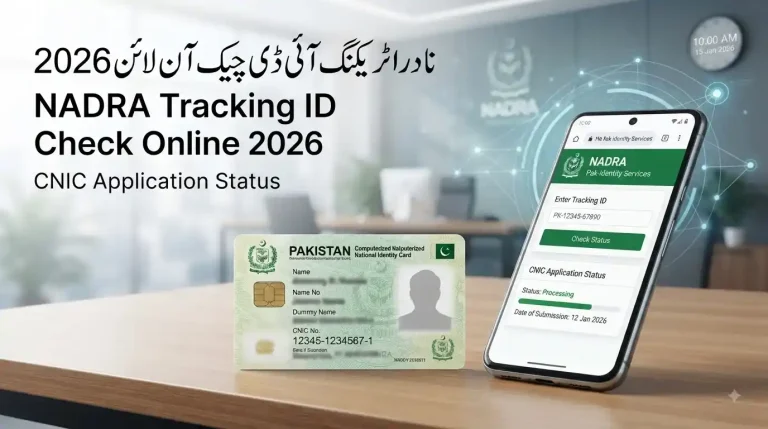
- Generate a token at the NADRA center or via the Pak-Identity portal (id.nadra.gov.pk)
- Submit documents for scanning and upload them to the central system
- Complete biometric capture 10 fingerprints, photograph, signature, and iris scan for SNIC (5–10 minutes)
- Track your application and receive the card at the center or via Pakistan Post
| Processing Type | Fee | Delivery Time |
| Normal | Rs 400 | 30 working days |
| Urgent | Rs 1,200 | 7 working days |
| Executive | Rs 2,500 | 3 working days |
14. How to Check City Name Using a CNIC
You don’t need any special tool to get a general idea of someone’s registered city or region just look at the starting digits of the CNIC number and cross-reference with the province and division codes. For accurate and updated information however, NADRA’s official CNIC verification systems should always be used. By entering the CNIC into an authorized verification platform, you can confirm registration details including the associated city and region while staying within legal and privacy boundaries.
15. How to Verify a CNIC’s Authenticity
Physical Card Checks
- Tilt the card to check the holographic strip (NADRA logo and Pakistan flag)
- Look for microprint text reading “NADRA PAKISTAN” around the photo border
- Use UV light to reveal hidden security patterns
- Confirm data is laser-engraved into the polycarbonate, not surface-printed
- Cross-check the last digit against stated gender
- Cross-check the first 5 digits against the stated province and district
Digital Verification
- SMS: send the CNIC number to 8300 to confirm status (active, expired, or blocked)
- Pak-Identity portal (id.nadra.gov.pk): official online verification for authorized organizations
- NADRA Verisys: real-time biometric verification used by banks, telecoms, and government agencies
16. CNIC & SIM Cards — The Biometric Link
Since 2014, every SIM card in Pakistan has been permanently linked to a CNIC through NADRA’s Multi-Finger Biometric Verification System (MBVS). The law caps registration at 5 SIMs per CNIC across all operators combined.
To check, send your 13-digit CNIC without dashes to SMS 668 and receive an operator-wise SIM count across all 5 networks. You can also send MNP to 667 to get the owner’s name, masked CNIC, and operator details. The PTA portal at cnic.sims.pk gives you a detailed breakdown with dates that’s printable, and a franchise visit with your original CNIC yields an official certificate that is court admissible.
| Method | How to Use | What You Get |
| SMS to 668 | Send your 13-digit CNIC (no dashes) | Operator-wise SIM count across all 5 networks |
| SMS “MNP” to 667 | Send MNP with the number | Owner name, masked CNIC, operator details |
| PTA portal (cnic.sims.pk) | Enter your CNIC online | Printable, detailed breakdown with dates |
| Franchise visit | Bring your original CNIC | Official, court-admissible certificate |
17. CNIC Security Threats
The most common identity-related frauds involving CNICs in Pakistan include:
- Unauthorized SIM Registration: Criminals use stolen or photocopied CNICs to register SIM cards without the owner’s knowledge. Around 4.7 million such cases have been reported.
- Bank Account Fraud: Fraudsters open fake bank accounts using photocopied CNICs and forged signatures to carry out illegal financial activities.
- Loan and Credit Fraud: Unauthorized loans, credit cards, and Buy Now, Pay Later (BNPL) accounts are obtained using someone else’s CNIC information.
- Property Document Forgery: Fake power of attorney documents and forged property transfer deeds are created using stolen identity information.
- Government Benefit Fraud: Criminals fraudulently enroll individuals or misuse stolen CNICs to claim benefits from programs such as BISP, the Ehsaas Program, and government health insurance schemes.
- SIM Swap Attacks: One of the fastest-growing identity crimes, where criminals hijack your mobile number using your CNIC details to intercept OTPs and gain unauthorized access to your bank accounts and online services.
| Fraud Type | How It Happens |
| Unauthorized SIM registration | Stolen CNIC copies used to register SIMs without the owner’s knowledge (4.7M cases) |
| Bank account fraud | Fake accounts opened using photocopied CNICs and forged signatures |
| Loan / credit fraud | Unauthorized loans, credit cards, and BNPL accounts opened using a stolen CNIC |
| Property document forgery | Forged power of attorney and fake property transfer deeds |
| Government benefit theft | Fraudulent enrollment in BISP, Ehsaas, and health insurance schemes |
| SIM swap attacks | Criminals hijack a phone number using CNIC details to intercept OTPs (127% surge in 2025) |
18. How to Protect Your CNIC Information
- Write “FOR [PURPOSE] ONLY” across every photocopy in bold marker
- Add the date and recipient name on each copy to create an audit trail
- Use watermarked copies where possible, and log to every organization you share your CNIC with
- Never share CNIC images over WhatsApp, email, or social media unless necessary
- Never store CNIC photos in unprotected or unencrypted cloud storage
- Send your CNIC to 668 monthly to monitor your registered SIM count
19. Services That Require CNIC in Pakistan
Your CNIC touches virtually every sector: in telecom, SIM registration, replacement, porting, and disowning all require biometric verification as mandatory. In banking, account opening, loan applications, credit cards, and mobile wallets all need the original CNIC plus a photocopy. Government services passport, driving license, vehicle registration, voter ID demand the original CNIC as mandatory, while property transactions like land purchase, property transfer, and rental agreements require attested CNIC copies.
For employment, you’ll need your CNIC copy and number for job applications, PF EOBI registration, and tax filing under NTN. In education, university admission, HEC degree attestation, and scholarships require a CNIC copy for 18+ applicants. Healthcare access from hospital registration to health insurance under Sehat Card and Ehsaas needs at minimum your CNIC number. For travel, domestic flights, train tickets, and hotel check-in need either your CNIC number or original card, while legal matters court proceedings, FIR filing, affidavits, Nikah registration mandate the original CNIC. Finally, financial instruments like insurance, mutual funds, and stock market accounts via CDC require attested CNIC with biometric confirmation.
| Sector | Requirement |
| Telecom | SIM registration, replacement, porting, and disowning — biometric verification mandatory |
| Banking | Account opening, loans, credit cards, mobile wallets — original CNIC plus copy |
| Government | Passport, driving license, vehicle registration, voter ID — original CNIC mandatory |
| Property | Land purchase, transfer, rental agreements — attested CNIC copies |
| Employment | Job applications, PF/EOBI registration, NTN tax filing |
| Education | University admission, HEC attestation, scholarships (18+ applicants) |
| Healthcare | Hospital registration, Sehat Card / Ehsaas health insurance |
| Travel | Domestic flights, train tickets, hotel check-in |
| Legal | Court proceedings, FIR filing, affidavits, Nikah registration — original CNIC |
| Financial instruments | Insurance, mutual funds, CDC stock accounts — attested CNIC with biometrics |
20. Legal Framework — CNIC Laws in Pakistan
Pakistan’s legal architecture around the CNIC is robust. The NADRA Ordinance 2000 governs CNIC issuance, data protection, and biometric security with unauthorized access carrying up to 3 years imprisonment and a Rs 1M fine. PECA 2016 §14 criminalizes unauthorized use of identity information with up to 3 years prison and a Rs 5,000,000 fine, while PECA 2016 §10 covers unauthorized access to an information system with up to 3 years prison and a Rs 1,000,000 fine.
Under the PPC, §419 punishes cheating by impersonation with up to 3 years prison, §420 covers cheating and dishonestly inducing delivery with up to 7 years, and §468 addresses forgery for the purpose of cheating also 7 years. The PTA Act §32 targets unauthorized telecom equipment operation for up to 3 years plus a Rs 10M fine.
| Law | Covers | Penalty |
| NADRA Ordinance 2000 | CNIC issuance, data protection, biometric security | Up to 3 years + Rs 1M fine |
| PECA 2016 §14 | Unauthorized use of identity information | Up to 3 years + Rs 5,000,000 fine |
| PECA 2016 §10 | Unauthorized access to an information system | Up to 3 years + Rs 1,000,000 fine |
| PPC §419 | Cheating by impersonation | Up to 3 years |
| PPC §420 | Cheating and dishonestly inducing delivery | Up to 7 years |
| PPC §468 | Forgery for the purpose of cheating | Up to 7 years |
| PTA Act §32 | Unauthorized telecom equipment operation | Up to 3 years + Rs 10M fine |
21. NADRA Contact Information
For any CNIC-related matter, keep these details saved: helpline 051-111-786-100, website nadra.gov.pk, Pak-Identity portal at id.nadra.gov.pk, SMS tracking by sending your CNIC number to 8300, and working hours from Monday–Saturday 9:00 AM to 5:00 PM with Mega Centers open until 7:00 PM.
| Channel | Details |
| Helpline | 051-111-786-100 |
| Website | nadra.gov.pk |
| Pak-Identity Portal | id.nadra.gov.pk |
| SMS Tracking | Send CNIC number to 8300 |
| Working Hours | Mon–Sat, 9:00 AM – 5:00 PM (Mega Centre’s until 7:00 PM) |
Conclusion
Your CNIC’s 13 digits are never random the format XXXXX-YYYYYYY-Z encodes your registration location, your family record, and your gender into a single verifiable string. Understanding this structure isn’t just trivia: it’s what lets you cross-check a CNIC’s authenticity, catch a mismatched location or gender digit, and recognize why NADRA built one of the world’s largest biometric identity systems around it.
With over 127 million CNICs issued and 197 million+ SIM cards permanently linked through NADRA’s biometric database, this number touches almost every official transaction in Pakistan banking, SIM registration, property, passports, and voting. That same reach is exactly why identity fraud has become a Rs 22.3 billion problem, from unauthorized SIM registrations to forged property transfers. Knowing how to read your CNIC, verify it physically and digitally, and monitor your linked SIMs is the simplest way to stay ahead of that risk.