
NADRA CNIC Cancellation Certificate After Death in Pakistan
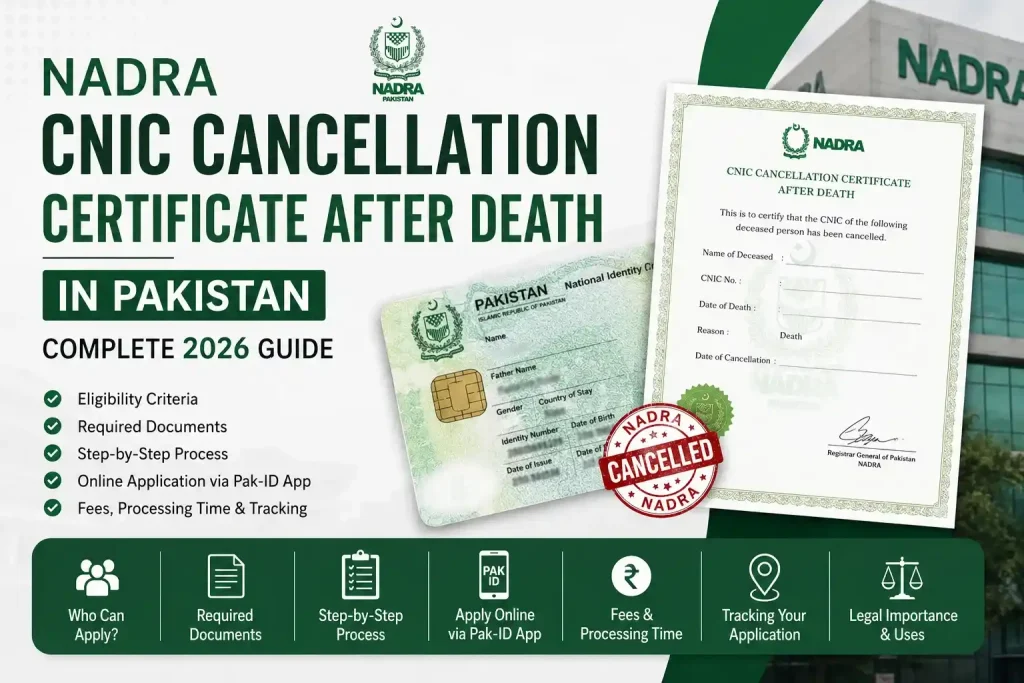
A NADRA CNIC Cancellation Certificate After Death is an official document issued once a deceased person’s Computerized National Identity Card (CNIC) has been canceled. It serves as legal proof that the CNIC is no longer valid and is commonly required for inheritance claims, property transfers, pension matters, and bank account closure.
The certificate can be obtained by the deceased’s eligible family members by submitting the required documents to NADRA. Understanding the eligibility rules, required paperwork, and application process helps families obtain the certificate quickly and avoid unnecessary delays.
What Is a NADRA CNIC Cancellation Certificate After Death?
When a person passes away, their CNIC doesn’t automatically become inactive — NADRA (the National Database & Registration Authority) requires a deliberate legal act to officially cancel that individual’s identity record from its system. The cancellation certificate is written confirmation that the database no longer lists the person as active; without it, government records remain out of sync with reality.
The process is governed under the NADRA Ordinance 2000 and the NIC/POC Rules, which set out how identity documents are closed once a lawful reason arises — death, status change, or other verification findings.
Why the Certificate Matters
- Prevents an active identity record from being exploited for illegal activities
- Updates legal records that are critical for inheritance claims
- Serves as NADRA’s official proof that a person has been legally declared deceased in government records
- Is required before heirs can process most legal and financial matters
Who Can Apply for a NADRA CNIC Cancellation Certificate After Death?
Not every relative qualifies to apply. NADRA operates on a strict eligibility structure that prioritizes immediate family members who hold a valid CNIC.
Eligible Applicants
- Spouse of the deceased
- Son or daughter of the deceased
- Parent of the deceased
- Sibling of the deceased
- A legal representative carrying authorized documents, if no immediate heir is available
The applicant must provide proof of their relationship to the deceased and their own valid CNIC for verification — this is non-negotiable regardless of how straightforward the case appears.
Required Documents for NADRA CNIC Cancellation After Death
Core documents required from every applicant:
- Original identity card(s) of the deceased — CNIC, NICOP, POC, or CRC (physically destroyed by NRC staff)
- Death Certificate issued by the Union Council office
- Graveyard Certificate, where applicable
- Foreign Death Certificate (Verified Computerized version) for deaths occurring abroad
- Applicant’s own valid CNIC
- Affidavit confirming the applicant’s relationship to the deceased
- Family Registration Certificate (FRC), if NADRA needs to resolve disputes among legal heirs
Simplified Path for Rural / Undocumented Cases
NADRA recognized that rural families — particularly from areas where documentation infrastructure was historically weak — could not always produce a UC, hospital, or graveyard death certificate. Under the revised policy, cancellation can be processed using:
- A Death Certificate issued by UC, Hospital, or Graveyard authority, OR
- An affidavit in the prescribed plain-paper format, countersigned by any blood relative
How to Apply at a NADRA Registration Centre (NRC)
Steps:
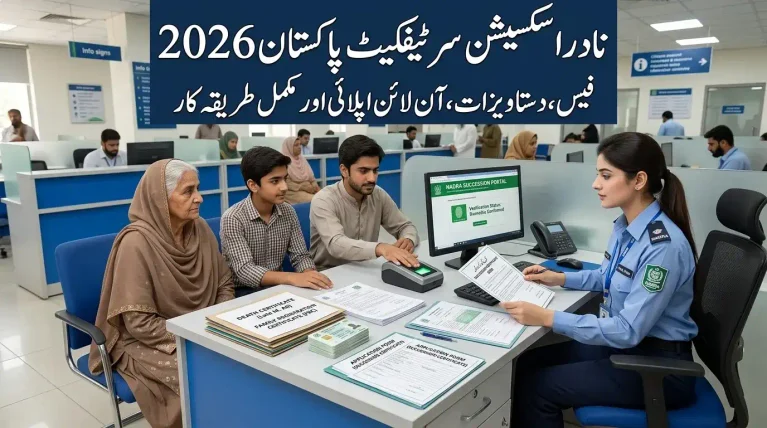
- Visit the nearest NADRA office and obtain a token upon arrival
- Biometrics are captured — photograph, fingerprints, and signature
- Biometric verification confirms the applicant’s identity
- Data entry and review — details are entered and a printed form is generated for review
- Attestation — the printed form must be attested by a blood relative (father, mother, brother, sister, son, or daughter) or a gazetted officer where applicable
- Submission — the attested form with all documents is handed to the NRC processing team
- The Cancellation Certificate is issued within the applicable timeline
Processing time varies by case complexity — typically ranging from a few days to a couple of weeks, though issuance can move quickly when all documents are in order. No prior appointment is required in most cases.
How to Apply Online via the Pak-ID App
NADRA has been gradually digitizing its services. For cancellation due to death and nationality surrender, applications can now be submitted online through the Pak-ID mobile app.
Navigation Paths
- Cancellation Due to Death: Pak-ID App → ID Documents → ID Cancellation → Cancellation Due to Death
- Cancellation Due to Nationality Surrender: Pak-ID App → Surrender ID → Myself / My Blood Relatives
After submission, verification is completed digitally, and once approved, a digital Cancellation Certificate is issued within the specified timeframe — no physical visit needed for eligible case types.
NADRA CNIC Cancellation Certificate Fee After Death
Cancellation due to death is entirely free of cost. There is no fee to cancel a deceased person’s CNIC, and no requirement to deposit the original CNIC as part of the application.
| Cancellation Type | Fee (PKR) |
| Due to Death | Free |
| DUP Cancellation — Same particulars | Rs 1,000 |
| DUP Cancellation — Different particulars | Rs 10,000 |
| Due to Nationality Surrender | As per NADRA’s notified charges |
| Processing Speed | Turnaround Time |
| Regular Processing | 10–15 working days |
| Urgent Processing (additional fee) | 5–7 working days |
NADRA CNIC Cancellation Certificate Processing Time
| Cancellation Type | Processing Time | Certificate Format |
| Due to Death | Within 24 hours | Digital (Pak-ID) or Printed (NRC) |
| Due to Nationality Surrender | Within 2 working days | Digital or Printed |
Applications submitted via the Pak-ID app receive a digital Cancellation Certificate that can be downloaded and used immediately. Applications processed at an NRC result in a printed certificate.
Uses of the NADRA CNIC Cancellation Certificate
The certificate is required for:
- Transferring property
- Processing inheritance claims
- Updating government records
- Filing pension claims
- Closing bank accounts
- Settling other financial and legal matters
How to Track Your NADRA CNIC Cancellation Application
| Method | How to Use |
| Online Portal | Enter your application number on the NADRA online tracking portal for real-time status |
| SMS Tracking | Send an SMS with your application ID to the NADRA tracking number |
| In-Person | Visit the NADRA office where the application was submitted |
Legal Requirements for CNIC Cancellation After Death
Pakistani identity law attaches a hard deadline to CNIC cancellation after death: 60 days. It is the legal responsibility of the concerned family member to initiate cancellation of the deceased person’s identity record within this period, under Section 17-A of the NADRA Ordinance.
The cancellation mandate is anchored in Sections 7(b)(ii) and 21 of the NADRA Ordinance 2000, and Rules 16 and 17 of the NADRA National Identity Card Rules 2002, under which NADRA undertakes nationwide reconciliation of civil registration records with the national citizen database.
What Happens If You Don’t Cancel a Deceased Person’s CNIC?
| Risk | Description |
| Identity Fraud | A live record can be misused for financial fraud or illegitimate property claims |
| Inheritance Disputes | Government records that don’t reflect a death can stall property distribution for years |
| Bank Account Misuse | Accounts can remain active, creating financial complications that are slow to resolve |
| Blocked Documentation | Surviving family members may face difficulties processing their own identity documents |
Latest NADRA CNIC Cancellation Drive and Policy Updates
NADRA has cancelled 4.2 million CNICs belonging to individuals recorded as deceased in provincial civil registration systems — despite 7 million deaths being registered in union councils, exposing a large gap between civil registration data and NADRA’s own database.
NADRA proceeded with proactive cancellation of these CNICs through verification against civil registration records, to safeguard database integrity and prevent misuse of identity records that remain active after death.
If a Death Was Reported in Error
- Visit the nearest NADRA registration center
- Undergo biometric verification — the CNIC is restored immediately, free of charge
- NADRA discloses the union council, town committee, or authority where the death was registered, and details of the relative who made the report
- If the underlying death registration was incorrect, it can be corrected through the relevant union council secretary
Other Reasons for NADRA Identity Document Cancellation
Death is not the only trigger for identity document cancellation. Other scenarios include:
| Scenario | Requirement |
| Surrender of Pakistani Nationality | Mandatory when acquiring a nationality that prohibits dual citizenship |
| POC Cancellation — Dual Nationality Resumption | Required when an ex-Pakistani resumes Pakistani nationality |
| POC Cancellation — Divorce | Foreign spouse’s POC must be cancelled once the marriage ends |
| DUP Cancellation | Resolves cases where a person holds two identity records under different numbers |
Documents Required by Scenario
- Nationality surrender: single-national country passport with Undertaking D, or a Renunciation Certificate, or a dual-national country passport with a verified Renunciation Certificate
- POC resumption: verified Resumption Letter or Citizenship Certificate from IMPASS, or Undertaking I as applicable
- DUP cases (overseas Pakistanis): email submission to NADRA with a Computerized Birth Registration Certificate (CRC) or other government-issued documents confirming correct particulars
NADRA’s New Policy for CNIC Cancellation Without a Death Certificate
Many families — particularly in villages without established documentation infrastructure — were unable to provide a hospital, UC, or graveyard death certificate. The complicated procedure of obtaining a court order for late entry, combined with financial constraints, made it practically impossible for some families to obtain formal death certificates.
NADRA now processes cancellation on the provision of either:
- A Death Certificate issued by UC, Hospital, or Graveyard authority, OR
- An affidavit in the prescribed plain-paper format, countersigned by any blood relative
This policy shift also addresses a related issue: names of deceased persons had been appearing on voter lists precisely because their CNICs had not been cancelled.
How to Restore a CNIC Incorrectly Marked as Deceased
In rare instances, a death may be reported erroneously — or fraudulently — by a relative, freezing an innocent citizen’s record.
- Visit the nearest NADRA registration center
- Complete biometric verification — the CNIC is restored immediately, without any fee
- NADRA discloses the union council, town committee, or local authority where the death was registered, and details of the reporting relative
- If the death registration itself was incorrect, request correction through the relevant union council secretary
Important NADRA Rules for CNIC Cancellation After Death
- 60-Day Responsibility: the concerned family member must initiate cancellation within 60 days of death
- Accuracy: all submitted documents must be complete, accurate, and verifiable — incorrect or misleading information causes delays or rejection
- Overseas Submission: overseas Pakistanis follow specific procedures for certain cancellation types — DUP cases require email submission rather than in-person filing
- Use only official NADRA channels to avoid processing issues caused by intermediaries or unofficial routes
Sindh CRMS Mobile App and NADRA Death Registration
The Sindh government, in partnership with NADRA, launched the Civil Registration Management System (CRMS) mobile app to let residents complete civil registration services from home — without long queues, delays, or repeat visits to government offices.
The CRMS app enables timely registration of:
- Birth
- Death
- Marriage
- Divorce
Faster death registration at the union council level through CRMS directly accelerates the downstream NADRA cancellation process, closing the gap between a death occurring and the identity record being formally deactivated.
How NADRA Links Death Registration with the National Database
NADRA has begun sending SMS notifications to parents and guardians of approximately 14 million children whose births are registered locally but not yet with NADRA — a parallel gap at the other end of the identity lifecycle.
NADRA will soon introduce CRC / B-Form issuance through its e-Sahulat franchise network, extending child registration services further. This reflects NADRA’s view of identity registration as a continuous lifecycle — from birth through death.
Conclusion
Obtaining a NADRA CNIC Cancellation Certificate After Death is an essential legal step that protects a deceased person’s identity and helps family’s complete inheritance, property transfers, pension claims, bank account closures, and other official procedures.
Whether applying through a NADRA Registration Center or the Pak-ID Mobile App, submit accurate documents and initiate the process as soon as possible after the death. Keeping the CNIC record updated prevents identity misuse and ensures government records stay accurate.


One Comment