NADRA Marriage Certificate Online Check in Pakistan
If you are searching for NADRA Marriage Certificate online check in Pakistan, it is important to understand one point first: a Marriage Registration Certificate (MRC) is not simply a document that anyone can search through a public CNIC-based online portal.
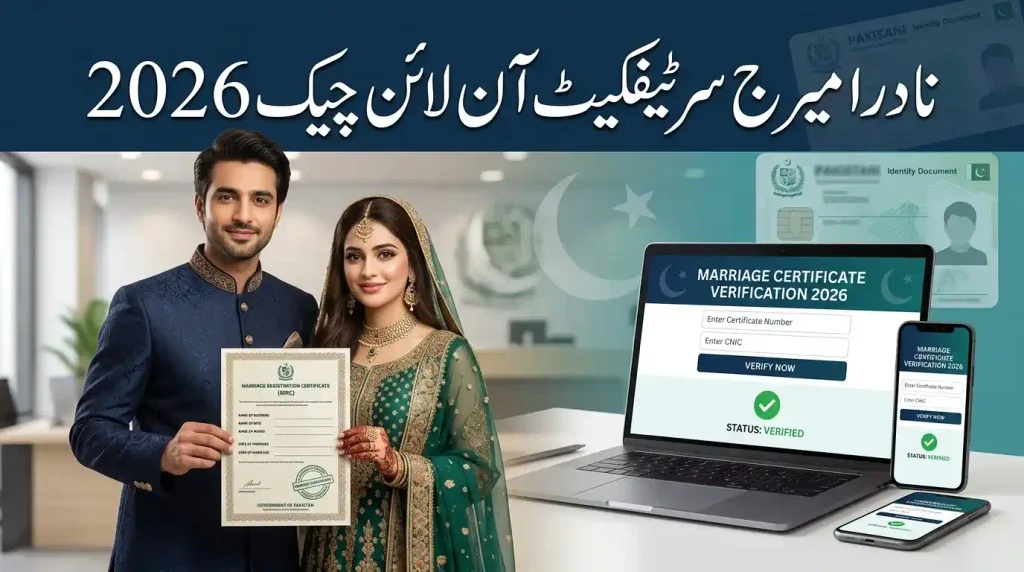
In Pakistan, marriage registration is handled through the authorized local registration authority, while NADRA-related identity and civil-registration systems are used as part of the broader record and verification process. The exact procedure, fee, processing time and required documents can vary by area.
This complete NADRA Marriage Certificate guide 2026 explains how marriage registration works, the difference between Nikah Nama and Marriage Registration Certificate, where to apply, required documents, online checking and verification options, corrections, duplicate certificates, overseas use, MOFA attestation and frequently asked questions.
What Is a NADRA Marriage Certificate?
The document commonly called a NADRA Marriage Certificate is generally referred to as a Computerized Marriage Registration Certificate (MRC).
It serves as official documentary evidence that a marriage has been registered with the relevant authority. The certificate contains important information about the spouses and the registered marriage.
A common misunderstanding is that NADRA itself directly issues every Marriage Registration Certificate. In practice, marriage registration and certificate issuance are handled through the relevant local authority, such as a Union Council or another competent local-government authority, depending on the location and applicable rules.
NADRA’s identity and civil-registration infrastructure may be involved in verification and record integration, but the applicant should contact the authority responsible for the marriage registration in the relevant area for issuance, correction, duplicate copies and local requirements.
Is a Marriage Registration Certificate Mandatory in Pakistan?
For Muslim marriages, Pakistani law provides for registration of the marriage. Section 5 of the Muslim Family Laws Ordinance, 1961 states that every marriage solemnized under Muslim law shall be registered according to the Ordinance.
The law also provides for licensed Nikah Registrars under the Union Council framework.
Therefore, completing the Nikah ceremony and keeping the Nikah Nama is not the end of the registration process. The marriage should also be properly registered with competent authority.
Nikah Nama vs Marriage Registration Certificate
The Nikah Nama and Marriage Registration Certificate are related but different documents.
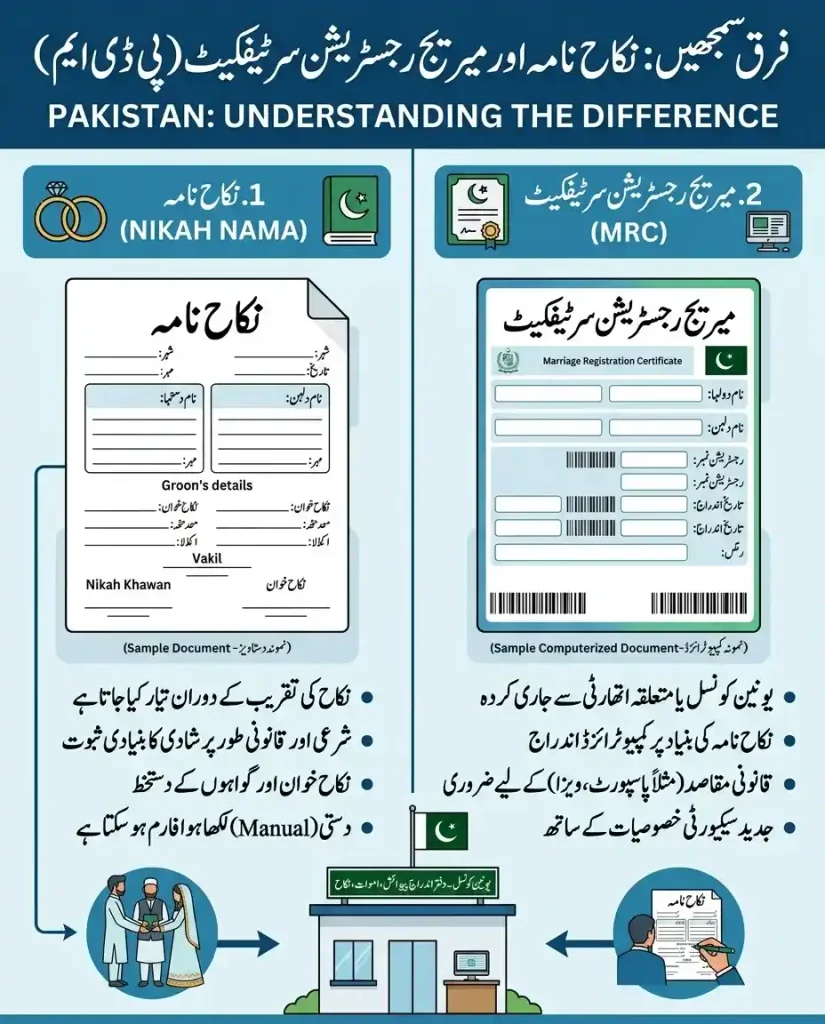
| Feature | Nikah Nama | Marriage Registration Certificate |
| Purpose | Marriage contract and original marriage record | Evidence of registered marriage |
| Prepared during | Nikah ceremony | After/through registration process |
| Language | Commonly Urdu | Often computerized and may be issued in English depending on authority |
| Main authority | Nikah Registrar | Relevant local registration authority |
| Information | Marriage terms, spouses, witnesses and other particulars | Registered marriage details |
| International use | May require translation/attestation | Commonly requested with other supporting documents |
| Replacement | Obtain through relevant registration record/authority | Request duplicate from issuing authority |
The Nikah Nama is an important foundational document and should be preserved even after obtaining the computerized Marriage Registration Certificate.
Do not assume that the computerized certificate replaces the original Nikah Nama in every legal or documentary situation.
What Is the Legal Basis for Marriage Registration in Pakistan?
For Muslim marriages, registration is governed primarily by the Muslim Family Laws Ordinance, 1961, along with applicable rules and local administrative procedures.
Section 5 requires Muslim marriages to be registered and provides for licensed Nikah Registrars.
The registration process can involve:
- Nikah Registrar
- Union Council
- Local Government authority
- Municipal or relevant local registration office
- Cantonment authority where applicable
- Arbitration Council in jurisdictions where it handles the relevant service
- Civil-registration and identity verification systems
The exact authority depends on where the marriage was solemnized and registered.
Who Issues the Marriage Registration Certificate?
One of the most important corrections to commonly published information is that applicants should not automatically assume that a NADRA Registration Centre is the place where the marriage certificate itself is issued.
The certificate is generally obtained through the competent local registration authority responsible for the marriage record.
Depending on the location, this may involve:
- Union Council
- Municipal/local government office
- Cantonment Board
- Arbitration Council or another designated authority
- Other legally authorized registration office
For this reason, applicants should first identify the authority responsible for the area in which the marriage was registered.
Is There a Public CNIC-Based Marriage Search?
A major misconception is that you can enter any person’s CNIC number into an official NADRA website and publicly see their marriage record.
You should not treat marriage records as a publicly searchable CNIC database.
There is no basis for assuming that an unrestricted public website exists where anyone can enter another person’s CNIC and download their complete marriage record.
Marriage information is personal data and access to official records is subject to applicable verification and authorization procedures.
How Can You Verify a Marriage Certificate?
If you need to verify a Marriage Registration Certificate, use an official verification route appropriate to your situation.
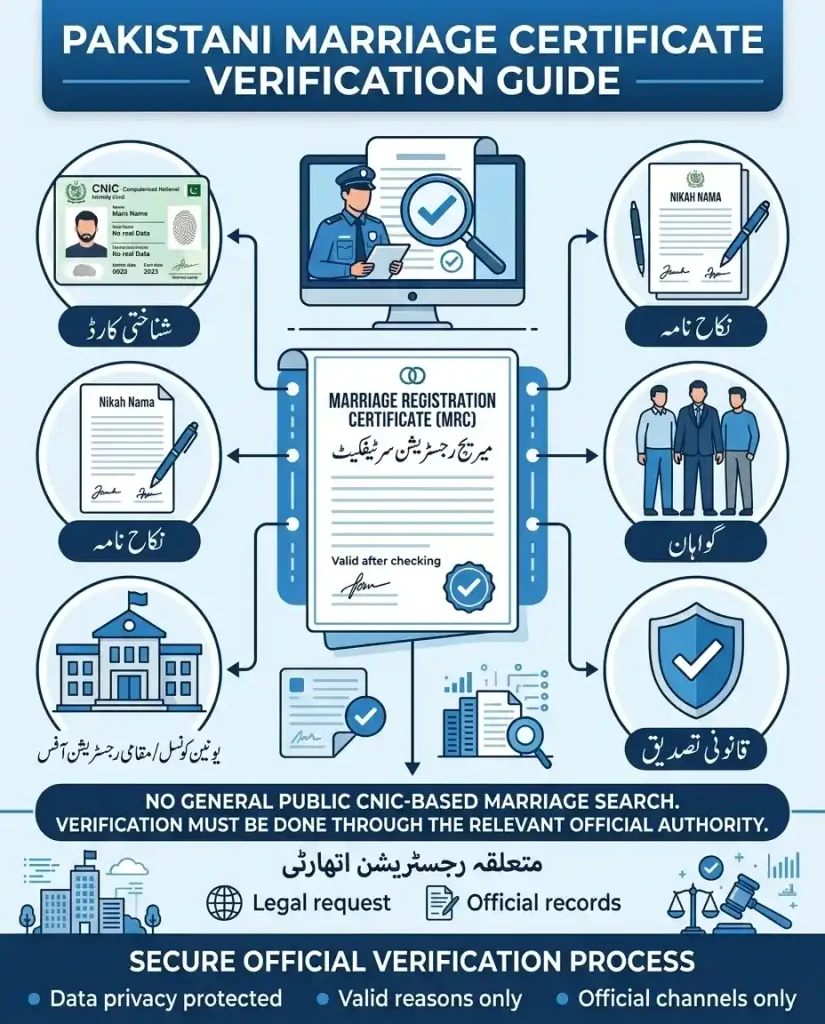
Possible routes include:
- Checking the certificate with the issuing authority.
- Presenting the original certificate for institutional verification.
- Following the verification procedure required by an embassy or government department.
- Using any official verification mechanism printed on the certificate, where applicable.
- Obtaining relevant family documentation through authorized NADRA services when appropriate.
Do not rely on websites, mobile applications or individuals claiming that they can reveal another person’s complete marriage record simply by entering a CNIC number.
Can NADRA Marital Status Be Checked Online?
NADRA provides family-related documentation, including the Family Registration Certificate (FRC). NADRA describes the FRC as a document that reflects and verifies registered family-composition data, including an FRC by Marriage category.
However, an FRC should not be confused with a public marriage-record search service.
An FRC may help establish registered family relationships for an eligible applicant, but it does not mean that the public can freely search for another person’s complete marital record by CNIC.
What Information Appears on a Marriage Registration Certificate?
The exact layout can vary by issuing authority, but a Marriage Registration Certificate may contain information such as:
- Husband’s name
- Wife’s name
- CNIC or identification information
- Marriage date
- Place or registration details
- Relevant registration/reference number
- Details associated with the marriage record
- Authentication or verification features, where applicable
Always compare the certificate against the original Nikah Nama and identity documents before using it for another official process.
Documents Required for Marriage Registration Certificate
Requirements vary between authorities, but applicants may commonly be asked for:
- Original Nikah Nama
- Copy of Nikah Nama
- CNIC copies of bride and groom
- CNIC copies of relevant parents were required
- CNIC of the Nikah Registrar/Nikah Khawan where required
- Applicant’s CNIC
- Passport copy where one spouse is a foreign national
- B-Form or other supporting documents where specifically required
- Additional supporting documents requested by the registration authority
For example, the Islamabad Capital Territory Administration currently lists the original Nikah Nama, attested copy of the Nikah Nama, CNIC copies of bride and groom, fathers’ CNIC copies, passport copy where a spouse has another nationality, B-Form where applicable, and applicant CNIC among its listed requirements.
Because requirements can change, confirm the checklist with the relevant local authority before visiting.
How to Get a Marriage Registration Certificate in Pakistan
The general process is as follows.
Step 1: Complete the Nikah
Marriage is solemnized according to the applicable legal and religious requirements.
The Nikah Registrar records the marriage details in the Nikah Nama.
Step 2: Obtain the Completed Nikah Nama
Make sure the Nikah Nama contains the required signatures, stamps and information.
Check the spelling of:
- Bride’s name
- Groom’s name
- Fathers’ names
- CNIC numbers
- Marriage date
- Address
- Witness information
Step 3: Submit the Marriage Record for Registration
Submit the required documents to the authority responsible for registering the marriage in the relevant area.
The authority responsible depends on the jurisdiction.
Step 4: Verification and Data Entry
The registration office checks the submitted documents and enters/processes the marriage information according to its applicable registration procedure.
Step 5: Proofreading and Record Confirmation
Applicants should carefully check the entered information before final issuance.
Step 6: Certificate Issuance
After completion of the registration process and applicable verification, the computerized Marriage Registration Certificate is issued by the relevant authority.
Step 7: Check the Certificate Before Leaving
Verify all names, CNIC numbers, dates and other information immediately.
If there is an error, ask the issuing authority about the correction procedure instead of using the incorrect document for immigration, banking or other official purposes.
Marriage Certificate Processing Time in Pakistan
There is no single nationwide processing time that should be quoted for every city and authority.
Processing can depend on:
- City or district
- Registration authority
- Record availability
- Verification requirements
- Whether the case is straightforward or requires additional documentation
- Local urgent/normal service options
For example, the Islamabad Capital Territory Administration currently lists 7 days as the processing time for its Marriage Registration Certificate service.
Therefore, claims such as “every NADRA Marriage Certificate takes exactly 3–5 days” should be avoided unless they are specifically confirmed by the relevant issuing office.
NADRA Marriage Certificate Fees in Pakistan
There is also no single fee that should automatically be presented as the nationwide NADRA Marriage Certificate fee.
Fees can depend on:
- Location
- Issuing authority
- Registration type
- Duplicate/reissue request
- Correction request
- Urgent service, where available
- Other local administrative charges
For example, the official Islamabad Capital Territory Administration page currently lists Rs. 200 processing fees for its Marriage Registration Certificate service.
Because local charges can change, confirm the current fee directly with the authority handling your marriage registration.
Where Can You Apply for a Marriage Certificate?
The correct office depends on the jurisdiction.
Applicants may need to contact:
- Union Council
- Municipal/local government office
- Cantonment Board
- Arbitration Council or designated authority
- Other competent local registration office
Marriage Certificate in Islamabad
Islamabad has a specific administrative process for Marriage Registration Certificates.
The ICT Administration currently lists the service through its Citizen Facilitation Centre and identifies the relevant local-government authority. It lasts Monday to Friday, 9:00 AM to 6:00 PM, with a Friday break, along with a 7-day processing time and Rs. 200 processing fees. Applicants should recheck the official page before visiting because government procedures can change.
Marriage Certificate in Rawalpindi
For Rawalpindi, applicants should identify with the Union Council or other competent local registration authority responsible for the marriage record.
Do not assume that every Rawalpindi applicant should visit a NADRA office for issuance.
Marriage Certificate in Other Cities
The same principle applies to Lahore, Karachi, Faisalabad, Multan, Peshawar, Hyderabad and other areas: identify the authority responsible for the marriage registration in that locality and confirm its current requirements.
NADRA Marriage Certificate Correction
Errors in a marriage record should be corrected through the authority responsible for the registration record.
Common errors may include:
- Incorrect spelling of bride’s name
- Incorrect spelling of groom’s name
- Incorrect father’s name
- Wrong CNIC number
- Incorrect marriage date
- Address mismatch
- Incorrect witness information
- Errors transferred from the original Nikah Nama
How to Request a Correction
Generally:
- Identify the incorrect information.
- Collect the original certificate and supporting documents.
- Compare the record with the Nikah Nama and CNICs.
- Contact the issuing/registration authority.
- Submit the correction request and supporting evidence.
- Follow any additional verification required by the authority.
Do not attempt to alter a government-issued certificate yourself.
What If You Lose Your Marriage Certificate?
If the original Marriage Registration Certificate is lost, damaged or unavailable, contact the authority that maintains the marriage registration record.
A duplicate/reissued certificate may be available after:
- Identity verification
- Confirmation of the marriage record
- Submission of the required application
- Payment of applicable charges
- Submission of supporting documents where required
Keep the original Nikah Nama and copies of the certificate in a secure location to make future verification easier.
Can Overseas Pakistanis Obtain a Marriage Certificate?
Overseas Pakistanis may need a representative in Pakistan when the issuing authority requires physical submission or collection.
A Power of Attorney may be relevant in some cases, but applicants should confirm the exact requirements with the registration authority concerned before assuming that a representative can complete every step.
Additional documentation may be required when:
- One spouse is a foreign national
- The marriage took place outside Pakistan
- The applicant is unable to appear personally
- An embassy or foreign immigration authority requires authentication
Do not assume that sending documents by email or WhatsApp automatically completes the legal registration process.
Marriage Certificate for Foreign Spouses
Where one spouse is a foreign national, additional documentation can be required.
The Ministry of Foreign Affairs currently states that for attestation of a Nikah Nama/Marriage Registration Certificate involving a foreign national, supporting documents can include the foreign spouse’s passport, Pakistani visa and date of entry into Pakistan.
The exact requirements for marriage registration itself should be confirmed with the local registration authority.
Marriage Certificate for Visa and Immigration
A Marriage Registration Certificate may be required as supporting evidence for:
- Spouse visa applications
- Family immigration
- Residence applications
- Family sponsorship
- Embassy documentation
- Foreign government procedures
However, having a Pakistani Marriage Registration Certificate does not automatically mean that every foreign embassy will accept it without additional steps.
The destination country’s immigration authority may require:
- Original certificate
- Certified copy
- Translation
- MOFA attestation
- Apostille
- Embassy/consular legalization
- Additional identity or family documents
Always follow the requirements of the specific destination country.
MOFA Attestation of Marriage Certificate
For documents intended for use abroad, the Ministry of Foreign Affairs (MOFA) Pakistan provides document attestation/apostille services.
MOFA currently lists Marriage Registration Certificate/Nikah Nama among documents eligible for relevant attestation procedures. Its published requirements include the original Nikah Nama issued by the Nikah Registrar, the Marriage Registration Certificate and specified supporting identity/family documents, depending on the case.
MOFA also lists Marriage Registration Certificates/Nikah Namas among personal documents covered by its attestation services.
Do You Need Translation?
If the destination authority requires a document in another language, you may need a certified translation.
Translation requirements depend on the embassy, immigration authority or foreign institution receiving the document.
Do not assume that every country requires the same translation or legalization process.
Apostille vs Embassy Attestation
These procedures should not be treated as identical.
Depending on the destination country and the purpose of the document, you may need an apostille or another form of authentication/legalization.
Before submitting your marriage certificate abroad, check the current requirements of:
- The destination country’s immigration or government authority.
- The relevant embassy/consulate.
- Pakistan’s Ministry of Foreign Affairs where applicable.
Can a Marriage Certificate Be Used to Update CNIC Information?
A registered marriage can become relevant when updating family and marital information with NADRA.
The exact documents required depend on the service being requested and the applicant’s circumstances.
For example, a spouse may need supporting marriage documentation when updating relevant identity/family information.
Because NADRA requirements can change by service and case type, applicants should use the current official NADRA procedure rather than relying on an old checklist.
Marriage Certificate and Family Registration Certificate (FRC)
The Family Registration Certificate (FRC) is different from the Marriage Registration Certificate.
NADRA describes the FRC as a document showing and verifying registered family-composition information. It provides categories including FRC by Marriage, which can include spouse and children information.
A simple comparison is:
| Document | Main Purpose |
| Nikah Nama | Original marriage contract/record |
| Marriage Registration Certificate | Evidence of registered marriage |
| FRC by Marriage | NADRA family-composition record |
These documents can complement one another but should not be treated as interchangeable.
Common Mistakes to Avoid
Applicants can reduce delays by checking their documents before submission.
Common mistakes include:
- CNIC number entered incorrectly
- Different spellings of names
- Incorrect father’s name
- Wrong marriage date
- Incomplete Nikah Nama
- Missing signatures or stamps
- Missing supporting documents
- Submitting to the wrong authority
- Assuming a NADRA office issues the certificate in every case
- Using unofficial online marriage-record websites
- Waiting until a visa application to discover an error
- Failing to keep copies of the original documents
How to Check Your Marriage Certificate Before Using It
Before submitting your certificate to an embassy, bank, court or government department, check:
- Bride’s name
- Groom’s name
- CNIC numbers
- Father’s names
- Marriage date
- Registration information
- Spelling
- Document number/reference details
- Authentication/verification information, where applicable
If anything is incorrect, contact the issuing authority before using the document.
Is There a Public NADRA Marriage Database?
No assumption should be made that NADRA provides a public database where anyone can search the marriage records of other people.
Marriage and family information should be accessed through authorized channels and applicable identity-verification procedures.
Be particularly careful with websites, APK files, social-media pages or individuals claiming they can provide someone’s:
- Marriage record
- Wife/husband details
- Complete family tree
- CNIC information
- Marriage history
Simply entering a CNIC number into an unofficial website does not make the resulting information an official NADRA record.
Final Takeaway
The term “NADRA Marriage Certificate” is commonly used online, but applicants should understand the actual registration structure. The Marriage Registration Certificate (MRC) is evidence of a registered marriage, while the Nikah Nama records the marriage contract and its particulars.
For Muslim marriages, Pakistani law requires registration, and the relevant Union Council/local registration framework plays an important role.
There is also an important distinction between official verification and an alleged public online CNIC search. Applicants should use authorized government channels rather than unofficial websites claiming to provide private marriage records.
For 2026, the safest approach is to confirm the current issuing authority, document checklist, fee, processing time and overseas-attestation requirements before applying. Local requirements can differ, and official government pages should take priority over outdated third-party information.