Lifetime CNIC for 60+ Years — NADRA Rule 2026
If you are 60 years or older, a major change in Pakistan’s identity-card rules may make CNIC renewal much easier. Under the updated NADRA rules 2026, citizens aged 60 and above, including eligible resident and non-resident Pakistani citizens, are covered by the new lifetime-valid identity card provision.
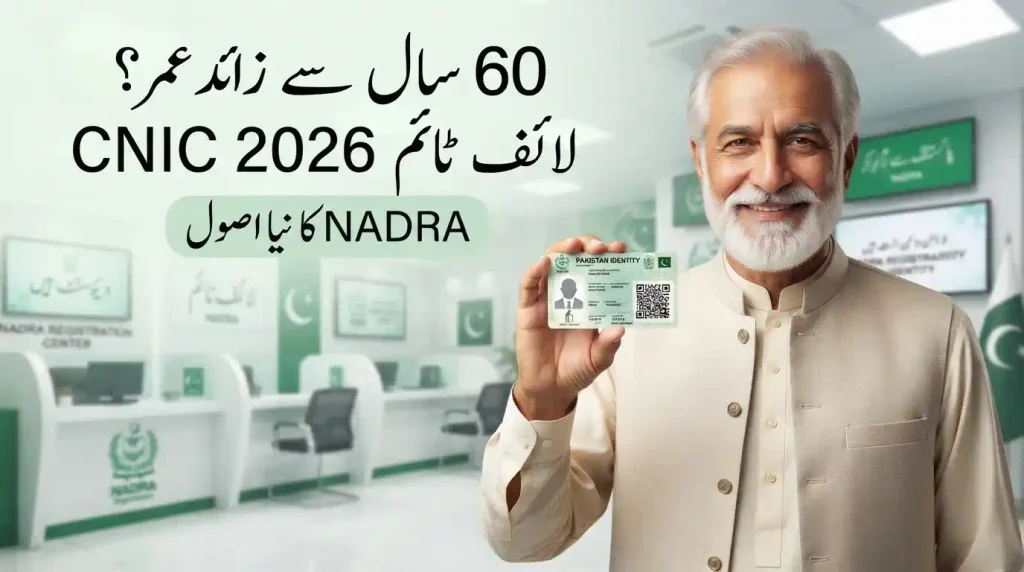
NADRA has also introduced a new QR-code-based National Identity Card in 2026. The new card includes a specific symbol for senior citizens and is being introduced in phases. Existing identity cards remain valid until their respective expiry dates.
This guide explains the Lifetime CNIC for 60+ years, eligibility, application process, fees, renewal requirements, QR-code CNIC, senior-citizen facilities, biometric issues, and other important NADRA CNIC rules 2026.
Quick Answer
| Question | Answer |
|---|---|
| Who can get a lifetime CNIC? | Citizens aged 60 years and above, subject to the applicable NADRA rules and verification |
| Is the CNIC lifetime valid? | The 2026 reforms provide lifetime validity for eligible citizens aged 60+ |
| Is there a senior-citizen symbol? | Yes. The new identity-card design includes a specific symbol for senior citizens |
| Do existing CNICs automatically become lifetime cards? | An existing card remains valid until its expiry; the new QR-card rollout does not require immediate replacement of every existing card |
| Can seniors use PakID? | Yes, PakID supports CNIC renewal, modification and reprint/lost services |
| Is the new QR-code CNIC already available? | Yes. NADRA began the first phase on 14 August 2026 |
| Is the QR card replacing all identity cards immediately? | No. NADRA is introducing it in phases |
| Does lifetime validity mean information can never be changed? | No. Changes to personal information may still require the relevant NADRA modification service |
What Is a Lifetime CNIC?
A lifetime CNIC is an identity card issued with lifetime validity rather than requiring the holder to renew it periodically.
The 2026 reforms introduced a specific lifetime-valid identity-card provision for citizens aged 60 years and above. The change is particularly relevant to senior citizens who previously had to deal with recurring identity-card renewal requirements.
A CNIC remains an official identity document issued by NADRA and serves as proof of identity, nationality and legal status in Pakistan. NADRA currently provides standard CNIC, Smart CNIC and QR-code CNIC formats.
NADRA Lifetime CNIC Rule 2026
The NADRA lifetime CNIC rule 2026 is part of the updated identity-card framework introduced during 2026.
The key change is that eligible Pakistani citizens who have reached 60 years of age can be issued an identity card with lifetime validity.
The new senior-citizen identity card is also designed to carry a distinct senior-citizen symbol, making the status identifiable on the card.
This change should be distinguished from older CNIC policies and historical reports about lifetime validity at different ages. For 2026, the relevant age threshold discussed in the updated rules is 60 years.
Who Is Eligible for a Lifetime CNIC in Pakistan?
Basic Eligibility
The main eligibility condition is reaching 60 years of age.
The 2026 reforms cover eligible Pakistani citizens aged 60 and above, including resident and non-resident citizens under the applicable identity-document framework.
However, eligibility for lifetime validity does not remove NADRA’s normal identity-verification requirements. Applicants may still need to provide biometric verification or supporting documentation where required.
A senior citizen should therefore check their current NADRA record and card status before assuming that an existing card has automatically changed to lifetime validity.
What Is the Senior Citizen Logo on the CNIC?
The new NADRA identity-card design includes specific symbols for certain categories of citizens.
The senior-citizen symbol is one of the symbols incorporated into the new QR-code-based identity card.
According to NADRA, the new card also includes symbols identifying persons with disabilities, senior citizens, organ donors and citizens of Azad Jammu and Kashmir.
Do Senior Citizens Need to Renew Their CNIC After Age 60?
The purpose of the lifetime-validity provision is to remove the need for repeated renewal for eligible citizens covered by the rule.
However, lifetime validity does not mean that every administrative service connected with the CNIC becomes permanent.
For example, a citizen may still need to contact NADRA if:
- Their name needs to be modified
- Their address changes
- Their marital status needs updating
- Their photograph or biometric information needs updating
- The card is lost or damaged
- NADRA requires additional verification
- Their identity information contains an error
NADRA continues to advise citizens to keep identity information current and to renew documents when renewal is legally required for documents that have not been given lifetime validity.
Does an Existing CNIC Automatically Become Lifetime Valid at Age 60?
This is one of the most important points for senior citizens.
Do not assume that an existing physical CNIC automatically changes into a new lifetime-valid card simply because the holder turns 60.
NADRA’s 2026 QR-card announcement states that identity cards already issued will remain valid until their respective expiry dates. The new QR-code card is being introduced through a phased rollout.
Therefore, if your existing CNIC is still valid, you should check the applicable NADRA service or contact NADRA before applying for a replacement solely because you have crossed the age of 60.
What Happens If a Senior Citizen’s CNIC Has Already Expired?
An expired CNIC can create problems with identity verification and services connected to CNIC records.
NADRA has warned that expired identity documents can affect services such as:
- Bank-account verification
- Mobile SIM-related verification
- Government services
- Welfare-programme verification
- Property transactions
- Vehicle transfers
- Other CNIC-based services
For an expired card, the applicant should use the applicable NADRA renewal or identity-document service rather than assuming that the expired card has automatically become lifetime-valid.
How to Get a Lifetime CNIC After Turning 60?
The exact service available to an applicant can depend on the person’s existing CNIC record, card type and current NADRA rollout.
A general process is:
Step 1: Check Your CNIC Status
Check whether your current CNIC is valid, expired, lost or requires modification.
Step 2: Check Your Age and Identity Record
Make sure your date of birth is correctly recorded in the NADRA database.
Age eligibility depends on the date of birth recorded in the official identity record.
Step 3: Visit a NADRA Registration Centre if Required
If the required service cannot be completed digitally or NADRA asks for physical verification, visit the nearest NADRA Registration Centre.
NADRA also operates Mobile Registration Vans for several identity services, including CNIC renewal, modification and reprint/lost services.
Step 4: Select the Correct Service
Depending on your situation, the required service may be:
- Renewal
- Modification
- Reprint/Lost
- New CNIC
- Another identity-document service
Do not select a modification or replacement service unnecessarily. Explain your situation to the NADRA officer if you are unsure which service applies.
Step 5: Complete Biometric Verification
NADRA may require biometric verification as part of the application or identity-verification process.
The updated 2026 identity framework also recognizes biometric methods including fingerprint and iris-based verification.
Step 6: Check Your Information
Before confirming the application, carefully check:
- Name
- Father’s or mother’s name where applicable
- Date of birth
- Address
- Marital status
- Photograph
- Other printed information
Mistakes should be reported before final confirmation whenever possible.
Step 7: Pay the Applicable Fee
The applicable NADRA fee depends on the service and card category.
Step 8: Keep Your Receipt and Tracking Details
After submitting the application, keep your receipt, tracking details and any reference information provided by NADRA.
Step 9: Receive the Updated Identity Card
Once the application has been processed, the identity card is delivered according to the selected service and delivery method.
Can Senior Citizens Apply Through the PakID App?
Yes. PakID is NADRA’s official mobile application and supports several CNIC services, including:
- CNIC renewal
- CNIC modification
- CNIC reprint/lost
- Certain other identity-document services
NADRA’s official PakID FAQ confirms that CNIC renewal, modification and reprint/lost applications are available through the PakID mobile application.
A senior citizen can therefore use PakID where the required service is supported and the applicant meets the digital-verification requirements.
In some cases, biometric verification or another step may still require a visit to a NADRA Registration Centre.
NADRA CNIC Fees for Senior Citizens in 2026
The lifetime CNIC provision should not be confused with a blanket exemption from every NADRA service fee.
The fee depends on the service and identity-card category.
NADRA’s current fee structure lists the following standard CNIC charges:
| Service | Normal | Urgent | Executive |
|---|---|---|---|
| CNIC Modification | Rs. 400 | Rs. 1,150 | Rs. 2,150 |
| CNIC Duplicate | Rs. 400 | Rs. 1,150 | Rs. 2,150 |
| CNIC Renewal | Rs. 400 | Rs. 1,150 | Rs. 2,150 |
For Smart NIC services, the listed charges are:
| Smart NIC Service | Normal | Urgent | Executive |
|---|---|---|---|
| New / Modification / Duplicate / Renewal | Rs. 750 | Rs. 1,500 | Rs. 2,500 |
Always check NADRA’s current fee structure before submitting an application because fees and service categories can be updated.
What Are the Processing Times for CNIC Services?
NADRA’s listed processing timelines depend on the card type and service category.
For standard CNIC services, the commonly listed timelines are:
| Category | Processing Time |
|---|---|
| Normal | 15 days |
| Urgent | 12 days |
| Executive | 6 days |
For Smart NIC services, the listed timelines are different.
Processing time generally begins after the applicable fee has been paid, and delivery or verification requirements can affect the overall time.
What Documents Should a Senior Citizen Take to NADRA?
The exact documents depend on the service being requested.
A senior citizen should generally take:
- Existing CNIC or identity document
- Relevant supporting documents if information needs to be changed
- Any document requested by NADRA for the particular application
- Payment information or the required fee
- Application/tracking information if continuing an existing case
For modifications, the supporting document depends on what information is being changed.
For example, a name change, address change and date-of-birth correction can have different documentation requirements.
What If the Senior Citizen Has a Biometric Verification Problem?
Biometric verification can sometimes be difficult for elderly applicants because fingerprints may be difficult to capture.
If fingerprint verification fails:
- Inform the NADRA officer.
- Ask for the applicable alternative verification procedure.
- Follow the biometric or identity-verification process provided by NADRA.
- Do not repeatedly submit incorrect applications simply because the fingerprint scanner failed.
- Keep any application or complaint reference number.
NADRA’s current identity system uses biometric verification as an important part of identity authentication.
NADRA Facilities for Elderly and Vulnerable Citizens
NADRA has introduced and operates several facilities intended to make identity services more accessible.
Mobile Registration Vans provide services including CNIC fresh registration, renewal, reprint/lost and modification.
NADRA has also announced that its Proof of Life Certificate for pensioners is free of charge and can be obtained through several channels, including PakID, NADRA Registration Centres, Union Councils, e-Sahulat franchises and mobile service channels. This is particularly relevant to elderly pensioners who have difficulty visiting banks or pension offices.
For persons with disabilities, NADRA separately provides lifetime CNIC validity, preferential service, special counters, wheelchair and ramp facilities, and doorstep processing for bedridden persons with disabilities. This is a separate provision from the 60+ senior-citizen rule.
What Is the 2026 QR-Code CNIC?
In August 2026, NADRA introduced a new chipless QR-code-based National Identity Card.
Instead of relying on an imported microchip, the new card uses a secure QR code that can be read and verified using a smartphone or appropriate software.
The QR code contains relevant cardholder information and the cardholder’s photograph. The card also displays the family number and specific symbols for categories such as senior citizens and persons with disabilities.
The cardholder’s name and address are displayed in both Urdu and English.
When Did the New QR-Code CNIC Start?
NADRA introduced the QR-code identity card through a phased rollout.
Phase 1 — August 2026
Starting 14 August 2026, the QR-code-based card began replacing the standard National Identity Card.
Phase 2 — January 2027
From January 2027, the QR-code format is planned to extend to other identity-card categories, including NICOP and Juvenile Cards.
Final Phase
The final phase will transition the Pakistan Origin Card (POC) to the chipless QR-code format.
Do Existing CNICs Need to Be Replaced Because of the New QR Card?
No immediate replacement of every existing card is required simply because NADRA has introduced the QR-code CNIC.
NADRA has specifically stated that all identity cards already issued will remain valid until their respective expiry dates.
Therefore, citizens should not assume that they must replace a valid existing CNIC immediately just because the new QR-code design has been launched.
What Other Changes Were Introduced in NADRA Rules 2026?
The 2026 identity-document reforms involve more than lifetime validity for senior citizens.
QR-Based Verification
The new QR-code card supports faster digital verification using smartphones and compatible software.
Expanded Biometric Recognition
The updated framework recognizes biometric verification methods used by NADRA for identity authentication.
Stronger Suspension Controls
Identity verification and authentication can be affected when an identity record is subject to applicable suspension or verification controls.
Updated Card Formats
NADRA has updated identity-card designs and security features as part of the QR-code transition.
AJK Resident Identification
The new card includes a specific symbol identifying citizens of Azad Jammu and Kashmir.
Lifetime CNIC for Persons With Disabilities
Senior citizens are not the only category associated with lifetime CNIC validity.
NADRA separately states that CNICs issued to persons with disabilities (PWDs) are issued with lifetime expiry.
NADRA also provides preferential treatment, special counters and accessibility facilities for PWDs. Bedridden persons with disabilities can receive doorstep processing under the applicable service arrangements.
This should not be confused with the 60+ senior citizen lifetime CNIC provision.
Lifetime CNIC for Organ Donors
The new 2026 QR-code card also includes a symbol for organ donors.
This symbol is part of the new card’s visual identification features.
The organ-donor symbol and senior-citizen symbol are separate categories and should not be interpreted as the same eligibility condition.
Why Was Lifetime CNIC Introduced for Senior Citizens?
The lifetime-validity provision reduces the need for eligible senior citizens to repeatedly deal with identity-card renewal as they age.
This is particularly relevant for elderly citizens who may have mobility difficulties, biometric-verification challenges or difficulty travelling to NADRA offices.
The wider 2026 reforms also focus on more accessible digital identity verification through the new QR-code card.
What Happens If a Lifetime CNIC Is Lost?
Lifetime validity does not mean a lost physical card can be used indefinitely without replacement.
If a lifetime-valid CNIC is lost, the citizen should report the loss and apply for the applicable reprint/lost identity-card service through NADRA.
The replacement card will be processed according to the current NADRA procedure and applicable fee.
What Happens If Information Changes After Getting a Lifetime CNIC?
A lifetime-valid CNIC can still require modification if the underlying personal information changes.
Examples include:
- Change of address
- Name modification
- Marital-status update
- Correction of personal information
- Other changes recognized by NADRA
Lifetime validity refers to the validity period of the identity card, not a permanent freeze on the information stored in the NADRA database.
Common Problems Senior Citizens May Face
Incorrect Date of Birth
If the date of birth recorded in NADRA’s database is incorrect, age-based eligibility can become an issue.
The citizen should resolve the date-of-birth record through the applicable NADRA correction procedure.
Biometric Verification Failure
Fingerprint quality can become difficult to capture for some elderly people.
If this happens, request the applicable alternative verification process from NADRA rather than submitting inaccurate information.
Outdated Information
An old address, incorrect marital status or other outdated information can create problems during identity verification.
Lost or Damaged CNIC
A lost or damaged card should be reported and replaced through the relevant NADRA service.
Confusion About the New QR Card
The introduction of the QR-code CNIC does not mean that every existing card must immediately be replaced.
Existing cards remain valid until their expiry dates unless another rule or specific NADRA action applies.
Common Mistakes to Avoid
Senior citizens should avoid these common mistakes:
- Assuming that turning 60 automatically changes the physical card without checking NADRA requirements
- Replacing a valid CNIC unnecessarily
- Using unofficial websites or applications
- Giving CNIC details to unknown agents
- Paying unofficial charges
- Ignoring an expired CNIC
- Entering an incorrect date of birth
- Failing to check the printed information before confirming an application
- Sharing CNIC numbers, tracking IDs or personal documents publicly
- Assuming lifetime validity means personal information can never be modified
Always use official NADRA channels for identity-card applications and verification.
How to Check the Latest NADRA Information
NADRA rules, fees, services and rollout schedules can change.
For the latest information, check the official NADRA website and its current service pages before applying.
NADRA provides official information about:
- CNIC services
- PakID
- Fees
- Application tracking
- Registration Centres
- Mobile Registration Vans
- Identity-document requirements
- Current announcements
The official NADRA website should be treated as the primary source for current application requirements.
NADRA Helpline and Contact Information
For questions about the Lifetime CNIC for 60+ years, identity-card validity, biometric problems or other NADRA services, citizens can use NADRA’s official contact channels.
NADRA Helpline: 1777
Phone: +92 51 111 786 100
Complaint Email: csd@nadra.gov.pk
NADRA lists these contact channels on its official website.
Final Words
The Lifetime CNIC for 60+ years under NADRA rules 2026 is an important change for senior citizens in Pakistan. Eligible citizens aged 60 and above can benefit from the lifetime-validity provision, reducing the need for repeated identity-card renewal.
At the same time, citizens should understand the difference between lifetime validity, CNIC renewal, Smart CNIC and the new QR-code CNIC. NADRA began introducing the QR-code identity card on 14 August 2026, while existing cards remain valid until their respective expiry dates.
Before applying, verify the latest fee, service category and eligibility requirements through official NADRA channels. Keeping your NADRA record accurate and using official services can help avoid unnecessary delays and identity-verification problems.