
Child Registration Certificate (CRC) / B-Form / Juvenile Card
When I first helped a relative register their newborn at a NADRA office in Rawalpindi, I realized how many Pakistani families are unaware that the B-Form formally called the Child Registration Certificate or CRC is not optional. It is a legally required official registration document issued to children under 18 years of age, prescribed under Rule 18, Schedule VI of the NADRA NIC Rules, 2002. Under Section 9 1 of the NADRA Ordinance 2000, every parent or legal guardian is legally required to register a child within one month of birth, failing which becomes an offence under Section 30 1 of the same ordinance. This makes the CRC the first official identity record of a child inside the NADRA system.
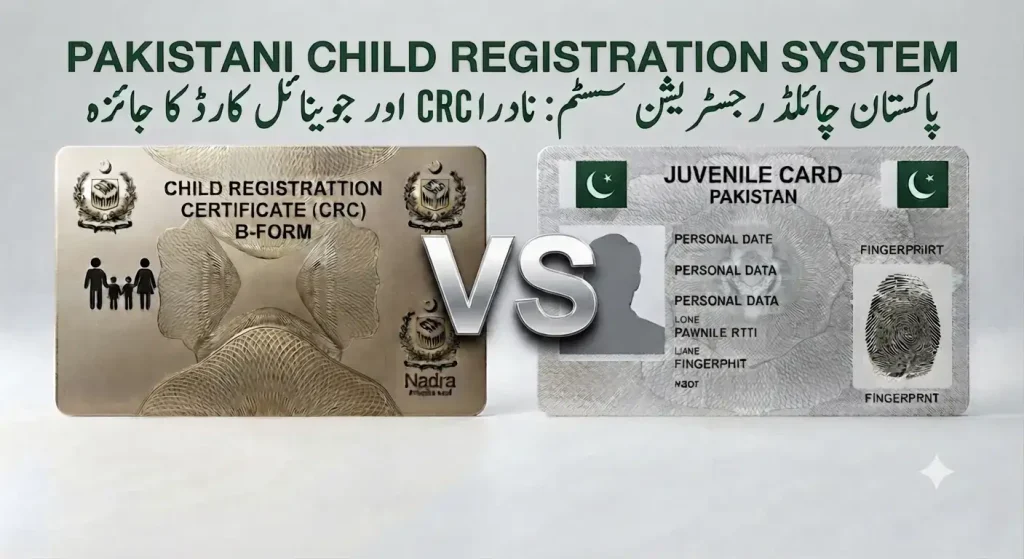
In practical terms, this document serves purposes beyond a piece of paper it is the gateway to Passport issuance, family registration, schooling, medical treatment, legal services, and future CNIC issuance at 18. The CRC records the child’s personal details and links them to the parents’ CNIC numbers, enabling verification of a child’s legal identity in government processes. The CRC remains valid until the child reaches 18 years of age, after which transition to CNIC becomes mandatory. It is worth clarifying that B-Form and CRC refer to the same document B-Form is the commonly used name, while Child Registration Certificate is the official legal term used by NADRA.
What Is a B-Form (CRC) / Juvenile Card?
The B-Form formally called the Child Registration Certificate or CRC is a legally required identity document issued to children below 18 years of age, prescribed under Rule 18, Schedule VI of the NADRA NIC Rules, 2002. Under Section 9(1) of the NADRA Ordinance 2000, every parent or legal guardian must register a child within one month of birth. Failure to do so is an offence under Section 30(1)(a) of the same ordinance.
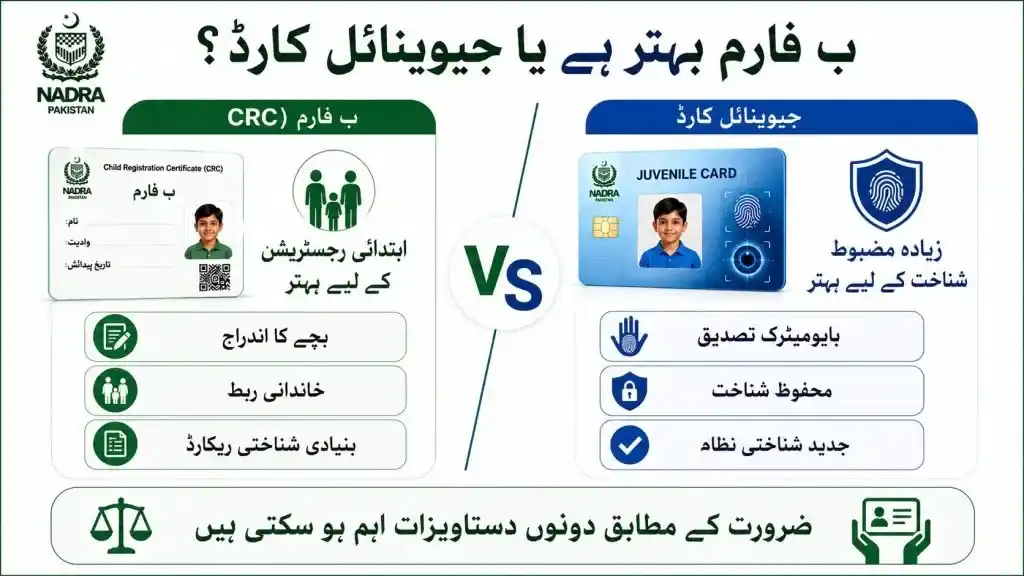
What the CRC gives a child access to:
- Passport issuance
- School enrollment
- Medical treatment
- Legal services
- Family registration
- Future CNIC issuance at age 18
The CRC records the child’s personal details and links them to the parents’ CNIC numbers, enabling verification of the child’s legal identity across all government processes. It remains valid until the child reaches 18, after which transition to a CNIC becomes mandatory.
B-Form vs CRC vs Juvenile Card — Key Differences
| Feature | CRC (B-Form) | Juvenile Card |
| Format | Paper-based registration document | Chip-based Smart Identity Card |
| Purpose | Legal registration in NADRA system | Full identity card with multiple facilities |
| Facilities covered | Foundational identity record | Education, travel, government, banking |
| Valid until | Child turns 18 | Child turns 18 |
| Online application | Available for children up to 1 year old | Only if existing CRC is in NADRA system |
Who Is Eligible for a B-Form / CRC?
Every Pakistani child under 18 whose parent or guardian holds a valid CNIC or NICOP is eligible for a B-Form.
Under Rule 18(1) of the NADRA NIC Rules 2002, every Pakistani citizen who has not attained 18 years of age must be registered with NADRA under Sub-Section (1) of Section 9 of the NADRA Ordinance 2000. A minor holds a fundamental right to receive a registration certificate from their place of origin, from the moment of birth.
Age-Based CRC Issuance System (New NADRA Rules)
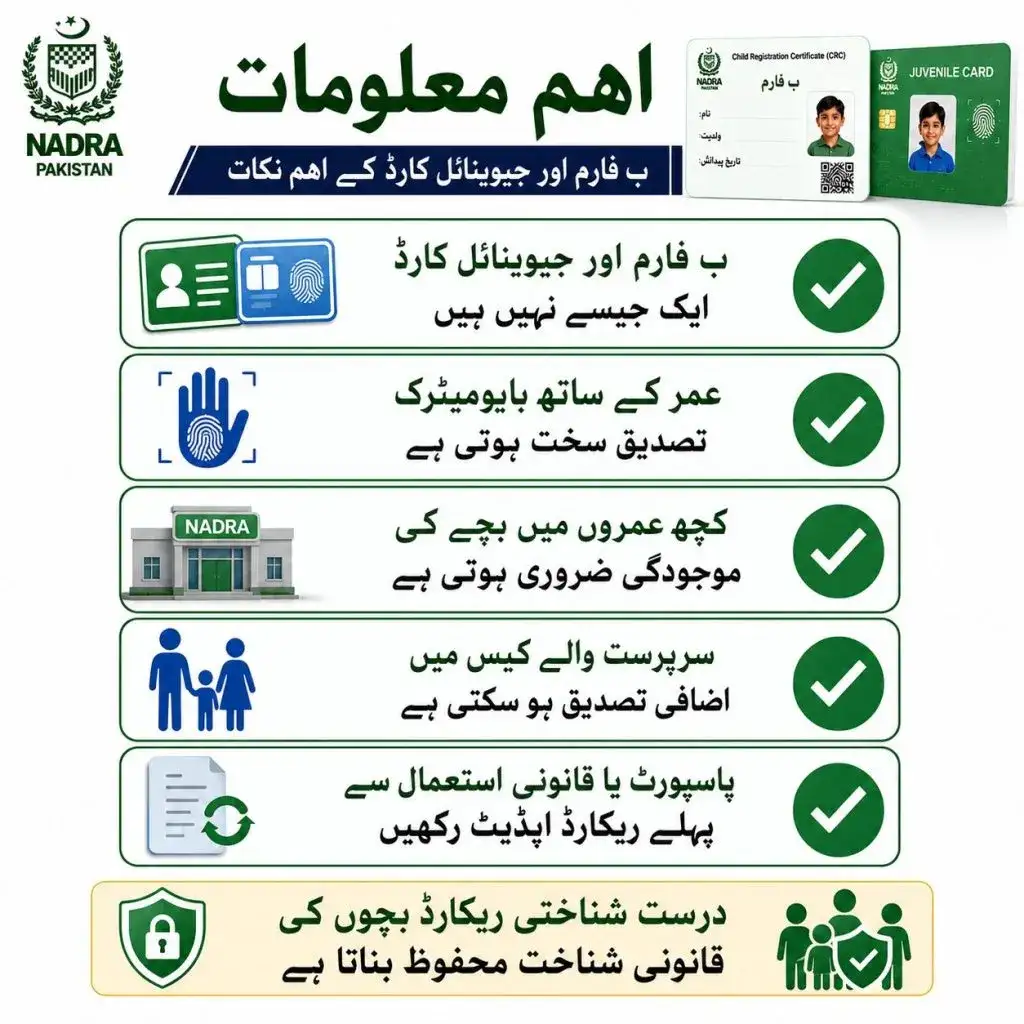
NADRA has replaced the single static B-Form with a staged, age-based issuance system. Each stage adds deeper identity verification as the child grows. Every new CRC replaces the previous one — parents must update at each milestone.
| Stage | Age Range | Requirements | Valid Until |
| Stage 1 | Birth – 3 years | No photograph, no biometrics; based on birth registration only | Age 3 |
| Stage 2 | 3 – 10 years | Photograph mandatory; fingerprints not required | Age 10 |
| Stage 3 | 10 – 18 years | Photograph + fingerprints mandatory; iris scan included | Age 18 |
Required Documents FOR Child Registration Certificate (CRC)
Core documents required from every applicant:
- Computerized Birth Registration Certificate from Union Council, Municipal Committee, or Cantonment Board (for births inside Pakistan)
- S-1 Form or Detailed Birth Certificate from a foreign authority (for births outside Pakistan)
- Valid CNIC or NICOP of at least one parent or legal guardian
- Child’s recent photograph (age-dependent — see table below)
Age-Based Biometric and Presence Requirements
| Child’s Age | Photograph | Fingerprints | Iris Scan | Child Must Be Present |
| 0 – 3 years | Not required | Not required | Not required | Only if processing for passport |
| 3 – 10 years | Mandatory | Not required | Where available | Yes |
| 10 – 18 years | Mandatory | Mandatory | Mandatory | Yes |
For children born abroad, additionally bring:
- Foreign birth certificate
- NICOP of both parents
General rules:
- Parent or legal guardian must be present at the time of application
- All documents must be clear, valid, and verifiable
- Carry originals alongside copies — additional documents may be requested during verification
B-Form / CRC Fees and Processing Time
| Category | Fee (PKR) | Processing Time |
| Normal | Rs 50 | 7 working days |
| Executive | Rs 500 | 1 working day |
- Processing timelines begin only after successful fee payment
- Once a category is selected, it cannot be changed after submission
- Fees are payable at NADRA Registration Centers or through the Pak-ID app
How to Apply Online (Pak-ID App)
Steps:
- Install and open the Pak-ID App (Android / iOS)
- Log in or create a new account
- Navigate: Home → Family → CRC B-Form
- Select applicant category: Myself or My Blood Relatives
- Choose processing priority: Normal or Executive
- Review pre-filled child information; add or correct any missing details
- Verify parent details and confirm identity information
- Provide disability information if applicable
- Upload child’s photograph; capture fingerprints for children aged 10–18 only
- Complete parent biometric (fingerprint) verification
- Upload required documents: birth registration certificate and supporting files
- Review all information carefully
- Submit and pay the prescribed fee
After submission:
- CRC is issued in PDF format and saved in your ID Vault inside the Pak-ID account
- A tracking ID is generated save it immediately
What Is the ID Vault?
The ID Vault is a secure digital storage section inside your Pak-ID account where all approved NADRA identity documents — including your CRC PDF — are stored and accessible at any time. You can view, download, or share documents directly from the vault without visiting a NADRA office.
How to Apply at a NADRA Registration Centre (NRC)
Working hours vary by city. Confirm your local NRC’s schedule at nadra.gov.pk or by calling 1777 before visiting.
- Visit the nearest NRC during working hours
- Get a token from the reception counter
- Parent/guardian biometric verification at the desk
- Child biometrics captured based on age (see Section 4 table)
- Data entry and review — all child and parent information entered and verified for accuracy
- Attestation stage (see Section 8)
- Fee submission based on selected category
- Application processing begins
- CRC printed and handed over at collection
Biometrics and Attestation Rules
| Child’s Age | Biometrics Required | Child Must Be Present |
| 0 – 3 years | None | Only for passport-related CRC |
| 3 – 10 years | Photograph + iris scan (where available) | Yes |
| 10 – 18 years | Photograph + fingerprints + iris scan | Yes |
Parent / Relative Biometric Verification
- Biometric verification of one parent is mandatory for fresh CRC cases or when adding a child
- If a blood relative (father, mother, brother, or sister) or spouse is present at the NRC, biometrics are captured on-site immediately
If no eligible blood relative or spouse is available:
- An attestation form is issued by NADRA
- The form must be attested by a guardian or gazetted officer
- The attested form must be resubmitted to the NRC
Late B-Form Registration
The one-month window for registration is legally required, but late registration is common and NADRA has established clear pathways for it. The process depends on how late the registration is being made.
| Registration Timeline | Process | Additional Requirement |
| Within 1 month of birth | Normal process | None |
| 1 month – 2 years | Late registration | Affidavit from one or both parents explaining cause of delay |
| 2 years – 5 years | Late registration with additional verification | Affidavit + supporting documents (school record, vaccination card, FRC) |
| After 5 years | May require court involvement | Court order may be required in addition to full document set |
Documents Required for Late Registration
- Affidavit from both parents or the applicant explaining the cause of delay — must be duly signed and stamped
- Union Council birth certificate (if available)
- Hospital birth record or delivery slip
- Vaccination card (where available)
- School admission record or school leaving certificate
- NADRA Family Registration Certificate (FRC) confirming family relationship
- Utility bill, lease agreement, or residency proof if no hospital record exists
- Statement from a witness or neighbor who can attest to birth particulars
- Parents’ CNIC or NICOP copies
For overseas Pakistanis managing this from abroad, documents can be submitted through a Power of Attorney — a designated person in Pakistan handles the filing and verification at the local Union Council and NADRA office while the parent remains overseas. The POA must be properly notarized and attested before use.
Single Parent, Divorced, and Separated Cases
NADRA requires biometric verification of at least one parent holding a valid CNIC or NICOP. In most straightforward cases this is sufficient — but when parents are separated, divorced, or the child lives with only one parent, some additional documentation is typically needed.
Separated or Divorced Parents
- The parent present at the NRC provides biometric verification as the applying parent
- A copy of the divorce certificate or court separation order should be carried to clarify custody status if asked
- In contested custody situations, a court custody order designating the legal guardian is required before NADRA will process the application on behalf of one parent only
- The CRC will link the child to both parents’ CNIC numbers regardless of marital status — NADRA records both parents in the registration
Single Parent (Never Married)
- The applying parent’s CNIC is used as the primary identity anchor
- If the father’s information is unknown or not to be included, a sworn affidavit to that effect must be provided
- NADRA may request additional documents to verify the applicant is the biological parent or legal guardian
Deceased Parent Cases
When one or both parents are deceased, the standard biometric verification requirement cannot be met. NADRA has specific provisions for this situation.
One Parent Deceased
- The surviving parent provides biometric verification as normal
- The deceased parent’s death certificate must be submitted alongside the standard document set
- The CRC will be registered under the surviving parent’s record
Both Parents Deceased
- A legal guardian must be appointed — this typically requires a court guardianship order
- The guardian must hold a valid CNIC and be present at the NRC for biometric verification
- Documents required: death certificates of both parents, court guardianship order, guardian’s valid CNIC, child’s birth certificate or available proof of birth
- NADRA FRC or any existing family registration document should also be brought
Required Documents for Deceased Parent Cases
| Situation | Required Documents |
| One parent deceased | Death certificate of deceased parent + surviving parent’s CNIC + standard CRC documents |
| Both parents deceased | Death certificates of both parents + court guardianship order + guardian’s CNIC + birth certificate + FRC |
| Guardian (non-parent) | Court guardianship order + guardian’s CNIC + attestation from gazetted officer |
Mixed-Nationality Families
When one parent is a foreign national without a Pakistani CNIC or NICOP, the child can still be registered under the Pakistani parent’s identity.
- The Pakistani parent’s CNIC serves as the primary identity anchor for the application
- The foreign parent’s passport should be brought for reference, but their biometric verification is not required
- The child’s foreign birth certificate (with both parents’ names) must be submitted
- A marriage certificate may be requested to confirm the lawful relationship between the parents
- If the child holds only a foreign passport and no Pakistani travel document, POC (Pakistan Origin Card) may be more appropriate than a B-Form — confirm eligibility at the NRC before applying
B-Form Correction and Modification
Errors on a B-Form — wrong name spelling, incorrect date of birth, or incorrect parent details — must be corrected before they carry forward into subsequent identity documents including the CNIC. The correction path depends on what needs changing.
Name Spelling Correction
- Submit a written application at the nearest NRC or through the Pak-ID portal
- Required supporting documents: child’s original birth certificate from Union Council, both parents’ CNICs, school records if available
- The correction is cross-referenced against the Union Council birth record — if the UC record also has the wrong spelling, correct it there first before approaching NADRA
- No court order is required for simple spelling corrections
Date of Birth Correction
- Under the 2026 NADRA rules, any date of birth correction on a CRC, CNIC, NICOP, or Juvenile Card requires a court order from a competent court
- The court order must be submitted in writing to the Union Council, Cantonment Board, or Municipal Corporation
- Along with the court order, a verified computerized birth registration certificate must also be submitted
- NADRA will not process a DOB correction without this legal backing
Parent Details Correction
- Corrections to parent names or CNIC numbers on the B-Form require documentary evidence matching official records
- Submit parents’ valid CNICs alongside the correction application
- If the error originated at the Union Council level, a corrected UC birth certificate must be obtained first
| Type of Correction | Court Order Required? | Key Supporting Documents |
| Name spelling | No | UC birth certificate, parents’ CNICs, school records |
| Date of birth | Yes — mandatory under 2026 rules | Court order + computerized birth registration certificate |
| Parent name/CNIC | No | Parents’ valid CNICs + corrected UC record if applicable |
| Gender | Requires special clearance | Contact NRC / helpline 1777 for case-specific guidance |
Transition from CRC to CNIC at Age 18
When a child registered on a B-Form turns 18, transition to a Computerized National Identity Card (CNIC) is mandatory under NADRA rules. This does not happen automatically — the applicant or their family must initiate it.
Process
- Visit the nearest NADRA Registration Centre (NRC) after turning 18
- Bring the original B-Form (Stage 3 CRC — with photograph and fingerprints)
- Bring the parent’s CNIC and your birth certificate
- Undergo biometric verification — fingerprints, iris scan, and live photograph
- Complete data entry and review for accuracy
- Pay the CNIC processing fee
- Receive tracking ID and wait for CNIC issuance
What Happens to the B-Form
- The B-Form is not automatically cancelled — but it becomes invalid for all official purposes once the CNIC is issued
- The CNIC carries the same 13-digit identity number that will have been associated with the child’s NADRA record since registration
CNIC Fee and Processing Time (Standard Rates)
| Category | Fee (PKR) | Processing Time |
| Normal | Rs 750 (approx.) | 7–10 working days |
| Urgent | Rs 1,500 (approx.) | 2–3 working days |
| Executive | Rs 3,000 (approx.) | 1 working day |
Overseas Pakistanis — Applying for a Child’s B-Form from Abroad
Pakistani parents living outside Pakistan can register their child’s B-Form without being physically present in Pakistan, through two official routes.
Route 1: Power of Attorney (POA)
- Appoint a trusted person in Pakistan (a close relative) as your attorney through a properly notarized and attested Power of Attorney document
- The POA must be attested by the Pakistani consulate or embassy in your country of residence
- The appointed attorney visits the local Union Council and NADRA NRC in Pakistan on your behalf
- The attorney carries the POA, child’s birth certificate, and copies of the parents’ CNIC/NICOP
- Biometric verification of the parent is still required at the NRC — if the parent is abroad, a gazetted officer attestation on the application form may be accepted in some cases (confirm with the NRC in advance)
Route 2: Pakistani Embassy or Consulate Abroad
- Many Pakistani embassies and consulates offer NADRA registration services including B-Form applications
- Contact your nearest Pakistani diplomatic mission to confirm whether this service is available and what documents to bring
- Processing timelines through embassies are typically longer than domestic NRC applications
- For children born abroad, the consulate route is often the most practical first step
For Children Born Abroad Specifically
- Register the birth with the Pakistani consulate or embassy in the country of birth as the first step
- Obtain an S-1 Form or a Detailed Birth Certificate from the foreign authority
- This forms the basis of the B-Form application, which can then proceed through the consulate or via POA in Pakistan
Tracking Your B-Form Application
| Method | How to Use |
| Pak-ID App | Log in → Family → CRC B-Form → real-time status via tracking ID |
| SMS | Send tracking ID to 8400 |
| Mobile helpline | 1777 |
| Landline helpline | +92-51-111-786-100 |
Status updates you can expect:
- Application submission confirmation
- Verification and biometric stage update
- Fee payment confirmation
- Processing progress (Normal or Executive track)
- Completion and availability — PDF in ID Vault or ready for printed collection
Do I Need a B-Form for a Child Passport?
Yes — without exception. The CRC is mandatory for any child passport when the child is under 18 and does not hold a NICOP. The Directorate General of Immigration and Passports requires it to verify the child’s identity and parental linkage.
- The B-Form must be updated with photograph and fingerprints for children aged 10 and above
- Original CNIC or NICOP of both parents must be presented at the passport office
- Child must be accompanied by a parent or legal guardian
- Original B-Form is submitted alongside a photocopy
Juvenile Card — Full Details
The Juvenile Card is a chip-based Smart Identity Card for children under 18. It carries multiple facilities across education, travel, government, and banking — functioning like a scaled-down CNIC rather than a paper registration slip.
How to Apply
At a NADRA Registration Centre
- Child’s parents or a blood relative holding a valid NIC must be physically present for biometric capture
- An existing CRC is not required for NRC applications
- Child must be present regardless of age (unlike CRC, there is no age exemption)
Via Pak-ID App (requires existing CRC in NADRA system)
- Path: Pak-ID App → ID Documents → ID Card → My Blood Relatives → New Smart ID
Juvenile Card Fee
| Priority | Fee (PKR) | Processing Time |
| Normal | Rs 2,500 | 9 working days |
| Executive | To be confirmed from official NADRA source | — |
Additional Notes
- Supports passport applications — a separate passport is still required for international travel
- In case of loss, a duplicate card can be obtained from NADRA with the applicable replacement fee
- For situations where parents are unavailable or deceased, call helpline 1777 or visit the nearest NRC for case-specific guidance
Lost or Damaged B-Form — Duplicate Application
Losing a paper B-Form is a common occurrence. The replacement process is straightforward provided the original application was submitted through NADRA and a record exists in the system.
If the CRC Was Issued Through Pak-ID (Digital)
- Log in to your Pak-ID account and open the ID Vault
- The CRC PDF is stored permanently in the vault and can be downloaded and reprinted at any time
- No fee or reapplication is needed for a digital reprint
If Only a Physical CRC Was Issued (NRC Application)
- Visit the nearest NRC
- Provide the original tracking ID from the initial application (check the Pak-ID app or SMS history to retrieve this)
- Bring parent’s CNIC and any other supporting identity documents
- Submit a request for duplicate issuance
- Pay the applicable fee (same as Normal or Executive, depending on urgency)
- Collect the printed duplicate
E-Sahulat Franchise — B-Form Access Point (Lahore)
NADRA has extended limited services to 173 e-Sahulat franchises across Lahore, allowing parents to apply for a B-Form for children under 10 years of age at neighbourhood-level franchise locations — removing the need to travel to a dedicated NADRA centre.
Services available at e-Sahulat centres:
- B-Form / CRC application (children under 10 only)
- Identity card renewal
- Duplicate card issuance for lost cards
What to bring: birth certificate issued by the relevant Union Council.
Downloading Your B-Form Online
After approval, log in to your Pak-ID account and open the ID Vault. The CRC PDF is accessible for download and printing directly from the vault. In some cases, physical collection from the NADRA office may still be required — NADRA does not always enable instant digital download, particularly for older NRC-based applications.
B-Form Photo Requirements
| Requirement | Specification |
| Angle | Clear front-facing |
| Background | White or light background |
| Head covering | No cap or covering |
| Lighting | Good, even lighting throughout |
| Expression | Neutral, eyes open, mouth closed |
These standards directly affect the speed of online B-Form issuance approval. Non-compliant photos are auto-flagged and cause delays.
Contact and Helpline
| Channel | Contact |
| Mobile helpline (24/7) | 1777 |
| Landline (24/7) | +92-51-111-786-100 |
| helpdesk@nadra.gov.pk | |
| Official website | www.nadra.gov.pk |
Keep your tracking ID ready when calling. Never share personal information or your tracking ID with unofficial sources or on social media.
Final Thought
The B-Form is the most underestimated document in a Pakistani child’s life and the most consequential one to get right. Every identity document that follows it, from a passport to a CNIC, traces directly back to what was registered here. A misspelled name entered at a Union Council in 2005 can surface as a mismatch on a CNIC application in 2025. A registration skipped at birth can mean an affidavit, a court, and months of delay twenty years later.
What this guide should make clear is that the process itself is not the problem NADRA’s systems are more accessible in 2026 than they have ever been. The Pak-ID app, the age-based renewal system, the E-Sahulat extension in Lahore, the digital ID Vault, and the 24/7 helpline all exist to reduce friction for families who engage with the system on time. The problem is almost always delay waiting until a passport application is rejected to discover the CRC is outdated, or waiting until a child turns 18 to realize the Stage 3 biometric update was never done.
The single most actionable takeaway from everything covered here: register at birth, update at 3 years, update at 10 years, transition to CNIC at 18. Those four steps, done on time, eliminate the overwhelming majority of complications that fill NADRA helplines and keep families making repeat trips to registration centers. Everything else in this guide corrections, late registrations, deceased parent cases, overseas applications exists because those four steps were skipped or delayed somewhere along the way.
If you are an overseas Pakistani reading this for a child born abroad, the earliest step is always the right step. Register through your nearest Pakistani embassy or consulate, start the documentation trail now, and use the Pak-ID platform to track everything digitally. The paper trail you build today is the identity your child will rely on for the rest of their life.


2 Comments