
NICOP Pakistan Guide 2026: Eligibility, Fees & Online Apply
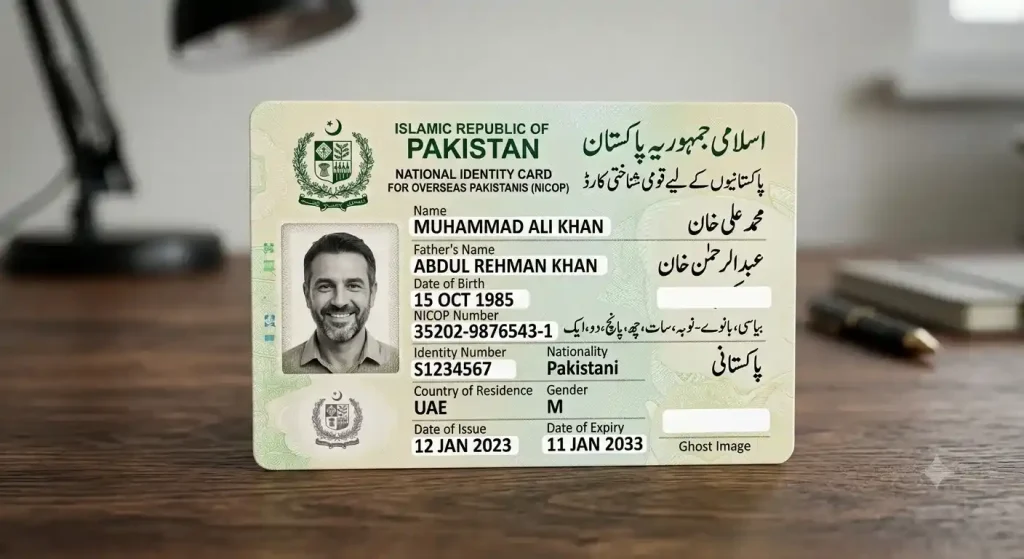
Plenty of people treat the NICOP as little more than a travel pass, but anyone who has actually lived outside Pakistan for a stretch of time knows it does far more than get you through immigration. It is the one document that keeps your Pakistani citizenship formally on record while you’re based abroad — without it, you have no real footing in the country’s legal or civic systems. NADRA is required to issue this card under Section 12 of the NADRA Ordinance, 2000, to Pakistani citizens and dual nationals living overseas, which is what gives the card its legal and civic standing in the first place. NICOP is not a convenience item or optional paperwork — it’s the official thread connecting you back to Pakistan while you’re living elsewhere.
What the card actually covers:
- Fees and timelines vary by category, country, and application channel (Pak-ID vs Pakistani mission)
- Carries a 10-digit ID number
- Serves as proof of identity and proof of nationality
- Recognized by Pakistani institutions at home and abroad
- Enables visa-free entry to Pakistan
- Used as primary ID for property, banking, inheritance, and court matters
What Is NICOP?
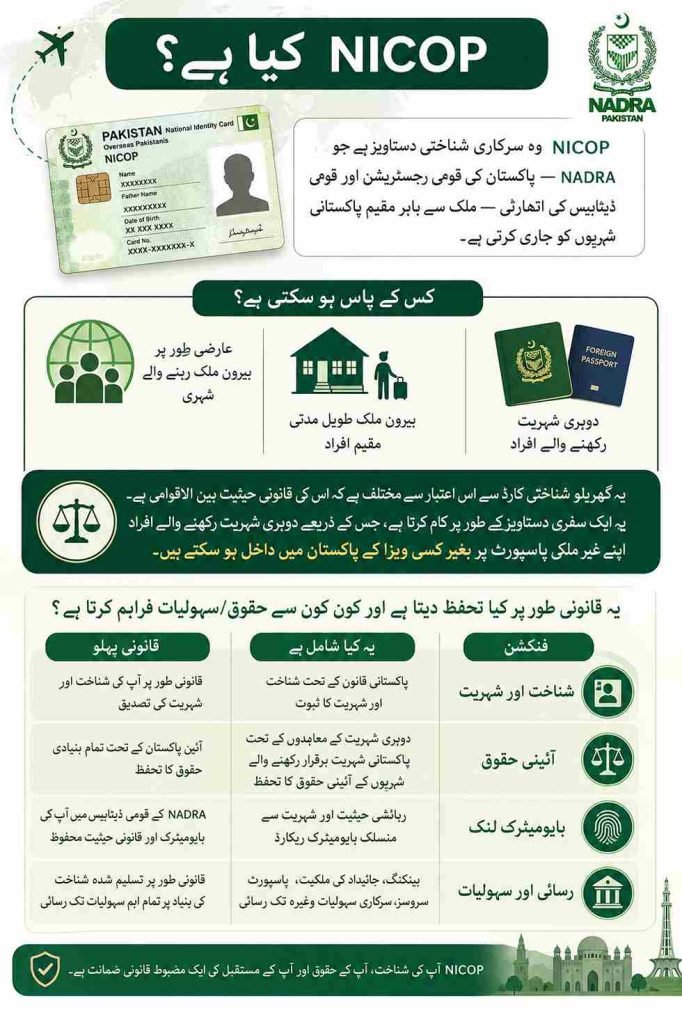
NICOP is the official identity document NADRA — Pakistan’s national authority for civil registration and the national database — issues to citizens living outside the country.
Who can hold one:
- Dual nationals
- Long-term residents abroad
- Citizens living overseas even temporarily
What sets it apart from a domestic ID card is its cross-border legal weight: it works as a travel document, letting dual nationals enter Pakistan on their foreign passport without a separate visa.
What it legally protects and unlocks:
| Function | What It Covers |
|---|---|
| Legal proof | Identity and citizenship under Pakistani law |
| Constitutional rights | Protected for citizens retaining Pakistani nationality under dual-nationality agreements |
| Biometric link | Tied to residency status and nationality |
| Access | Banking, property ownership, passport services, government facilities |
Who Is Eligible for NICOP?
The Pakistan Citizenship Act, 1951 sets out a defined eligibility structure under NADRA’s issuance rules. There are five core categories:
- Overseas workers/residents — valid foreign employment agreement, residence visa, or permit holders, including equivalent status in countries Pakistan has formal arrangements with
- Dual nationals — holding a foreign passport alongside Pakistani nationality (NICOP becomes their primary identity instrument since CNIC doesn’t reflect status abroad)
- Emigrants and dependents — permanently relocated citizens, their dependents, and intending emigrants with a documented foreign employment agreement or migration intent
- Long-term visa holders and naturalized citizens — those wanting to keep a legal tie to Pakistan
- Temporary residents abroad — with a documented residence visa or permit
Rights this eligibility unlocks:
- Standard government facilities available to resident citizens
- Uninterrupted government access
- Banking access
- Property rights
- Passport services
- Voting and travel rights, including visa-free entry
NICOP vs CNIC vs POC vs CRC – Key Differences
| Card | Who It’s For | Citizenship Status | Key Feature |
|---|---|---|---|
| CNIC | Citizens residing inside Pakistan | Full Pakistani citizen | Standard domestic ID |
| NICOP | Dual nationals / citizens based abroad | Full Pakistani citizen | Visa-free entry; same legal weight as CNIC |
| POC | Foreign nationals of Pakistani heritage who surrendered or never held Pakistani nationality | Not a Pakistani citizen | Property ownership, banking access, visa-free movement; recognized across 32 countries (UK, USA, Canada, Australia, France, Germany, Italy, UAE, Saudi Arabia, Bahrain, Kuwait, Oman) |
| CRC | Children born abroad | Citizenship status not yet formally established | Consular document required before other cards become accessible |
The gap most applicants miss: NICOP holders retain full citizenship, including voter registration and election participation. POC holders get many practical benefits but no recognition of Pakistani nationality, which affects their standing under the bilateral agreement governing their host country.
Types of NICOP
| Type | Status | Features |
|---|---|---|
| Smart NICOP | Current standard | Chip-based, secure microchip, QR code, embedded digital identity data, contactless reading, stronger anti-fraud protection, more durable materials |
| Teslin-based NICOP | Discontinued | Older plastic card; not currently issued; lacks readable data and biometric compliance now expected at embassies and NADRA desks |
NICOP – What You’re Actually Entitled To
Travel and physical presence
- Visa-free entry through Pakistani immigration
- Useful for court filings, opening a bank account, or executing a Power of Attorney through a consulate or notary
- Right to work, open accounts, buy/sell property, and run a business
Financial
- Functions as a strong KYC document
- Unlocks the Roshan Digital Account for diaspora investment
- Keeps remittances and portfolio activity within a regulated, NICOP-linked framework
Property
- Can register residential and commercial property
- Can initiate legal transfers with the same standing as resident citizens
- Agricultural land remains restricted in several provinces (restrictions vary, not uniform)
- Supports succession certificate filings for overseas heirs (usually needs a death certificate and embassy-attested documents)
Civic participation
- Voting rights through the I-Voting portal (requires valid voter registration)
- Supports passport applications via DGIP portal cross-reference
- Allows legitimate local SIM registration
Business
- SECP filings
- Tax registration
- Access to regulatory processes that otherwise require a resident CNIC
For foreign-born children of Pakistani parents
- Access to Family Registration Certificates, data corrections, and succession certificates via the PakID app
- Treated as Pakistan-born citizens for most eligibility purposes
- Indefinite stay provisions that don’t apply to foreign visa holders
For foreign spouses (via POC)
- Visa-free entry and exit
- Mobile SIM registration
- Access to most of NADRA’s 11 digital service categories
Important: All of the above depends on the card being unexpired. An expired NICOP can freeze voter registration, block bank account renewals, disrupt SIM registration, and strip recognized ID status.
Countries Where NICOP and Dual Nationality Are Both Recognized
Pakistan officially recognizes 22 countries under bilateral/international agreements where citizens can hold foreign citizenship without losing Pakistani nationality:
| Australia | Belgium | Canada |
| Egypt | France | Iceland |
| Ireland | Italy | Jordan |
| Netherlands | New Zealand | Sweden |
| Switzerland | Syria | United Kingdom |
| United States of America | Bahrain | Finland |
| Denmark | Germany | Norway |
| Luxembourg |
Important: If your country of residence isn’t on this list, acquiring foreign citizenship can legally void your Pakistani status — and your NICOP application along with it.can’t cover, which is why knowing the difference between all three saves time during applications.
Required Documents for NICOP
Documents required for every applicant, regardless of category:
- Valid Pakistani passport (or expired one, for renewals)
- Foreign passport with a residence permit or legal stamp confirming lawful stay abroad
- Verifiable proof of overseas address (utility bill or bank statement)
- Clear, current copy of existing NICOP, CNIC, or manual NIC
First-Time Applicants
- Birth certificate or Birth Registration Certificate (or Matric certificate/degree showing name and parentage as a substitute)
- Old Form B from school registration (accepted as strong proof of citizenship)
- Documents linking the applicant to a family member already in NADRA’s system (parent, sibling, or spouse — their CNIC/NICOP copies)
Renewal Applications
- Existing NICOP (valid or expired)
- Pakistani passport
- Current foreign passport
- Proof of continued overseas residence
- Updated residence permit, if renewed since last application
Modification Cases
| Type of Change | Documents Required |
|---|---|
| Name change | Court affidavit or gazette notification; change must already reflect on Pakistani passport |
| Date of birth / parentage | Birth certificate, Matric certificate, or Union Council record |
| Marital status | Marriage or divorce certificate from a verifiable authority |
| Dual-nationality discrepancies | Entry/exit records |
Duplicate Cases
- Valid foreign passport
- Residence permit
- Pakistani passport
- Written declaration of loss
- Proof of address/address verification (utility bill or bank statement)
- Original application reference number (request from the mission beforehand)
Cancellation Requests
| Reason | Documents Required |
|---|---|
| Death | Death certificate, deceased’s NICOP/CNIC, family CNIC copy, Union Council death record (in some cases) |
| Nationality surrender | Surrendered foreign nationality documents, formal declaration to the Pakistani mission |
Note: Foreign-language records need Urdu or English translation to avoid being returned as incomplete.
NICOP Fee Structure and Processing Time (2026)
NADRA splits the world into two zones for fee purposes:
- Zone A — USA, UK, Canada, Australia, rest of Europe
- Zone B — Middle East and Africa, including Saudi Arabia, UAE, Qatar, Kuwait, Oman, Bahrain
Zone A Fees (USD)
| Application Type | Priority | Fee | Processing Time |
|---|---|---|---|
| New Smart NICOP / Renewal / Modification / Duplicate | Normal | $39 | 31 days |
| New Smart NICOP / Renewal / Modification / Duplicate | Urgent | $57 | 23 days |
| New Smart NICOP / Renewal / Modification / Duplicate | Executive | $75 | 09 days |
| Cancellation (due to death) | — | Free | — |
Zone B Fees (Local Currency Examples)
| Country | Normal | Urgent | Executive |
|---|---|---|---|
| UAE | AED 75 | AED 110 | AED 150 |
| Saudi Arabia | SAR (converted from Zone B USD baseline) | SAR | SAR |
Within Pakistan (PKR)
| Priority | Fee |
|---|---|
| Normal | Rs 5,563 |
| Urgent | Rs 8,344 |
| Executive | Rs 11,126 |
A separate consular service fee of $10 (or local equivalent) applies when applying in person rather than online.
Exceptions to standard pricing:
- Nationality-surrender cancellation: free once submission is successful
- CRC cancellation: same $20/$30/$40 priority-based structure as standard applications
- Second-time modifications or duplicates involving multiple records/age corrections: flat $5 surcharge on top of base fee
- Minimum one-year gap required between Smart NICOP modification requests
- Fastest possible turnaround (1 day): only on Executive-tier Standard applications, fees fully settled before verification, and only at authorized missions
- Executive-tier second-time modifications with consular fee: $125 ceiling
Payment Methods for NICOP Applications
Available everywhere (via NADRA website or Pak-ID app):
- Visa or Mastercard debit/credit cards only
Card payment steps:
- Enter cardholder details (name, billing address, email, contact number)
- Confirm via OTP
- Submit payment
- Save the tracking ID immediately once generated
Additional options inside Pakistan or via franchise agent:
- e-Sahulat
- EasyPaisa
- JazzCash
- Smart FRC counter
Note: Whichever channel is used, what matters is that payment is confirmed on the NADRA portal — the channel itself doesn’t affect processing speed.
How to Apply for NICOP Online Through the PakID App?
- Download the app and create an account
- Sign in and select new NICOP registration
- Fill in personal details exactly as they appear on existing records
- Upload required documents
- Book a biometric appointment at the nearest centre
- Track status directly inside the app
- Visit the centre only once the appointment notification arrives
How to Apply for NICOP at a NADRA Registration Centre
- Take a numbered token at reception (first-come, first-served)
- Move to the data entry counter when called; officer enters details and collects documents
- Biometric capture: fingerprints, digital signature, live photograph
- Review the printed data form carefully — check spellings and dates
- Correct any errors, then sign off
- Pay the processing fee
- Application moves forward based on selected processing category
- SMS confirms dispatch; new NICOP is mailed directly — no separate collection trip needed
How to Track Your NICOP Application Status
| Method | How It Works |
|---|---|
| Pak-ID App | Log in to see real-time stage updates: payment received, processing, biometric verification, approval, issuance |
| SMS | Automated updates via shortcode 8400 to your linked mobile number |
| Helpline | 1777 (within Pakistan) or 051-111-786-100 (international) — connects to a live agent |
NICOP Delivery and Collection
- Delivery channel depends on country of residence, application category, and processing arrangement tied to your specific embassy/consulate
- Once tracking ID shows movement, follow collection instructions specific to your designated centre or postal route
- Treat the Pak-ID portal as the primary reference — avoid relying on social media for updates
- Double-check address and documentation accuracy before submission; mismatches are the most common cause of delayed delivery
NICOP Renewal
- Renewals now run entirely through the official Pak Identity Portal or the PakID app
- Core identity record stays intact — renewal extends existing status rather than rebuilding the profile
- As of 2026, physical applications are no longer processed through consulates
If your existing card is expiring rather than new, follow the dedicated NICOP renewal online guide for the renewal fee, steps and tracking.
NICOP for Children Born Abroad
Required documents:
- Birth Registration Certificate issued by NADRA
- Foreign birth certificate from the country of birth (certified translation required if not in English/Urdu)
- Both parents’ NICOP or valid CNIC documents
Validity cycle:
| Stage | Validity |
|---|---|
| Minor’s card | 5 years |
| After reaching adulthood | Shifts to standard 10-year cycle |
What the card unlocks for the child: visa-free entry, indefinite stay, right to work, ability to open accounts, and buy/sell property.
Common Reasons of NICOP Rejections
Common Cause #1: Document Quality
| Problem | Fix |
|---|---|
| Blurry scans that look fine on a phone screen | Use a flatbed scanner where possible |
| Uneven lighting in scanning apps | Make sure lighting is even and all corners are visible |
| Illegible text | Confirm every word is legible before submitting |
Common Cause #2: Name Conflicts, Missing Records, System Flags
- Leftover duplicate records from the manual NIC/CNIC era — requires a consular visit and formal resolution before a new NICOP can be issued
- Name mismatches across documents (e.g., “Muhammad” vs “Mohammed”)
- Missing sibling documentation or absent parental CNICs
- Expired foreign residency documents without valid renewal proof
How Is NICOP Cancellation Processed?
- Cancellation request submitted through Pak-ID or a NADRA centre
- System runs verification against the individual’s record
- Cancellation category selected at submission determines processing speed and approval path
- Once approved, the document is permanently deactivated — no longer usable for travel, banking, or identity confirmation
- Applies to nationality surrender, dual-status conflicts, or related CNIC/CRC records
- NADRA cross-checks all linked documents before closing the file

2 Comments