NADRA Date of Birth Change Policy in Pakistan (CNIC, B-Form & Birth Certificate)
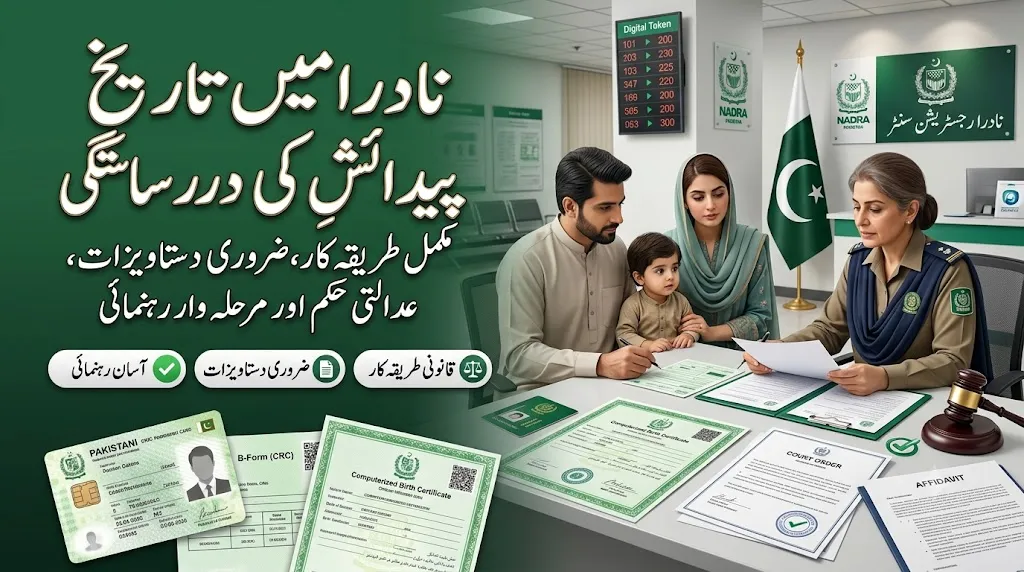
NADRA, formally known as the National Database and Registration Authority, acts as the central body for all identity records and identity documents in the country, but it rarely works alone on a date of birth case. Bodies like the Union Council, Cantonment Board, and Municipal Corporation are recognized as competent authorities and play a direct role whenever a child’s life is shaped by what’s written on a CNIC, NICOP, CRC, Juvenile Card, or Child Registration Certificate (B-Form). The Government of Punjab has tied this process to applicable laws that demand a formal court order or court decree, and NADRA has no flexibility here. A verified, computerized birth registration certificate is mandatory before the submission process even begins. From personal experience helping families through this, the scrutiny at this stage catches almost every shortcut people try to take.
Parents and legal guardians are the only ones who can request to increase or decrease recorded data, and they need real documentary proof, not assumptions, to back it up. A genuine mistake can often be fixed through a simple affidavit at the office, and this first-time correction is allowed within a reasonable timeframe but try it again later, and the process turns complex fast, pulling in legal action that affects rights and obligations across multiple systems. The stakes go beyond paperwork too, touching school admissions, passports, and international travel eligibility. NADRA periodically updates its instructions, and the online system through the Pak-ID mobile app has made visiting a registration center far less necessary than it used to be.
Why Does NADRA Have Strict Rules for Date of Birth Changes?
I’ve handled enough of these cases to tell you straight: your date of birth isn’t just a digit on a form, it’s a core identity attribute that’s deeply woven into government systems, education records, passports, and broader legal documentation. That’s exactly why NADRA keeps this process strictly regulated conflicting records across departments create real headaches, and unchecked changes open the door to misuse and fraud. Both provincial laws and federal laws govern this space, and here’s something most people don’t realize: NADRA manages identity data, but it doesn’t authorize changes to birth records on its own. Only legally competent institutions like the courts hold that power.
At a practical level, this matters more than people expect. Your personal details need to line up perfectly across core services, government services, bank accounts, inheritance matters, succession cases, visa applications, and educational admissions and consistent, accurate, up-to-date official documents are non-negotiable for all of it. A single mismatch can drag you into legal complications and administrative complications that take months, sometimes years, to untangle. So this regulation isn’t there to throw hurdles in your way — it’s there to protect citizens from the cascading damage an incorrect date can cause down the line.
NADRA Date of Birth Change Rules and Legal Requirements
In my years of helping people sort out their NADRA paperwork, I’ve learned that most rejected applications come down to one thing: not understanding the law behind the process. Any change of date of birth in Pakistan rests on two pillars, and these key pillars aren’t just bureaucratic technicalities they’re what stands between a smooth correction and a denied request. NADRA Ordinance 2000 lays out guidelines for modifying personal information like your date of birth, and it’s the foundation of how the national identity system handles these changes in the first place.
But here’s what catches people off guard: it’s not just NADRA rules you’re dealing with. The Pakistan Penal Code, through PPC Section 420, directly addresses fraud and dishonesty in legal documents, reinforcing why accurate information isn’t just preferred it’s legally required. This legal framework exists precisely because date of birth changes has been misused in the past, and understanding this governing structure upfront saves you from headaches down the road.
NADRA Date of Birth Change Procedure (Step-by-Step Process)
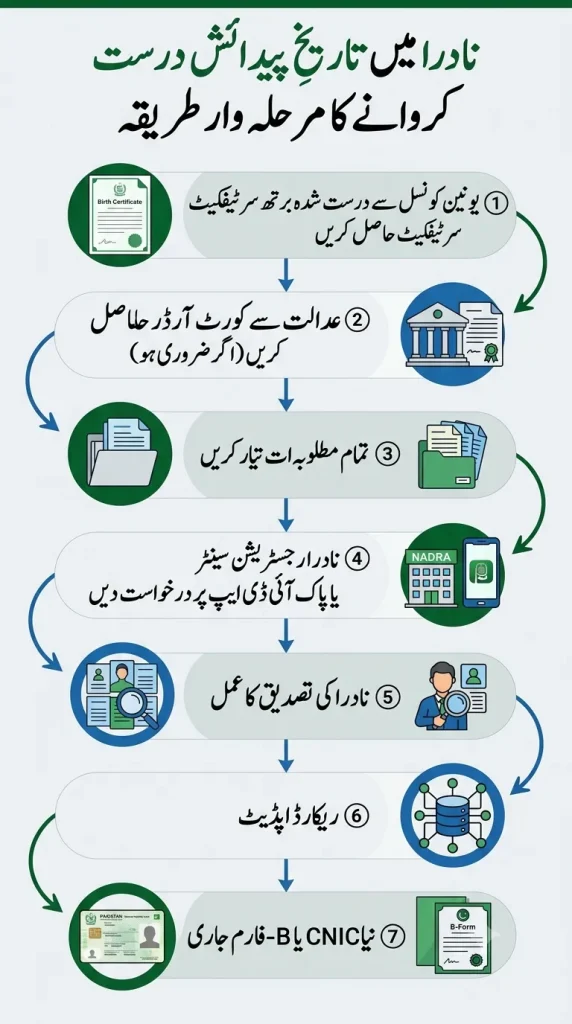
Getting your date of birth fixed through NADRA starts with Application Submission at a registration center, where the applicant hands over required documents along with the application. From there, NADRA runs verification, checking everything against previous records to confirm authenticity. You’ll need credible Supporting Documents — think birth certificate, school records, or a Matriculation certificate — and once the Documentary Evidence holds up, approval moves forward, the record gets updated, and issuance of a corrected identification document wraps up the process. In Punjab, this entire procedure only works if it’s legally permissible, meaning a court order from a competent court tied to the original Union Council, Cantonment Board, or Municipal Corporation that issued the computerized birth registration certificate is non-negotiable — no court order, no change.
Where things get tricky is when the correction isn’t a simple genuine error anymore. I’ve seen cases where legal documents like succession certificates, passports, or educational records carry inconsistent dates, and that’s when complexity creeps in fast. An Affidavit spelling out the incorrect dates and correct dates becomes necessary, backed by stronger Documentary Evidence — a hospital birth record, an immunization card for minors, or a Family Registration Certificate (FRC). You’ll also be dealing with both NADRA and the local Union Council, and sometimes with the approval from a Magistrate or relevant authority. Honestly, the rule of thumb is simple: the more recent document and the longer after CNIC issuance you wait, the harder the fix gets. Clerical mistakes filed as a first-time change can usually be handled directly, but anything beyond that means a suit under Section 42 of the Specific Relief Act 1877 gets filed against NADRA — a route that typically drags on for 3 to 4 months, with the petitioner or their attorney and two witnesses required to appear before court for evidence and cross-examination by NADRA’s lawyer.
Which NADRA Documents Can Be Updated Under This Policy?
In my years of reviewing NADRA cases, one thing stands out: there’s no shortcut around the legal framework NADRA follows. NADRA processes every date of birth correction requests under the same policy, and this isn’t something that bends for special cases — no exceptions are made, no matter how convincing the reasoning sounds. Once legal requirements are fulfilled, the request moves forward. If they’re not, it doesn’t, full stop.
What surprises most people I’ve worked with is just how wide this policy stretches. It covers four key identity documents: the Computerized National Identity Card (CNIC), the National Identity Card for Overseas Pakistanis (NICOP), the Child Registration Certificate (CRC), and the Juvenile Card. Each one is held to the same strict verification standard — there’s no easier route through a Juvenile Card versus a CNIC, for example. NADRA treats them all with equal scrutiny.
Required Documents for NADRA Date of Birth Correction
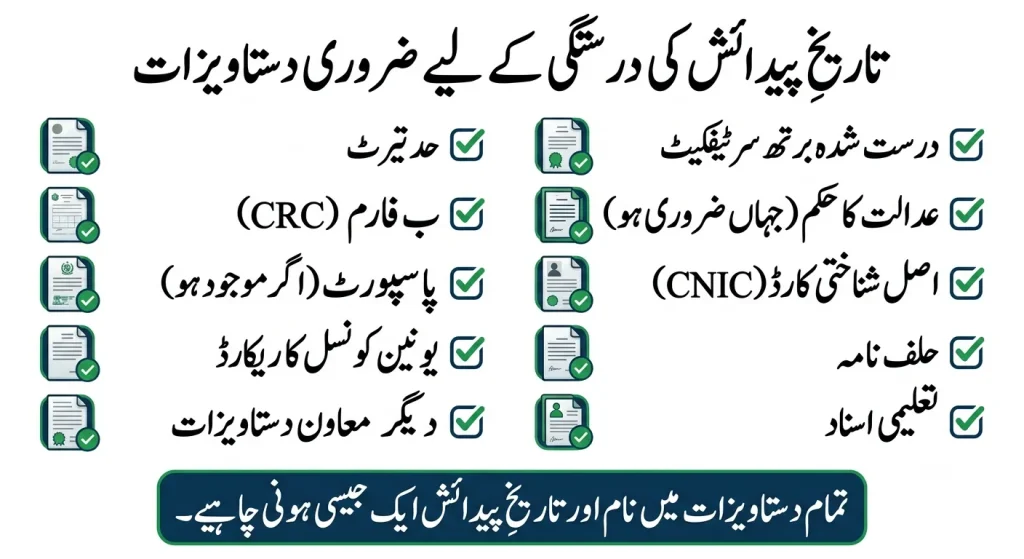
Applicants must submit a formal court order authorizing the correction, along with a verified computerized birth registration certificate — without both, applications simply cannot be processed. From my experience handling these cases, NADRA treats this pair as non-negotiable, no matter how minor the date error seems. Beyond these two essentials, the full document checklist includes an application form, original and copies of the national identity card (CNIC), a birth certificate or other credible proof of the correct date of birth, and an Affidavit explaining the reason for the change.
A court order is listed as applicable depending on the nature of the case, and for name-related matters, additional requirements come into play. Original CNIC or B-Form, the father’s or guardian’s CNIC, a Newspaper advertisement, and an attested Affidavit are all part of the supporting package, along with any additional proof required based on individual circumstances.
How to Correct the Birth Certificate at the Union Council First
Here’s something most families miss when they try to fix a child’s date of birth: NADRA won’t even look at your case if the underlying birth record itself is wrong. If your B-Form was originally issued based on a computerized birth certificate, that certificate is your source record, and any correction has to start there, not at a NADRA counter. Parents need to physically visit the same Union Council, Municipal Committee, or Cantonment Board that issued the certificate in the first place, carry full supporting documents, and apply for the change directly with that office.
I’ve seen people waste weeks going back and forth with NADRA staff before realizing this. Once the Union Council updates its records and hands over a revised, verified corrected certificate, that paper becomes the foundation for requesting an updated B-Form. It’s a strict, sequential process — get the birth record right first, and the rest follows smoothly.
Accepted Proof of Age for NADRA Date of Birth Change
Most citizens assume a birth certificate is the only starting point for fixing their date of birth, but that’s not the full picture. A birth certificate works as the primary document, yet it’s far from the only one NADRA accepts. I’ve guided several older applicants through this exact situation, and the NADRA staff I’ve dealt with at the NADRA Registration Center were quite flexible once accurate, verified paperwork was on the table. Head to your nearest center with the original documents in hand — a passport counts as strong alternative proof, and so do travel documents, Educational certificates, school records, Service records, and Medical records that clearly state the correct date of birth.
The key is making sure every piece of supporting evidence lines up. NADRA cross-checks all supporting documents against each other, so any mismatch between them raises queries at the NRC and stalls your file. Proper preparation before you walk in — gathering consistent, matching records — saves you repeat visits and frustration.
How to Update B-Form Date of Birth Using Pak-ID App
I’ve helped a few families go through this process, and the Pak-ID mobile application genuinely makes things easier compared to standing in line at a NADRA office. To get started, you’ll need to login to your existing Pak-ID account, or create new account if you’re using the app for the first time. Once you’re in, tap Apply Now, then choose Issuance of Identity Document, followed by Identity Card, and finally select Child Registration Certificate (CRC). At this stage, you’ll enter the parent’s CNIC number (the 13-digit code), and the system pulls up prefilled family information for you to review — this is where Parents confirm everything looks right before moving forward. You’ll also pick a processing priority depending on how quickly you need the application processed.
The next part is where the actual correction happens. You’ll upload the child’s photograph, add a digital signature, and go through the personal details carefully — this is your chance to fix the date of birth and enter the correct date of birth, along with attaching the corrected birth certificate and any other supporting documents. Verifying fingerprints of one parent is required as well, so make sure that’s done before reviewing entries one last time and hitting submit. Once the application is processed and approved, the updated B-Form becomes available to download straight from the app — no hard copy needed, no second trip to a NADRA center. Honestly, this convenience upgrade has cut down what used to be a multi-day situation into just a few final steps, all done online through one significant update to how NADRA handles B-Form corrections.
Does This NADRA Date of Birth Policy Apply Across Pakistan?
The updated instruction under this NADRA rule is specifically applies to birth registration certificates issued in Punjab, and it’s worth knowing this upfront before you go looking for help with your own case. I’ve seen plenty of confusion among applicants who assumed the rule was nationwide — it isn’t. This part of the Date of Birth Change Policy is covering cases involving a genuine correction or change of date of birth on birth certificate records, the kind that actually carries weight in legal documentation, not the not routine, minor clerical verification type of fix that has no real legal impact on your official record.
If you’re based in other provinces, this exact procedure won’t apply to you the same way — each region can operate under its own applicable legal frameworks, since civil registration falls under provincial jurisdiction in Pakistan. So the procedures for amendment or rectification may differ outside Punjab, and that’s something I always tell clients before they start the process, because following the wrong province’s steps is one of the most common mistakes people make.
NADRA Helpline and Official Support for Date of Birth Changes
NADRA has clarified publicly that the requirement for a court order is mandated by law — this is not a policy preference but a statutory obligation. The authority remains committed to guide citizens through the correct procedure and offers Assistance within the bounds of the legal framework, but it will not waive or bypass statutory requirements for any individual case.
For Official Contact and Guidance, citizens can reach NADRA through official channels for clarification or procedural guidance. The Helpline 1777 is accessible from mobile phones across Pakistan, and queries can also be sent to the Email address helpdesk@nadra.gov.pk. Relying only on official NADRA communication channels ensures you receive accurate information rather than outdated advice from third-party sources.
RESPONSIBILITIES OF REGULATORY BODIES
NADRA is directly responsible for processing and verifying requests for changes to the date of birth across all covered documents. It ensures that all necessary documents are provided before moving forward, and that the verification process is both thorough and accurate — with no shortcuts permitted regardless of the urgency of the case.
Why NADRA Rejects Date of Birth Change Applications
Applicants whose date of birth change requests have been rejected are not without recourse — they can appeal the decision through proper legal channels. The strongest ground for appeal is Adequate Documentation: presenting additional or corrected documents that directly address any identified deficiencies in the original submission. A well-prepared Legal Justification — a valid reason for the change supported by legal documents or court orders — further strengthens the case.
Finally, demonstrating Procedural Compliance — showing that all procedural requirements were met accurately — removes any administrative grounds for refusal and signals that the applicant acted in good faith throughout the process.
High Court Judgments on NADRA Date of Birth Change
Two landmark cases shaped how NADRA handles date of birth change applications in Pakistan. In Ahmed Ali vs. NADRA, the Lahore High Court reviewed a case where an application was rejected due to a lack of supporting documents. The court ruled in favor of the applicant and stressed that NADRA must provide clear guidelines and assistance to applicants — a judgment cited as PLD 2018 Lahore 367 that set the standard for transparency and procedural fairness in handling such cases.
The second case, Zainab Bibi vs. NADRA, came before the Sindh High Court after a denial of a date of birth change request stemming from an administrative error. The court ordered NADRA to rectify the error and approve the change — captured in PLD 2019 Sindh 410 — underscoring the institution’s responsibility for accurate record-keeping and the obligation to correct errors promptly.
How to Correct the Date of Birth on a B-Form
NADRA has confirmed that citizens can request both an increase and a decrease in the recorded date of birth on the B-Form, provided they come with valid evidence. Most mistakes occur at the time of birth registration, when information is being entered from handwritten forms into the digital system — a simple transcription error that can cause years of complications if ignored.
Parents should review the B-Form as soon as it is issued, checking whether the date of birth matches the child’s birth certificate, passport, or school record. Starting the correction process as soon as possible is always the right call — Delaying correction creates complications, especially when a child already holds multiple documents showing different dates.
Why the B-Form Date of Birth Must Be Correct
The B-Form is the first official identity document issued for a child in Pakistan, and it does more than just record a name. It links the child’s information directly to the parents’ CNICs, becoming the base record from which all future documents — including the CNIC, passport, and school records — are built. If the date of birth on the B-Form is wrong, problems appear almost immediately: passport applications get flagged, visa processing hits walls, admission processes get complicated, and discrepancies between school and government records create legal headaches.
Correcting the date at an early stage gives families the best chance to avoid lasting conflicts and delays in future applications — protecting the child’s identity before it becomes entangled in bureaucratic contradictions.
Tips to Avoid Delay in NADRA Date of Birth Correction
From personal experience helping others through this process, the most common reason for delays is document mismatch. Always Check that name spellings and dates match across all documents before applying — even a minor inconsistency can trigger a full review. Correct any mistakes in the Union Council birth certificate first, since NADRA relies on that record as the primary source. Keep all original documents available for verification, even if you are applying online.
If NADRA comes back with a request for additional proof or clarification, Respond quickly — delays on the applicant’s end extend the timeline significantly. With documents prepared in advance and the Pak-ID app used carefully, parents can push through the correct date of birth on the B-Form with less hassle. Timely corrections protect the child‘s legal identity and prevent problems in future applications for passports, visas, and educational admissions.
Legal Effects of Changing Your Date of Birth
When date of birth changes happen through a court decree, there are no negative legal consequences — but it does trigger a responsibility chain. Correction requests must be sent to all relevant departments, schools, and holders of official documents to ensure everything stays aligned. The risk emerges if someone tries to go back: Reverting becomes legally challenging once a court decree has been granted.
Any failure to file an appeal within the stipulated time effectively renders the change irreversible — a reality that underscores why careful decision-making before pursuing a court-ordered change is so important.
NADRA Name Change Policy (Related Identity Correction)
One of the more important legal provisions under NADRA law is the Name Change Law, which allows individuals to officially change their name on identity documents including the CNIC (Computerized National Identity Card), B-Form, Passport, Driving License, and Educational Certificates. To initiate a name change, the applicant must write an Affidavit stating their intent and reason for changing their name, and then Publish a Name Change Advertisement in at least one national newspaper.
The Application is then Submitted to NADRA with full supporting documents: the Original CNIC or B-Form, the Father’s or guardian’s CNIC, the Newspaper advertisement, the attested Affidavit, and any additional proof required. Once approved, NADRA will issue a new CNIC bearing the updated name — a clean record going forward.